Young plumage III
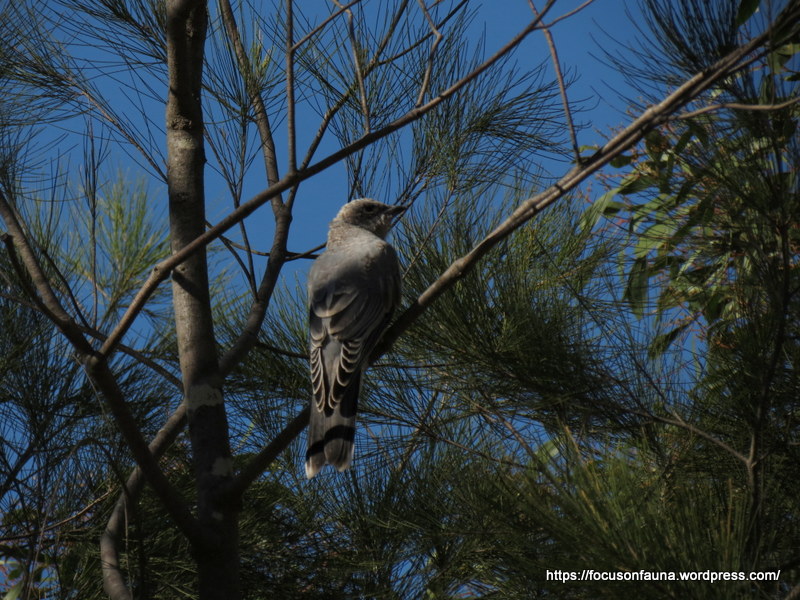

Adult Black-faced Cuckoo-shrike
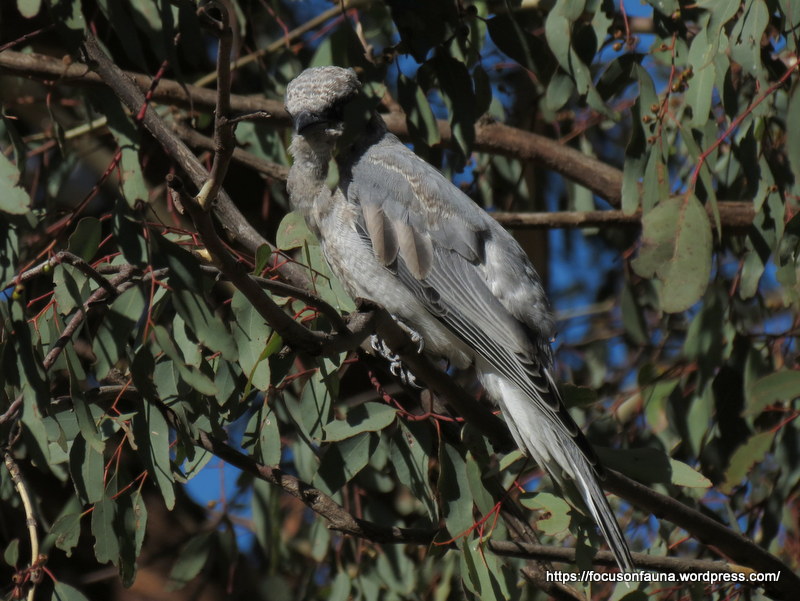
A couple of earlier posts were about young birds with plumage differing from that of the adults, and here is another example. We came across a pair of obviously young and not too confident birds preening their downy feathers and making unusual, possibly begging, calls, although no adult birds seemed to be in the immediate vicinity. They were identifiable to us as cuckoo-shrikes, and we assumed them to be juvenile Black-faced Cuckoo-shrikes, the common local species. But without the black facial colouring being fully developed (cf adult below), the young birds (above and at right) could possibly be mistaken for White-bellied Cuckoo-shrikes, a species we have come across in Seymour Bushland Park. The fine barring on the crown and dark shadow behind the eye (not clear in the photos) seemed to indicate Black-faced.
The cuckoo-shrikes are neither cuckoos nor shrikes and the origin of the term is somewhat obscure, although probably due to their undulating flight similar to a cuckoo and their shrike-like bill. The Black-faced Cuckoo-shrike has had a wide variety of common names, including Blue or Grey Jay, Shufflewing, Leatherhead, Stormbird, Cherry Hawk and several others. None seems entirely satisfactory for this very elegant bird.
Black-faced Cuckoo-shrikes are migratory, moving north for winter, although not all birds do so and we have recorded them here throughout winter in three out of the past fifteen years. The unmistakable call of the adult bird, recorded locally, can be heard by clicking on the audio below.
Fly United
 Damselflies and dragonflies make up the insect order Odonata. For anyone who has walked past a dam in summer the mating process is probably very familiar. Males patrol and aggressively defend a territory of water. After he attracts a mate, the male will grasp the female behind the head with claspers on the end of his abdomen. Pictured left are two Aurora Bluetails (Ischnura aurora) in that position.
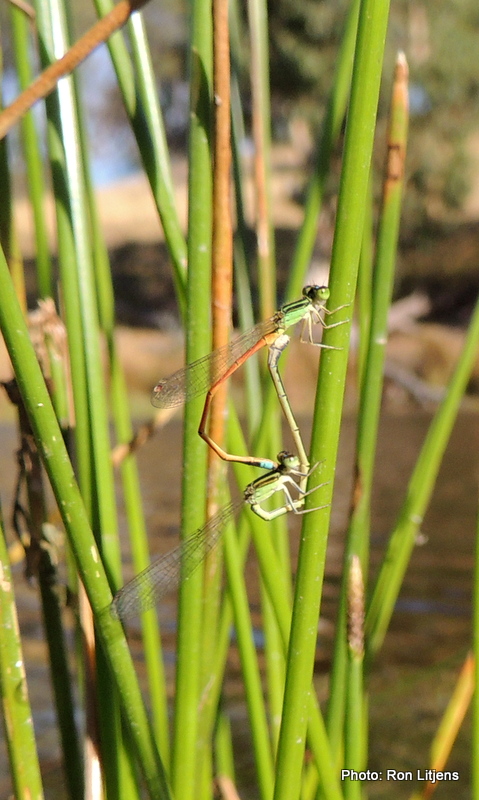 Mating occurs when the female curls her abdomen underneath the male and picks up the sperm from a location where the male has previously placed it (see picture right). This is called the heart or wheel position. The pair will then fly in tandem, with the male still grasping the female behind the head while the female deposits eggs on submerged plants. In this way the male ensures that his sperm is used to fertilise the eggs, because if the female is left alone other males can scrape out the sperm of a previous male and deposit their own.
 I have observed many damselfly pairs land on the appropriate vegetation so the female can deposit the eggs on underwater stems and leaves (pictured left). I recently witnessed an extraordinary display of stamina, when over the course of an hour a female dragonfly grasped and laid eggs on several different submerged stems.
  During the entire time, the male remained in flight and fended off continuous attacks from other males (right). The mating game out there is tough!
Just some more Odonata data for you.
Heaven sent
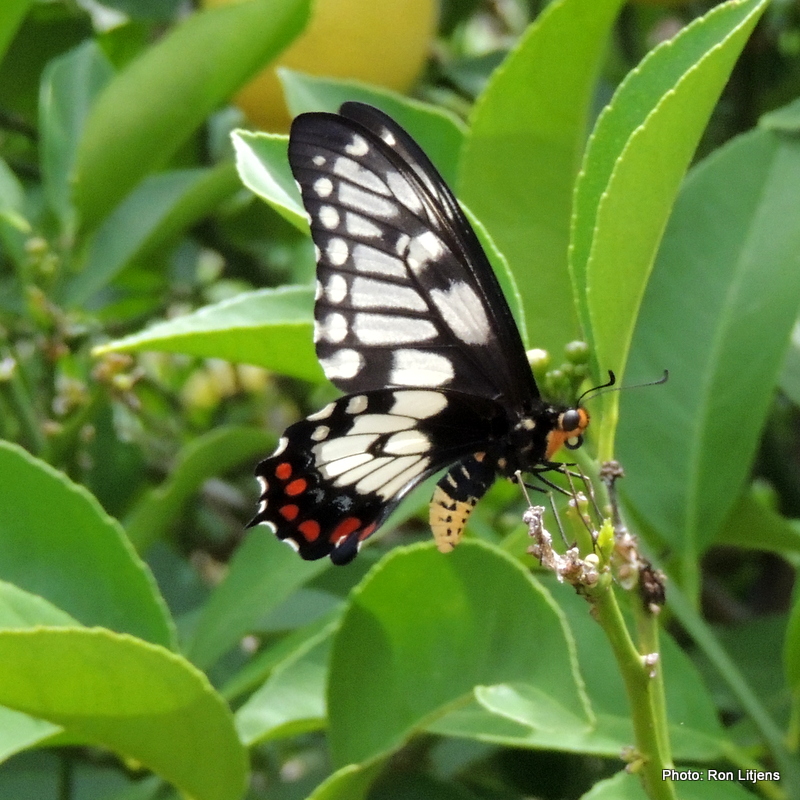 A sure sign that I have been busy is two Macwake posts in a row on this blog. In a desperate attempt to write a post I was sitting at my computer staring out of my office window when a swallowtail butterfly appeared to drop from the heavens, gracefully float past outside the window and land on the lemon tree. The butterfly (pictured left) was a Dainty Swallowtail (Papilio anactus) alternatively known as the Small Citrus Butterfly. Existing along the east coast of Australia the range of this butterfly has probably been extended into central and southern Victoria by the planting of citrus trees, the larval food source.
 And sure enough a single, pale yellow spherical egg was laid on the tip of a young lemon leaf (pictured right). The ongoing life-cycle will be the topic of another post but until then I’d better find something to write about for next week.
Collateral damage
 This ugly sight confronted fish research scientist Jo Kearns recently while she was mapping fish habitat along the King Parrot Creek. The photo shows a cormorant, probably a Little Pied Cormorant, hanging from fishing line left strung across the creek by a careless angler.
(We hate to think of an alternative possibility that the cormorant was deliberately killed and tied up – cormorants are not the favourite birds of some fisher-persons !)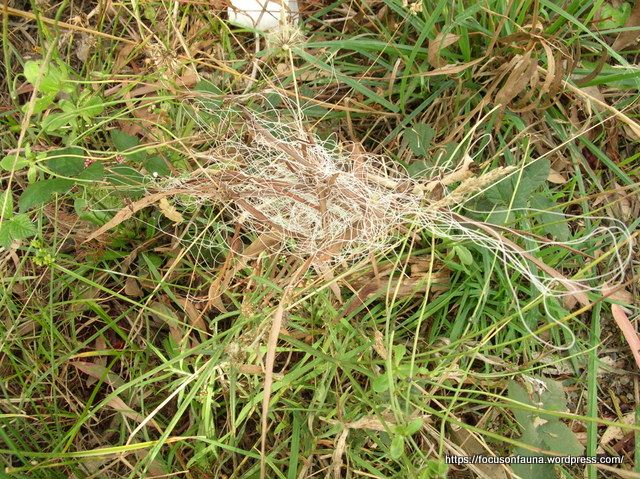

It is not uncommon to see litter and tangled fishing line left along the creek and in overhanging vegetation. As well as being an eyesore, this presents a potential death trap for wildlife including birds, platypus, rakali, turtles and fish. So, a plea to anglers: retrieve any tangled line for the sake of the creek’s wildlife.
Incidentally, on a positive note, a platypus watch held last Saturday by Strath Creek Landcare and Flowerdale Landcare at several observation points along King Parrot Creek for one hour at dusk recorded a total of 8 platypus.
Well camouflaged
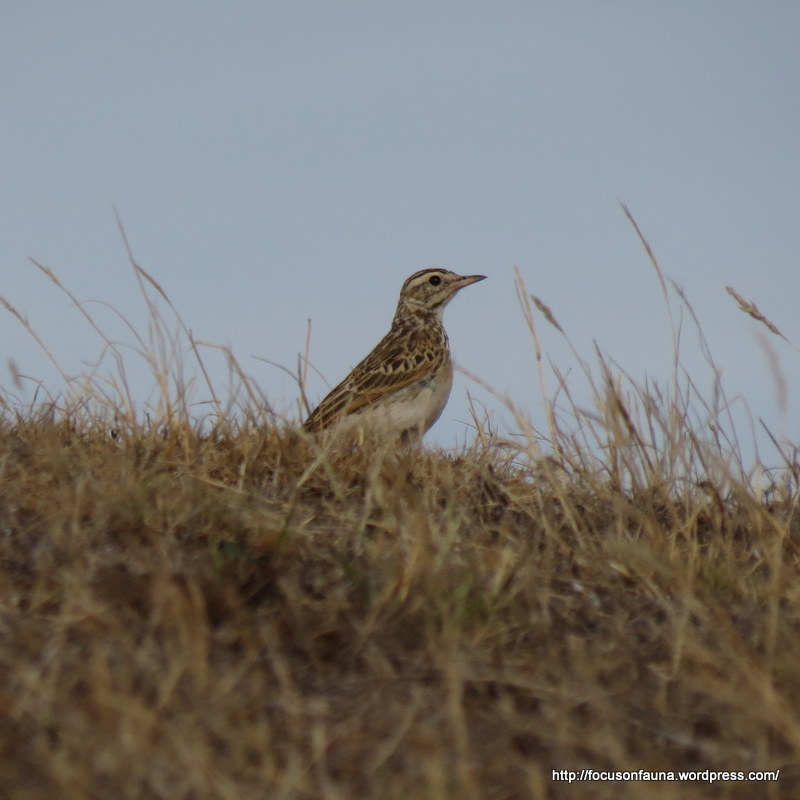
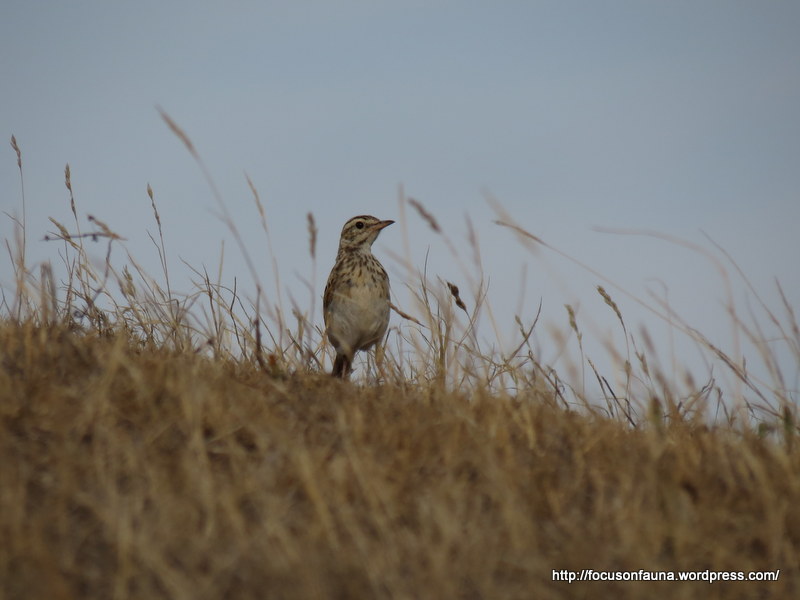 Here’s a bird you’re unlikely to find on a bush block. It’s an Australasian Pipit, formerly known as Richard’s Pipit, an open-country bird you might see even on a heavily-grazed paddock, as this one was between Strath Creek and Flowerdale.
Despite its apparent vulnerability as a bird that feeds, roosts and nests on the ground, it is fairly common and is found throughout most of Australia, as well as New Zealand and New Guinea. Its secret to survival is probably its excellent camouflage and its swiftness in both running and low flight.
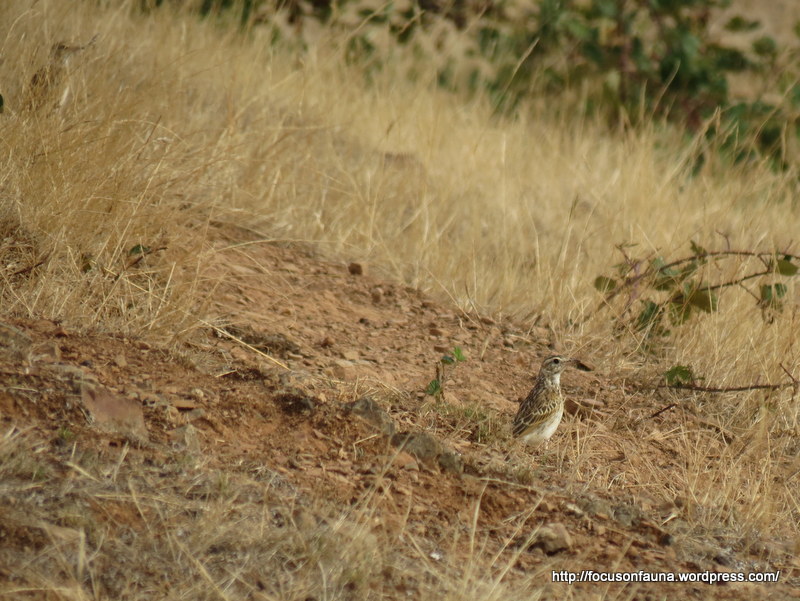
It’s not an easy bird to detect, but after straining to spot even one, we eventually realised there were at least five scurrying around, probably after the many small grasshoppers among the grass tufts. The pipit’s pale eyebrow and white edges to its tail are indicators of its presence, and it often perches on rocks or fences, flicking its tail up and down.
Its unobtrusiveness was highlighted when a second bird showed up in a couple of photos that we hadn’t even noticed in the paddock!
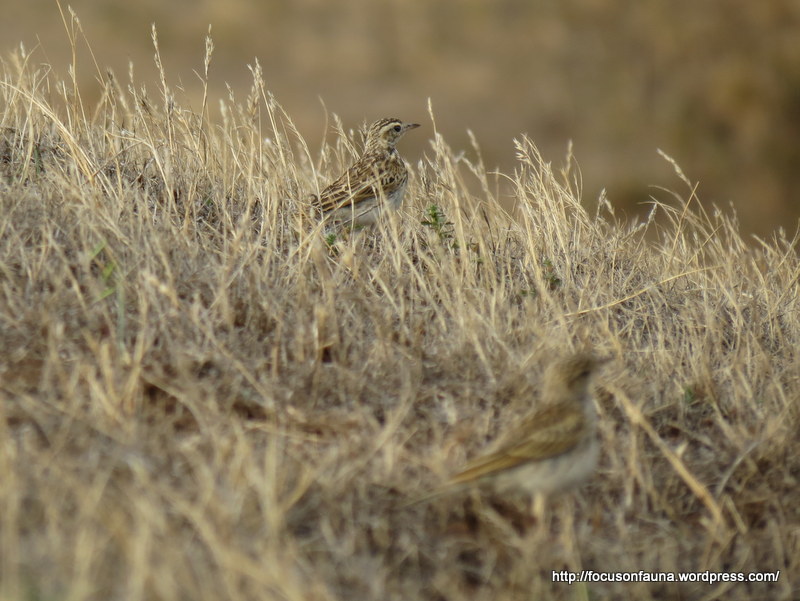
At breeding time in spring/early summer we have seen a male pipit displaying in a courtship flight, swooping and rising while repeatedly emitting a drawn-out trill.
I’ll huff and I’ll puff
Three Little Pigs is a cautionary fairy tale on a number of levels. It comments on the peril of strangers, the benefits of planning for the future and on a most practical level, which building materials make the best houses.

Dad
I have been watching a female Rufous Whistler (Pachycephala rufiventris), pictured below, single-mindedly build a nest on the limb of a Long-leaved Box (Eucalyptus goniocalyx). The cup-shaped construction was made of sticks, not straw (as in one Little Pig’s house), but even still it did not look too stable. The process took about a week, after which time both the male and the female birds took turns to sit on the nest (pictured below left).

Mum
Rufous Whistlers are one of a number of whistlers known for their musical calls. Both they and the Grey Shrike-Thrush are our early morning alarm clocks in spring and early summer. The geographical range of this whistler covers most of Australia and they are breeding migrants, arriving in south-eastern Australia to breed in early spring before heading to inland or northern Australia in autumn.

Dad on nest
And flimsy the nest was. All it took was a brief summer storm (not even a wolf’s huffing and puffing) and it was no more. All that was left was pile of twigs on the ground. Next time, I’d copy the wisest pig and build in brick (or at least in mud like the choughs do).
What’s in a name?
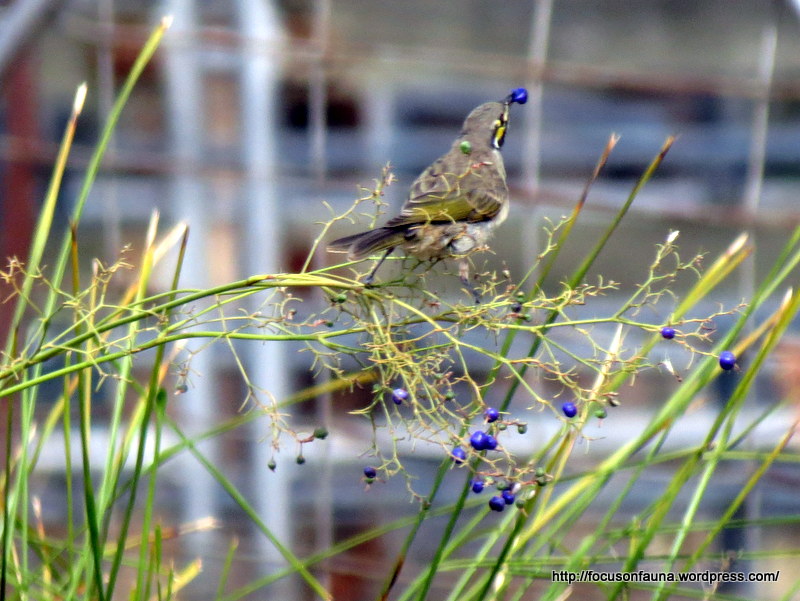 Despite their name Australian honeyeaters don’t actually eat honey (although they probably wouldn’t reject it if offered!). This large and diverse group of birds has developed a range of feeding strategies, but the feature they have in common is a brush-tipped tongue, ideal for collecting nectar from blossoms and sugary insect secretions called honeydew.
However, for some honeyeaters, insects – an essential source of protein – and fruit form a significant part of their diet. One of these is the Yellow-faced Honeyeater (seen in the photo above), a common bird of this district – and the succulent blue/purple berries of native flax-lilies (Dianella spp.) provide a ready food source at this time of year.
Flax-lilies can still be found on undisturbed local roadsides, but we won’t attempt to name the species shown in the picture because classification of the genus Dianella is under revision at present.
The Yellow-faced Honeyeater clings onto the flax-lily’s stem as it droops under the bird’s weight, and picks off the berries one by one. But we have seen a different technique used by a magpie – it kept leaping from the ground in an attempt to seize the berries – sometimes successfully and often not!
Male bonding in the bush
Whereas human males may resort to sweat lodges, fishing trips or men’s sheds to find gender-biased comfort and support, for one of our native bees the blokes simply find a branch and huddle. 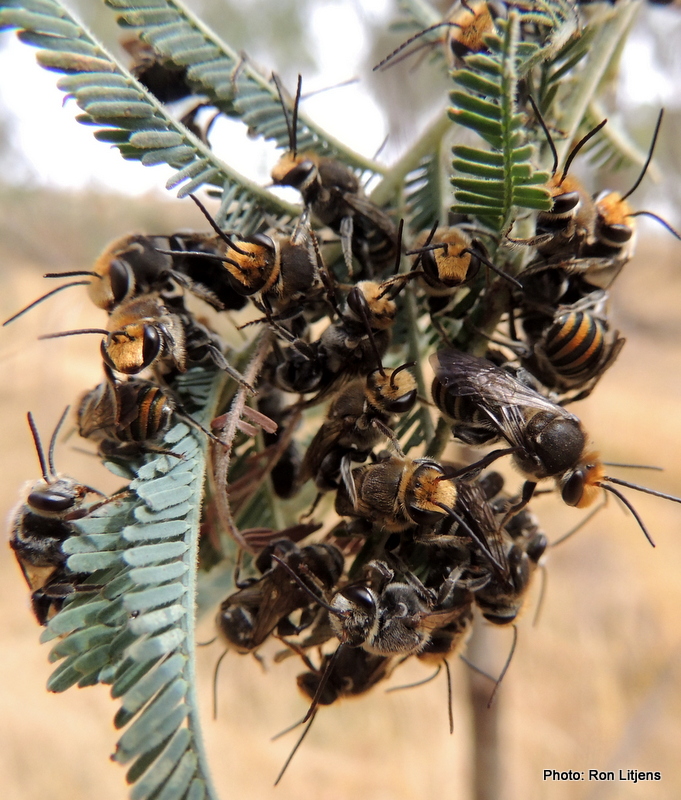 Nomia bees (Nomia sp), which featured in a previous post, belong to the halictid family of burrowing bees. They do sting but are not easily provoked. The female bees nest in the ground or in rotten wood, either by themselves or in a communal nest with other females, where they look after their own young and help guard the nest. The nests can be reusable. The females are much hairier than the males as they need to carry pollen to feed the young. The males do not nest. At the end of each day they will group together on a grass stem or branch. Pictured is a group of male Green and Gold Nomia Bees (Lipotriches australica) found on a Silver Wattle (Acacia dealbata) branch. During the day the bees leave this resting place only to return at dusk. Sort of like a plein air YMCA.
Singing above its weight
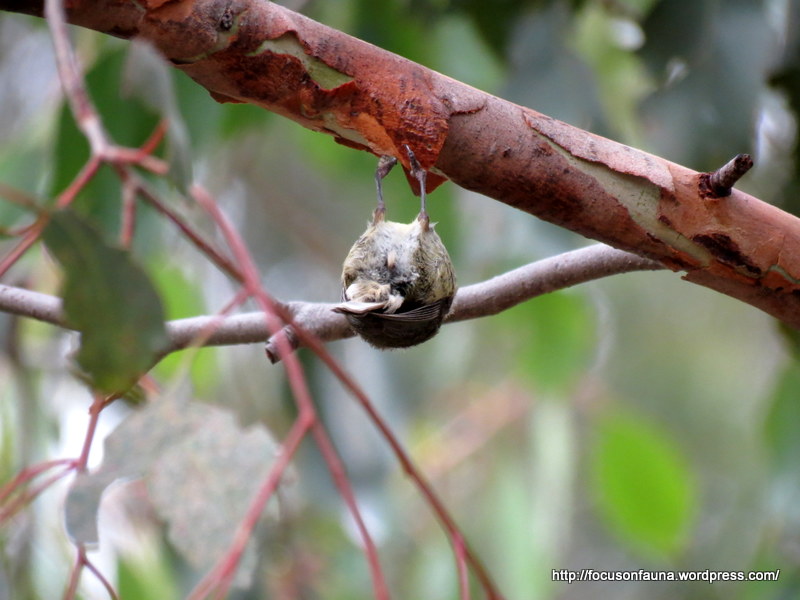
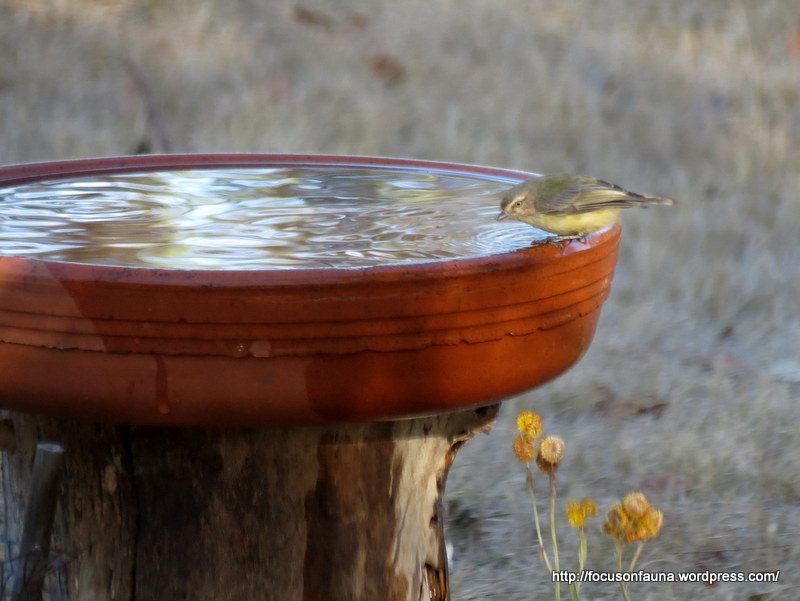 At just 8 to 9cm long, the Weebill is Australia’s smallest bird. We have been hearing them regularly and occasionally seeing them for the past few weeks, but photographing one is another matter. They are constantly on the move, usually high in a tree canopy, often hovering while gleaning insects from the foliage. We got lots of blurred images or ones with leaves or twigs partly obscuring the bird – and the unflattering shot above, which at least shows how acrobatic they are !
It was only when a couple ventured down to a bird-bath that we got a half-way decent snapshot taken through a window – click on the image at right for a better view.
The Weebill is a common bird of dry open eucalypt forest and woodland, often encountered in association with other small insect-eaters such as thornbills and pardalotes – it can easily be confused with the Yellow Thornbill, although the Weebill has a much stubbier bill, as its name suggests.
For such a tiny bird, it has a surprisingly loud and distinctive call, which means it is often heard before being seen. Click on the bar below to hear a sample of its call, recorded locally.
My Oz Day photo
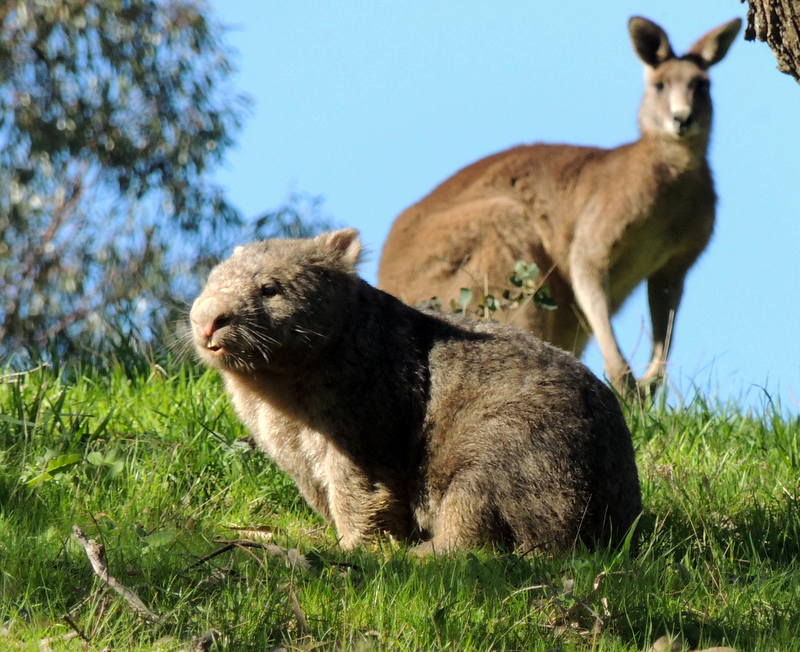 What could make the wattles under your chin quiver more than the proud pose of a Common Wombat (Vombatus ursinus)? Unfortunately the most common time we get to see a wombat, particularly in our area, is when it is lying dead on the side of the road with all four legs in the air. And if you do get to see one during the day it is usually suffering from the tick-borne disease, wombat mange, and very often is so ill it needs to be put down.
It was therefore a rare treat to see this large healthy specimen out and about during daylight. There was a strong southerly wind blowing towards me, which probably explains how I managed to get so close to both the wombat and the Eastern Grey Kangaroo (Macropodus giganteus) before they could smell or hear that I was there.
Common Wombats have very powerful front legs and large claws for digging burrows, an amazing feat given the rocky nature of where I live. The burrow opening of this particular individual is just shy of half a metre high. In the next bushfire it is going to be my place of refuge.
This was not taken on Australia Day (note the green grass!) but just looking at it makes me want to yell, “Oi, oi, oi”.




 Focus On Fauna