The Singing Stump

Lepidoptera lunch!
It’s Odonata time. The dragonflies and damselflies are doing their zoomy patrols around the dams. My aim this year is to get the perfect photo of one in flight. In ten years I have had no luck. I can’t see that changing. As I was sitting by the water’s edge (waiting for that dragonfly shot) I heard a high-pitched manic chirping every ten to fifteen minutes. A search of the surrounding trees revealed no nest. I finally tracked down the ‘singing’ to a nearby stump.
On a regular basis both a male and female White-throated Treecreeper (Cormobates leucophaea) arrived at the stump bearing beaks full of food. Their disappearance into the stump was greeted by a cacophony of chirping from inside. A quick look in the stump with a fibre-optic camera after the parents had departed revealed three chicks deep in the bowels of the stump. You can just make out the white flashes of the beaks (pictured below).
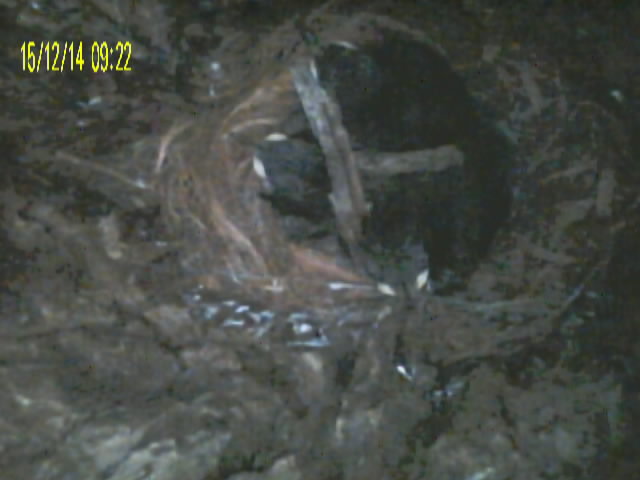 White-throated Treecreepers are insectivores and are often seen hopping up the trunks of trees. In fact the binomial name is derived from the Greek words kormos meaning trunk of a tree and bates meaning to travel. Local lore has it that treecreepers hop up the trunks of trees and Varied Sittellas (Daphoenositta chrysoptera) hop down, thus finding different food sources. The female treecreeper has an orange marking on its cheek.

It’s a shit job but someone has to do it
When the parents left the stump they carried in their beaks a fecal sac (pictured left). Because the nest is enclosed, the waste products from the chicks needs to be removed regularly. As was previously posted about Striated Thornbill chicks, treecreeper chicks excrete a translucent gelatinous membrane containing all the excrement, which the parent then picks up and removes from the nest.
The nest, situated where it is, guarantees that these two chicks are at least safe from the Pied Currawongs hunting in such numbers at the moment.
Any ideas ?

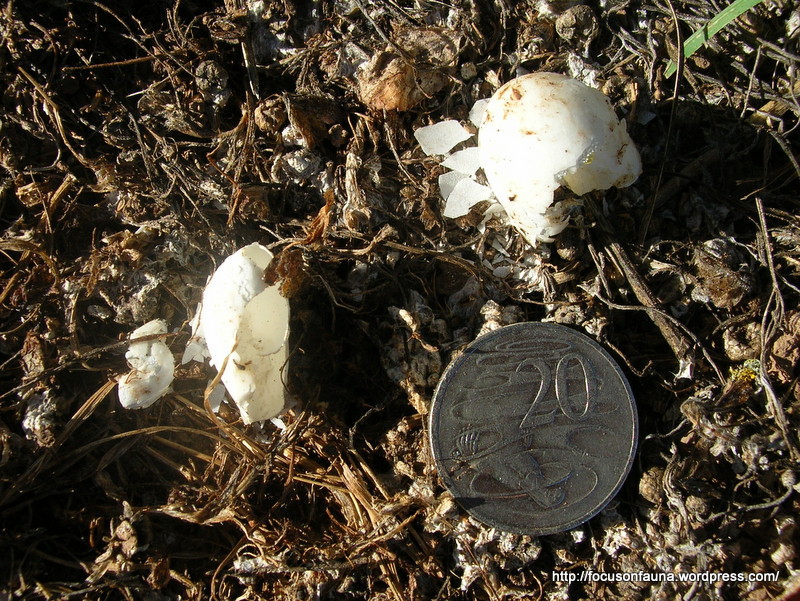 Once in a while when observing the natural world around us, we come across a mystery that we can’t readily solve from reference books – or a search engine for that matter. One such occurrence was the discovery of a hole near our apple tree the other morning. It was about 10cm deep, with sloping sides above a circular excavation with straight sides. It appeared to be a nest, presumably of a reptile, which had been exposed during the night, as it wasn’t visible the previous day and there was a pile of soil on one side, with four or five shattered eggs lying on the ground nearby.
The questions that arose were: who did the hole and eggs belong to, and had the nest been dug up by a predator, and if so, which predator? Presumably if the hatchlings had managed to dig their way out, the egg shells would still be in the hole.
There is an Eastern Brown Snake using a hole below a tree stump a few metres away – we know that because it occasionally surprises us (and itself) as we fill a bird-bath on the stump! But they normally have a clutch-size of 15 – 25 or even more, and use cracks in the ground. There is also a Common Blue-tongue regularly seen nearby, but they are viviparous (bear live young).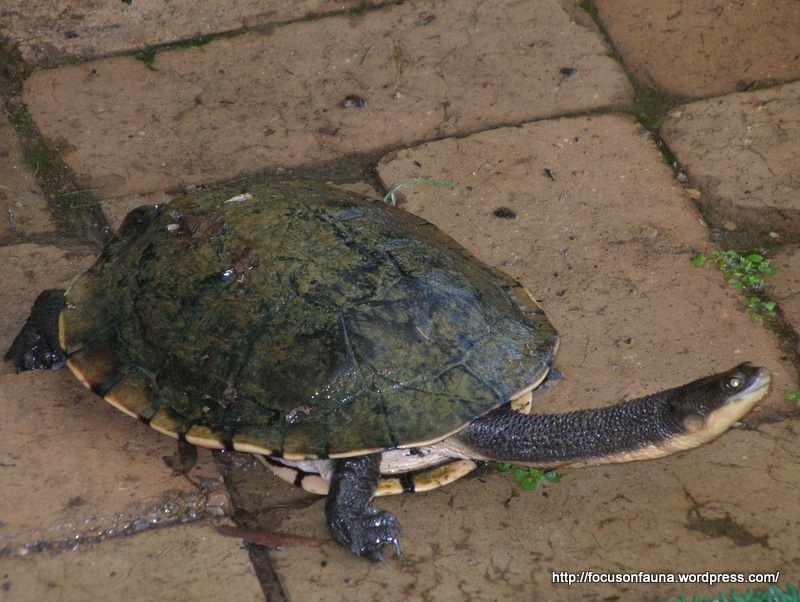
Our best guess is a Snake-necked (or Long-necked) Turtle, even though the nearest dam is over 100m away and the only nearby accessible water is a small amount in a leaky garden pond. As for the assumed predator, Red Fox perhaps, which we know is around – three recently killed chooks attest to that.
Any better suggestions would be welcome.
Christmas comes early to Flowerdale
 The scene pictured left could have been shot in Scotland – a timid deer standing proudly on the edge of a Scottish glen. BUT IT WASN’T. It is a picture of a feral nuisance (Sambar Deer) ripping the foliage off another feral nuisance – a Plum Tree (Prunus sp.) – in our backyard.
Sambar Deer (Cervus unicolor) were first introduced into Australia from Asia in the 1860s and feral populations have established themselves in areas of SA, Victoria and southern NSW. In previous years we have rarely seen deer around our place. If we did see them, it was usually their rapidly retreating rumps off in the far distance. But this year it is different. They appear to be everywhere. Sambar Deer are largely solitary animals, which means the small herd I saw trotting down our driveway last week was probably of a different species. If I was charitable (or hopeful) I would say it was one of Santa’s helpers doing some reconnaissance before the big day. Obviously not Rudolph.
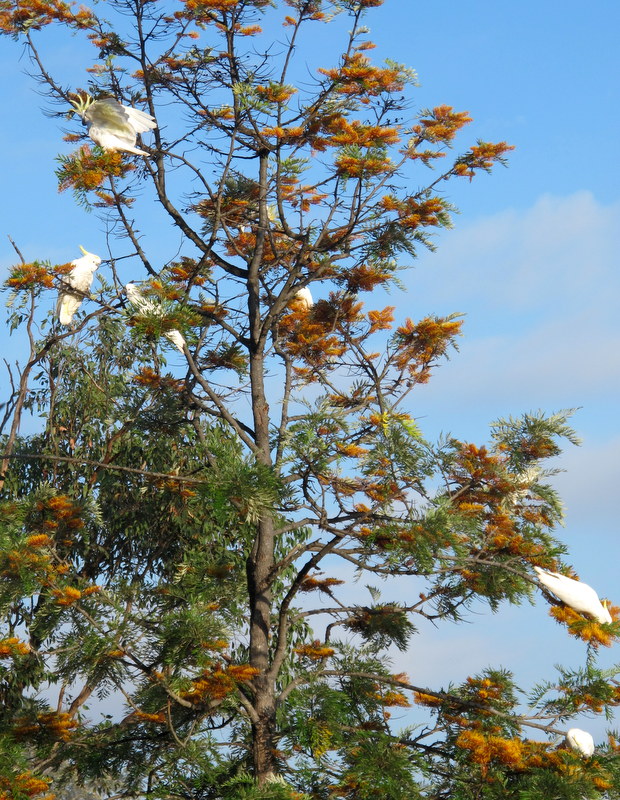 Also fitting in with the Festive theme is our Silky Oak (Grevillea robusta), pictured right, decorated with what look like Christmas baubles, aka Sulphur-crested Cockatoos (Cacatua galerita). In our household, any tree thus adorned is called a Christmas tree, irrespective of the time of year. But the demolition of the Silky Oak by these birds is a true yuletide occurrence that happens in the last few weeks of every year.
They obviously find destroying the flowers a lot of fun. Ho Ho Ho.
Nestcraft
 One of the most exquisitely crafted bird nests would surely be that of the Grey Fantail. The nest shown at left was discovered, still under construction, in a tangle of Swamp Paperbarks (Melaleuca ericifolia). This nest is quite well camouflaged, unlike some Grey Fantail nests we have seen located on a bare branch in full view of any observer (or predator).
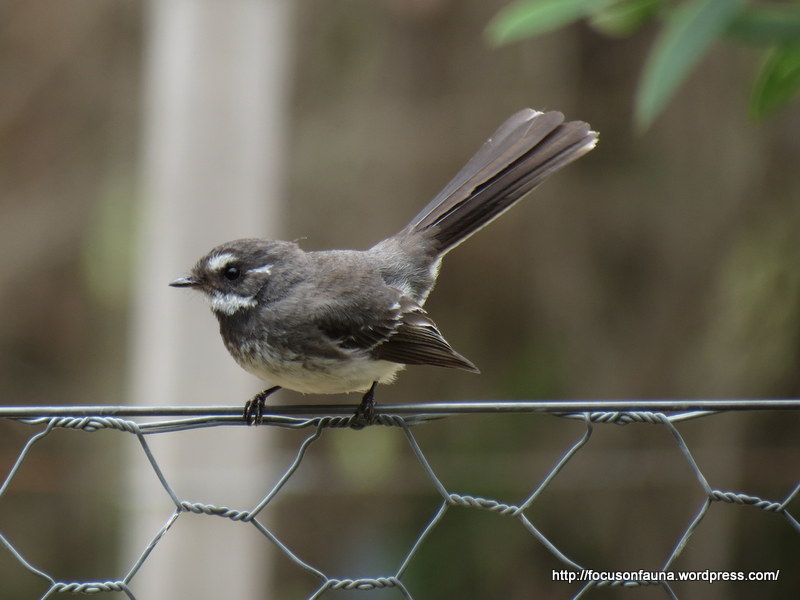
Both the male and female birds share nest construction and incubation and were seen nearby collecting material, including carpet underfelt. One of them is shown at right.
After some recent heavy downpours, the nest is looking slightly bedraggled and soggy (see below), but now holds a single egg. The usual clutch is 2 to 3 eggs, so we will keep discreetly monitoring activity at the nest.
Great leaping lizard (observer)
 I am not afraid of snakes. In fact I relish the opportunity to observe them up close … as long as they don’t mind. In the Yea Wetlands recently I observed a Tiger Snake (Notechis scutatus) up close and personal. It was curled up on a log sunning itself and didn’t seem to mind the attention it was getting.
Having said that, when I lifted the lid on our composting bin this week and saw a snake-like creature inside I knew the world high-jumping record was going to get a bit of a shake (from a standing start!). The visitor wasn’t a snake but a Blue-tongued Lizard (Tiliqua sp).
 Blue-tongued Lizards are the largest member of the skink family. Being diurnal (active during the day) they are often seen but this year I have seen more than I have for many years. Blue-tongues feed on insects, snails, flowers and fruit and obviously whatever it finds in our composting bin. The chap in the compost-bin looked particularly well fed.
Colour and patterning within a species is highly variable. My guess is the creature in our bin is an Eastern (or Common) 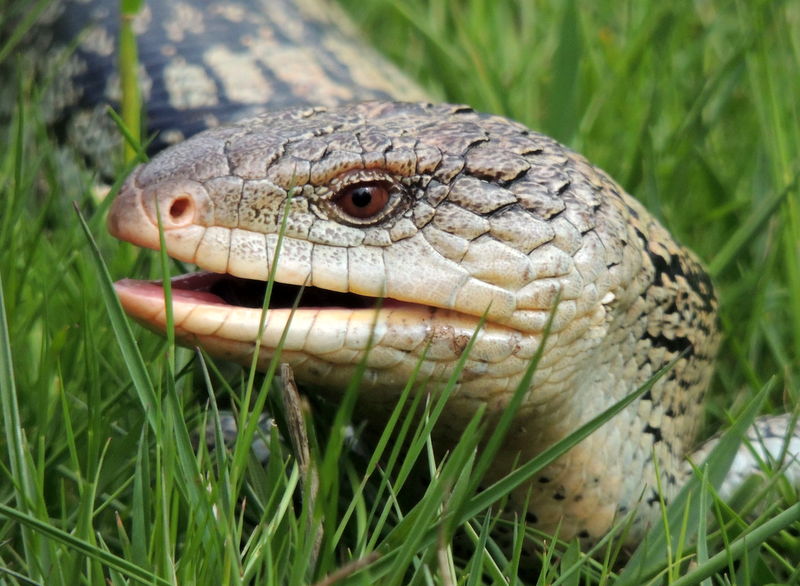 Blue-tongue (Tiliqua scincoides), pictured above. It is characterised by a broad prominent dark stripe from the eye to above the ear. Compare this to the lizard (pictured left) caught cruising around last week when I was riding my bike. It has no eye stripe and the patterning on its back comprises longitudinal blotches, probably a Southern Blue-tongue (Tiliqua nigrolutea).
These lizards are great to have around the place because they eat insects and snails. If you approach too close they will open their mouths wide and bare a dark-blue tongue as an aggression display. Poke your tongue out back at them – see what happens?
The irresistible force
The Red Wattlebird (Anthochaera carunculata) is the largest honeyeater on the Australian mainland. The only larger honeyeater is the Yellow Wattlebird (Anthochaera paradoxa), which is found in Tasmania. The wattles in question do not refer to the trees in which these birds live but rather the fleshy appendages that hang off the side of the head. The scientific name is derived from the Greek words anthos meaning flower and khairo meaning to enjoy and caruncula meaning little bits of flesh – referring to the wattles.
 Wattlebirds are mainly nectar-feeders, aggressively defending territories of flowering plants, but also eat insects and honeydew. Their loud cough-like call gives them the alternative name of Barkingbird.
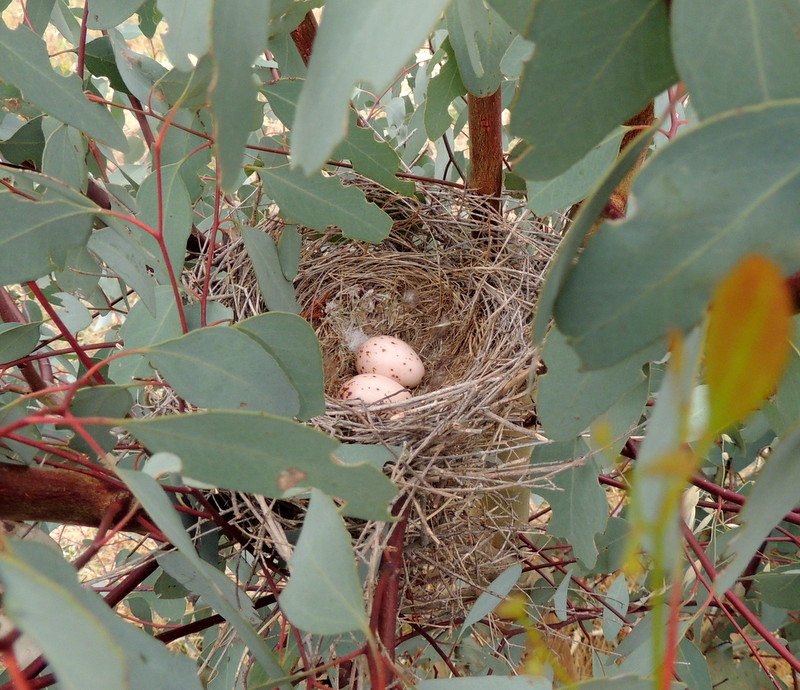
In my concerted quest to locate nests this season I was lucky enough to come across a nest in a two-metre high Red Gum (Eucalyptus camaldulensis) sapling. The nest contained two brown-spotted pink eggs (pictured left), with no adult in sight. A later viewing of the nest (from a distance) revealed mum (or dad) sitting on the eggs (pictured right).
This year there seem to be many Pied Currawongs (Strepera graculina) around. These birds are notorious nest robbers and with the honeyeater having such an exposed nest it will be interesting to see if the eggs or chicks survive. Both the Red Wattlebird and the Pied Currawong are aggressive birds. The ensuing battle will be like the irresistible force versus the immovable object.
Butcher’s apprentice
 This young Grey Butcherbird was ‘trapped’, or thought it was, in our large open shed for a short time until it managed to find a gap in the plastic mesh designed to keep out sparrows. During its search for an escape route, it occasionally let out some plaintive notes (click on the audio below), before breaking into harsher squawks, similar to the start of the adult bird’s call which you can also hear below.

Its parents were not in sight, presumably too busy out butchering fledgling birds, skinks or other tasty morsels !
As you can hear from the young bird’s attempt, it has a long way to go until it can emulate the full melodious songs of its parents.
Young Grey Butcherbird:
Adult Grey Butcherbird:
Quit while you’re a-head
If you are only into feel-good stories – look away.
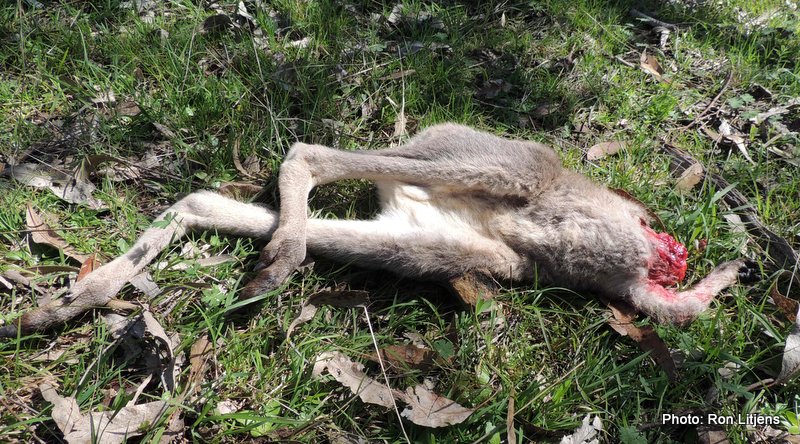 A recent gruesome discovery up on the hill behind the house was the fresh body of an Eastern Grey Kangaroo (Macropus giganteus) joey minus its head and right arm. It was hard to imagine any predator killing such a large creature – the Flowerdale panther perhaps! Later in the day the pictures from a remote motion-sensing camera situated at the back of the property revealed a Red Fox (Vulpes vulpes) wandering past with a kangaroo head clasped in its jaws. The fox in question has been observed every day following the same route in front of the camera.
Foxes are omnivores meaning that they will eat both meat and vegetable  matter. Fox scats around our place clearly show that berries and insects are part of its diet. It is also known that foxes eat birds and small mammals. Even after they are not hungry, foxes will continue to hunt, often burying food in caches under leaves or underground.
So many questions still remain. Did the fox kill the joey or did it opportunistically scavenge the body? If it didn’t kill the joey, what did? In the photo, was the fox going to feed its young or add to a food bank? I’ll probably never know.
Nature is not all butterflies and flowers!
Insect artistry
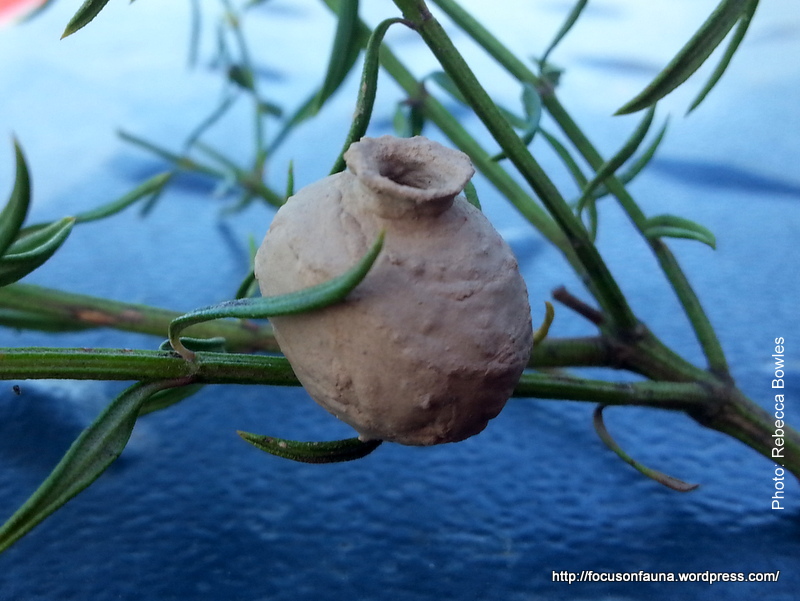 We received this photo of a beautifully formed pot from Bec, follower of this blog as well as being our local Blackberry Action Group project officer.
This small work of art is actually made by a potter wasp, one of a number of species of wasps in the subfamily Eumeninae. Many potter wasps stock their nest with caterpillars for their larvae to eat. The wasp grasps its caterpillar prey with its sharp forceps-like mandibles, immobilises it with its sting and flies/drags it to the nest. An egg is laid, then the nest is sealed. When hatched, the larva eats the caterpillar(s) live before pupating and emerging from the nest as a nectar-feeding adult wasp.

Potter wasp – photo: brisbaneinsects.com
Potter wasps are solitary, not social like some wasps, such as the European Wasp. They can sting but are not normally aggressive. The constructor of Bec’s nest would be similar to the wasp pictured at right.
The Ugly Duckling (Australian style)
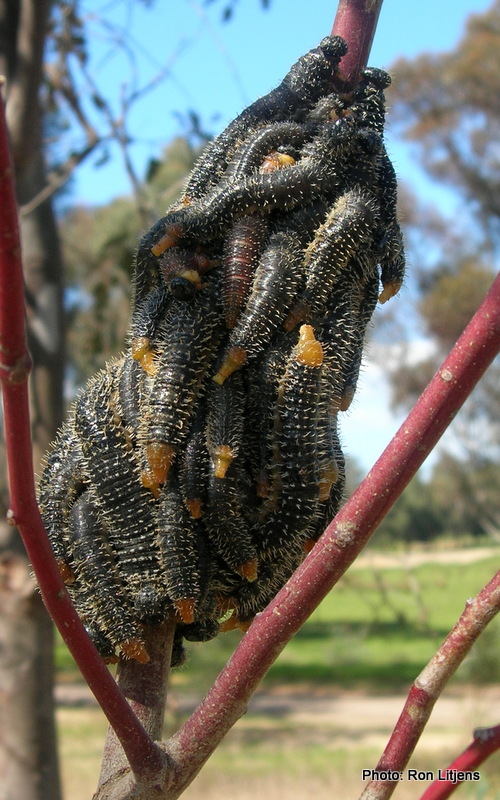
Ugly
We can probably all remember the Hans Christian Andersen tale of The Ugly Duckling – the story of a cygnet that thought it was ugly but grew up to be a graceful swan. (If it is any consolation, I think that cygnets look kind of cute). I am about to rewrite this tale to suit Australian conditions. The main role will be filled by a Spitfire, left.
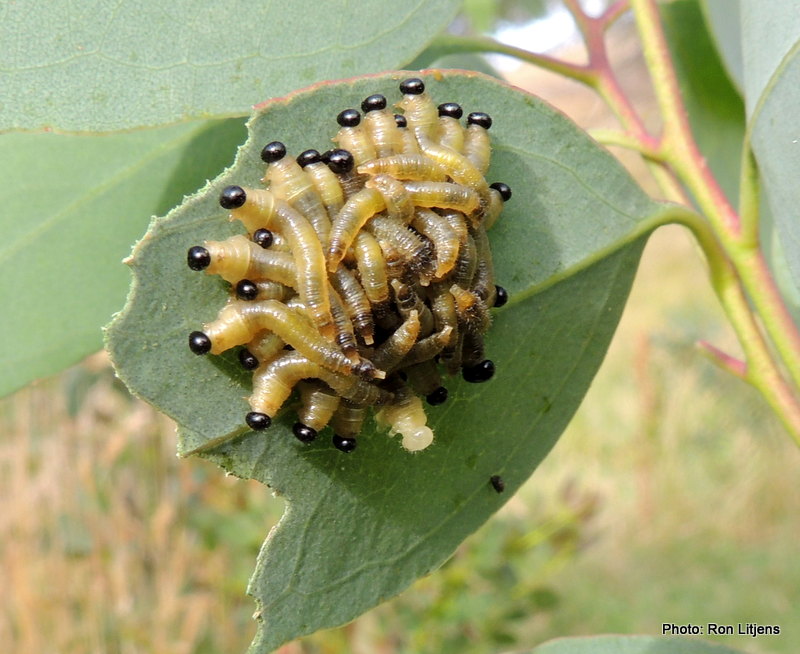
Spitfires are the larvae of Sawflies. This name is misleading as a Sawfly is a type of wasp. The term is derives from the saw-shaped ovipositor that the female uses to cut into plants to lay eggs.
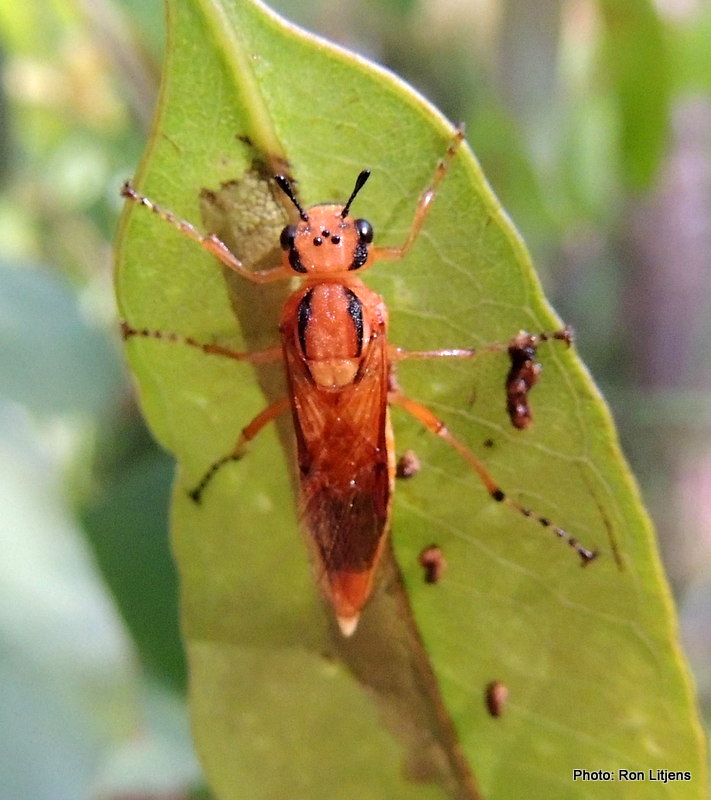
Beautiful?
There are many different species of Sawfly, many of which lay eggs only on specific tree types but they all discharge a strong smelling liquid when disturbed. Pictured above right is a group of Small Brown Sawfly (Pseudoperga guerinii) larvae. They feed on the leaves of young eucalypts. In early summer the larvae will dig into the ground and pupate. This phase could take several years, depending on species, until the adult sawfly appears.
When these spitfires grow up they turn into adult Small Brown Sawflies, pictured left – not as beautiful as a swan but definitely an improvement in appearance.
Even so I suspect a fairy tale called The Ugly Spitfire, as Aussie as it is, will not catch on.




 Focus On Fauna