Are you over the Rainbow?
Each October, thousands of Australians participate in Birdlife Australia‘s Great Aussie Birdcount, and each year since it began in 2014, the most commonly reported bird is the Rainbow Lorikeet. Trichoglossus moluccanus is a stunningly beautiful parrot, loud, bold, and easily tamed to come for regular feeding by homeowners. Colourful, small flocks of them streak across the sky in every town, park and woodland.

When I was a child in Melbourne last century, rainbow lorikeets were not ever seen. When I lived on the Murray River in the 1990s, they were rarely seen but gradually increased in appearances. When I came to Yea in 2012, rainbow lorikeets were infrequent visitors. As of 2025, they are common in all those places. This shows that they are native birds who have thrived with the changes we have brought to the environment with our farming and urban landscapes – as have Noisy Miners and Magpies.
This colourful species was not present in Western Australia until they turned up in Perth a couple of decades ago; now their population is over 40,000 and reports that they are out-competing local species for nesting hollows are raising concern. They have recently arrived in Tasmania, and New Zealand has a program to prevent their multiplication there. They have also increased their range along the Eastern seaboard of Australia well beyond their original confines. Some have also established in Hong Kong.
They have some endearing qualities: they are monogamous, pairing for life mostly it seems, they are friendly and very photogenic. Both sexes look alike and they adapt well to aviaries – if you can put up with the screeching. But balancing those endearments, they display some negative qualities – raiding fruit trees, expelling nestlings of other birds so they can take the hollows, and dominating the limited food resources of the bush. The WA Department of Agriculture estimates $3 million damage annually to fruit crops by rainbow lorikeets.
They are adapted to eat nectar, pollen and fruits with a specialised ‘brush tongue’ that scoops out the nectar from within flowers. Trichoglossus means ‘hairy tongue’. (Eeww!)
So what’s the verdict? Pest or prize? Beautiful or bad boy? Are you over the rainbow? For all the problems they cause, it is hard to resist such very pretty faces. I’m grateful to live with them.
Bird Hunters part 3: Stealth assassins
The third type of bird-hunting bird in this series is the stealth hunter. The prime exponents of this method are the goshawks and their close relatives, the sparrowhawks.
Goshawks occasionally soar around above the treetops but they don’t dive on prey from above like the eagles and the larger hawks and kites. Goshawks hunt by ambush, attack without warning, stealth strikes.
Goshawks have sharp eyes, dangerous talons and strong wings that give them great agility, speed and manoeuvrability. They will sit patiently for hours sometimes waiting for a prey species to make themselves vulnerable. It may be a honeyeater drinking at flowers, a pigeon or quail feeding on the ground, or a rodent or reptile. Suddenly the goshawk launches, effortlessly navigating through trees or under bushes and slamming onto the prey with arched feet. They can execute rapid turns, sudden dives, bush crashing, short wild pursuits, a testament to their superb physical design.
They are just as formidable in low-light dawn and dusk with their finely tuned eyesight, and their combination of speed and surprise -often ambushing from a concealed perch – makes them effective deadly hunters. These tactics work in a variety of habitats from dense forest to urban backyard with a few trees, which is why these birds are frequently observed in many places and often photographed.
Once the hunt is successfully completed, the goshawk or sparrowhawk will sit on a patch of open grass, plucking and dismembering the hapless bird, often to the accompaniment of outraged shrieks and chirps from many birds in the neighbourhood, which are blithely ignored. See Ron’s story here
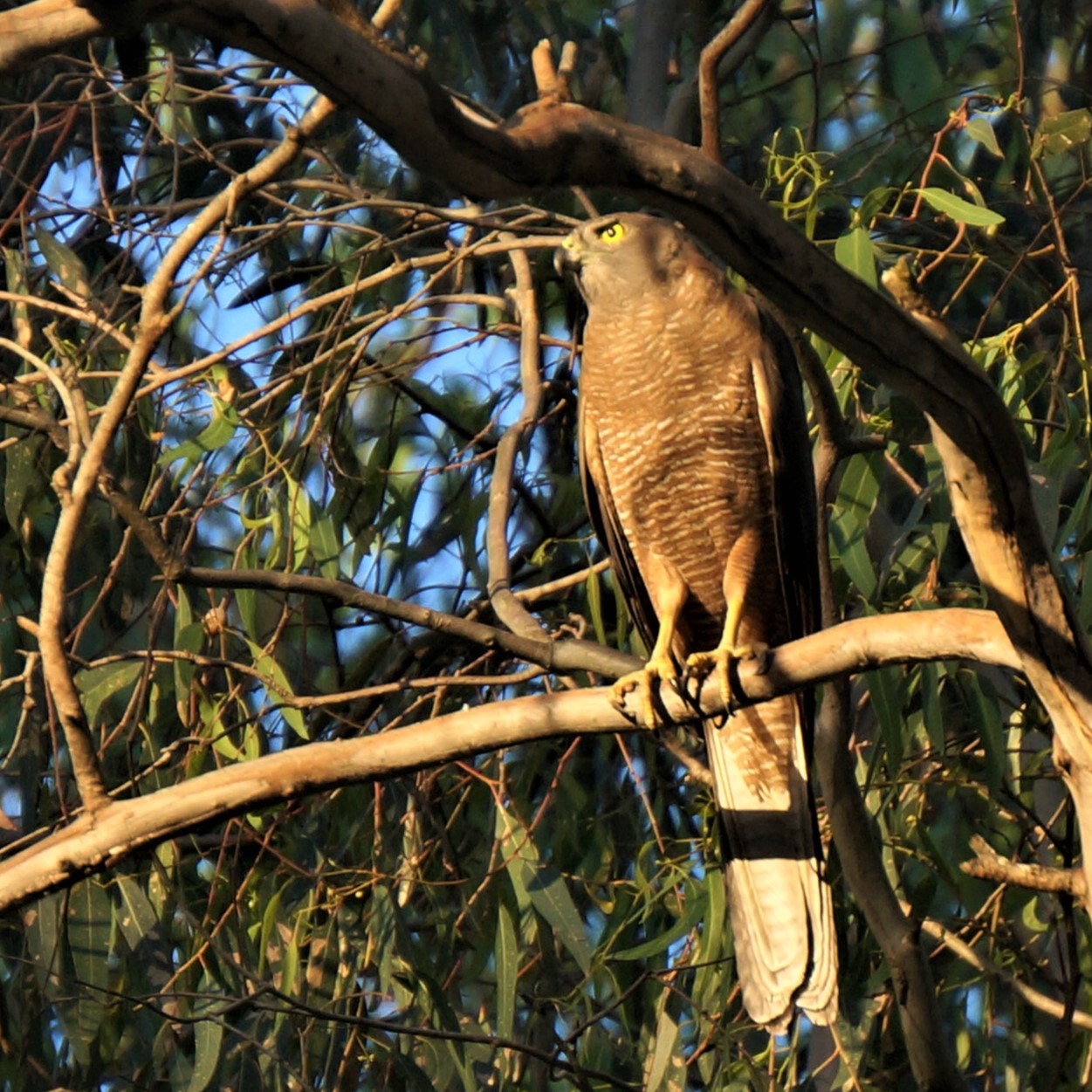
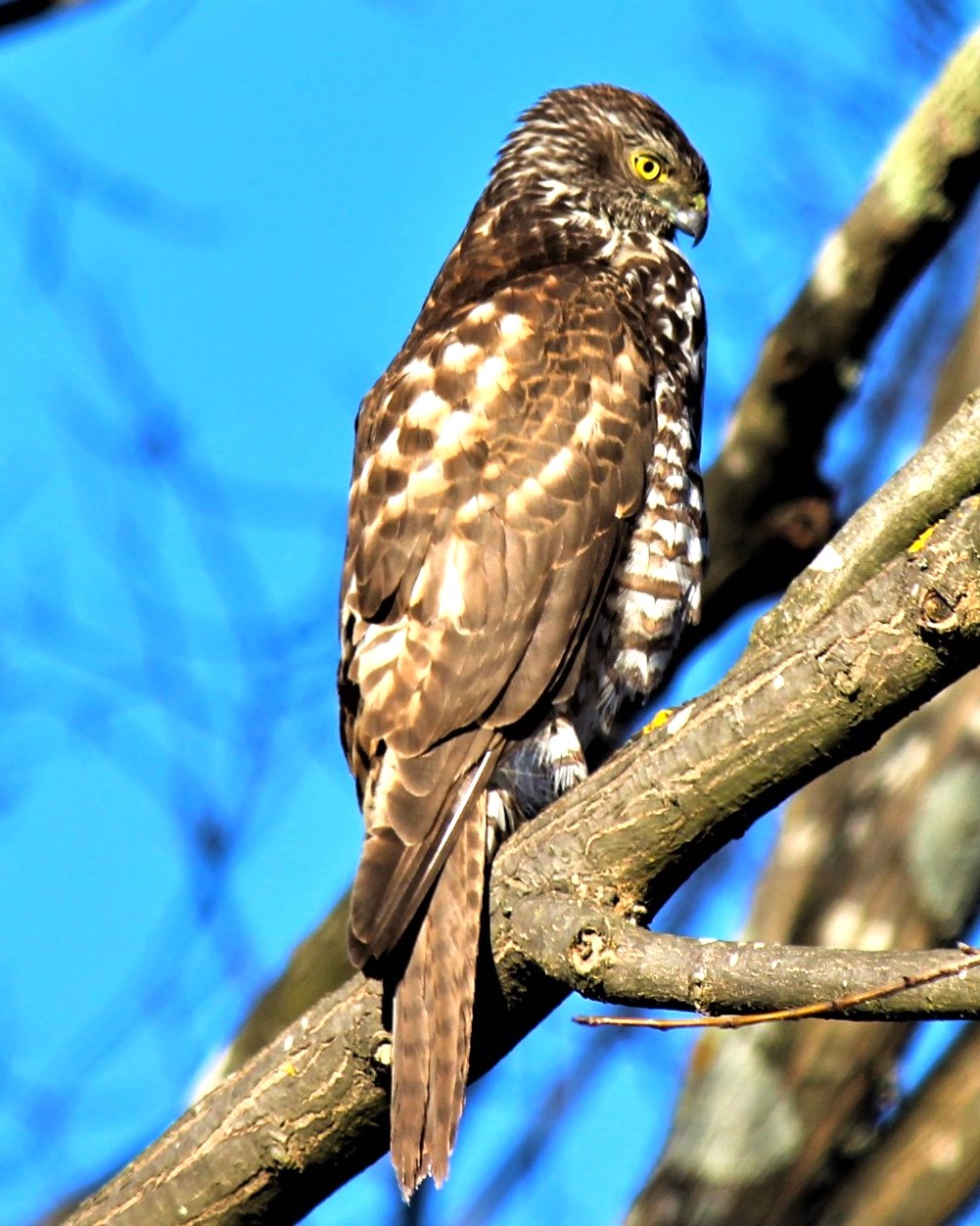

It is famously difficult to tell the difference between the Brown Goshawk (Tachyspiza fasciata) and the Collared Sparrowhawk (Tachyspiza cirrocephalus). Briefly, the BG is larger with a rounded tail, the CS is smaller and finer with a square tail. There are other goshawks and sparrowhawks in Australia but these two are quite common around the district. It is also possible to see the Grey Goshawk (Tachyspiza novaehollandiae) anywhere in Victoria and if one is very lucky the pure white form of this bird may present a fleeting rapturous view.
Bird Hunters Part 2: the Pouncers
The big beak on a butcherbird ends with a wicked spike – which is useful for the act of butchering. Today’s bird hunters are those with small feet and big beaks: butcherbirds and currawongs. They are pouncing opportunists who will take anything – rodent, insect, bird, nestling – and they must be doing pretty well because they are common, increasing throughout the country.


It is completely horrible when these birds rob nests. On this site, there are many sad tales of nests full of hungry young nestlings that suddenly go missing, and sometimes the culprit is identified as a currawong or butcherbird (eg here). Especially vulnerable are Grey Fantails and Willie Wagtails.
Currawongs (Streptera) come in two varieties in our district – the Pied (S. graculina), common around towns and the Grey (S. versicolor), a bird of forests and hills. The Pieds used to come to town for the Winter and spend the summer in alpine areas, but since the 1980s, observers have noticed that they now are present all-year round (though numbers are a bit smaller in the warmer months). Some people think this is responsible for a decline in small songbirds in cities and towns, as they are so effective at finding nests and robbing them.
The Grey Butcherbird (Cracticus torquata) gets its name from the alleged habit of this family of birds of hanging larger prey on spikes or in forks of branches to eat at leisure. I have never witnessed this and it certainly seems to be more common in American species of Shrike (which are the same family). I asked around and one friend supplied the following photo of a butcherbird with a forlorn young Rufous Fantail strung up.

While butcherbirds and currawongs are the foremost predators of nests, there are plenty of others who will have a go – kookaburras, ravens, magpies and some raptors. A rare raptor, the Square-tailed kite (Lophoictinia isura), makes a living by soaring low over treetops and dropping suddenly on to prey, especially nestlings of bigger birds. I have only seen one once in the district.
Butcherbirds and currawongs will take small birds other than nestlings when they can. They sit and watch for a vulnerable moment, drop on the victim and grasp its neck with the powerful beak.
This post is more about the horrors of nature than its delights, though all, of course, a necessary part of the circle of life. The moral might be: beware of predators with big beaks and small feet, and there seem to be a few around the world at the moment.
Bird Hunters Part 1
There are a few birds which make a living out of hunting other birds. This is distressing to us lovers of birds but on the other hand it is amazing the way they do it. I wish to focus on several groups of bird hunters according to the strategy by which they hunt.
Aerial Strikers
Some birds have incredible flying skills, combining speed and manoeuvrability to grab their bird prey in midair.
Preeminent among the aerial strikers is the Peregrine Falcon (Falco peregrinus). They usually nest on rocky ledges or cliffs. A pair nests on the cliffs at Strath Creek Falls where a large white stain on the cliffs reveals the nesting area. Famously, a pair has nested for many years on a skyscraper in Collins St, Melbourne where a camera streams the activity within the nest.
Peregrines are famous for being the fastest -flying bird in the world, reaching up to 300kmh. Every bird is afraid of them and I have seen a flock of galahs quickly head for the ground to avoid being tackled by a passing Peregrine. Sometimes they fly high and drop on a flying bird but I have also once witnessed a peregrine chase a duck (and ducks seem to fly very fast), effortlessly overtake it and passing underneath, swivel and strike its neck with extended talons. The duck tumbled to the water below and every bird in the vicinity shrieked and quacked and chirped angrily as the falcon swooped several times to finish the kill and obtain its meal. The photo is from Birdlife Australia.

The Australian Hobby (Falco longipennis) is a peregrine mini-me. It looks like a peregrine but smaller and more tawny-coloured; and it hunts like a peregrine but, being smaller, is even more aerobatic and skilful. A friend described watching one chasing a bat at dusk, and bats are incredible flyers (it escaped). The only successful strike I have witnessed was a hobby in Melbourne that picked out a starling from an airborne flock. They appear in our district usually dashing through the air, so hard to photograph unless one catches them perched.

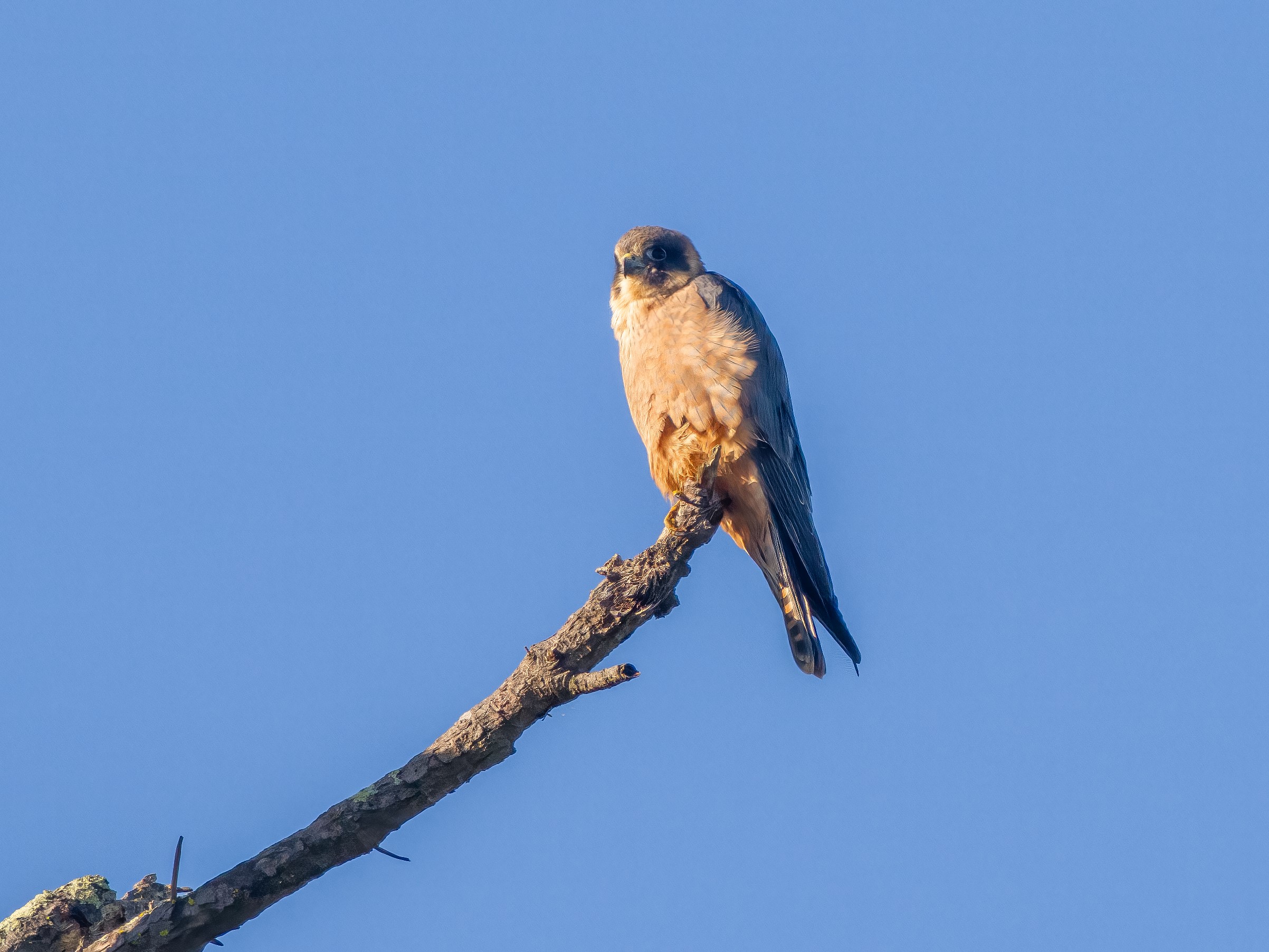
Photos by Christopher Rowney
Almost any raptor will take a bird at times but the falcons with their pointed wings and swift flight are the preeminent aerialists. You have to admire them – but not if you’re a bird taking a pleasant Sunday afternoon flight!
Red-footed Booby
This is a most astonishing find. On the Hubbard’s farm Three Sisters a Wedge-tailed Eagle dropped a strange prey. Upon investigation a large seabird was found with a wingspan over a metre wide and a long tube-nose typical of ocean-dwelling birds. It proved to be a Red-footed Booby (Sula sula).


Boobies are similar to gannets, they fly acrobatically and dive from on high plunging into the water to catch fish. They nest on offshore islands, this species on Christmas Island among other places, often building nests in trees.
The discovery of a Red-footed Booby in Strath Creek is unexpected (of course) and actually quite sad. The species was thought only to live in tropical areas but increasingly it has been found moving further south with records increasing in NSW. This will be linked to warming sea-surface temperatures associated with the strengthening of the East Australian Current under climate change. Some oceanic birds, especially younger birds – this bird is in immature plumage – get lost and driven by storms inland where they perish. The only other records in Victoria of this species are on a beach in East Gippsland (2013) and on a basketball court in Essendon (2019). Some wit said, they must be booby-traps.
Normally birds like this are encountered on “pelagic trips”. This is when a group of birders go far out on a boat, scatter some fish oil and berley and take photos of everything that flies past. This is the only way to observe albatross, storm-petrels, prions, fulmars, shearwaters and boobies. They feed on the wing and are able to drink seawater, excreting the salt out through specialised nostrils on their beak. Collectively they are called ‘tube-noses’.
There are other species of Booby, the Brown, the Masked. In Hawaii, there is a blue-footed booby, but this one is definitely not that. It has red feet.

Finding a seabird like this on a farm 70 kilometres inland is an astonishing discovery, and it may be part of a bigger story – changing waters, changing bird movements, adaptation and adjustment and the ones that get lost along the way.
[Thanks to the experts on the Facebook page Australian Bird ID for help with this identification.]
Additional Note: The Red-footed Booby was placed in the freezer and has now been delivered to the Melbourne Museum (on 21st Feb 2025) who will examine it and archive it.
Quit while you’re a head
The presence of Common Garden Skinks (Lampropholis guichenoti) in the garden (pictured below) is the sign of a healthy ecosystem. As is the appearance of butterflies. And whilst the presence of both may bring a thrill to the heart you know that Mother Nature can be cruel.

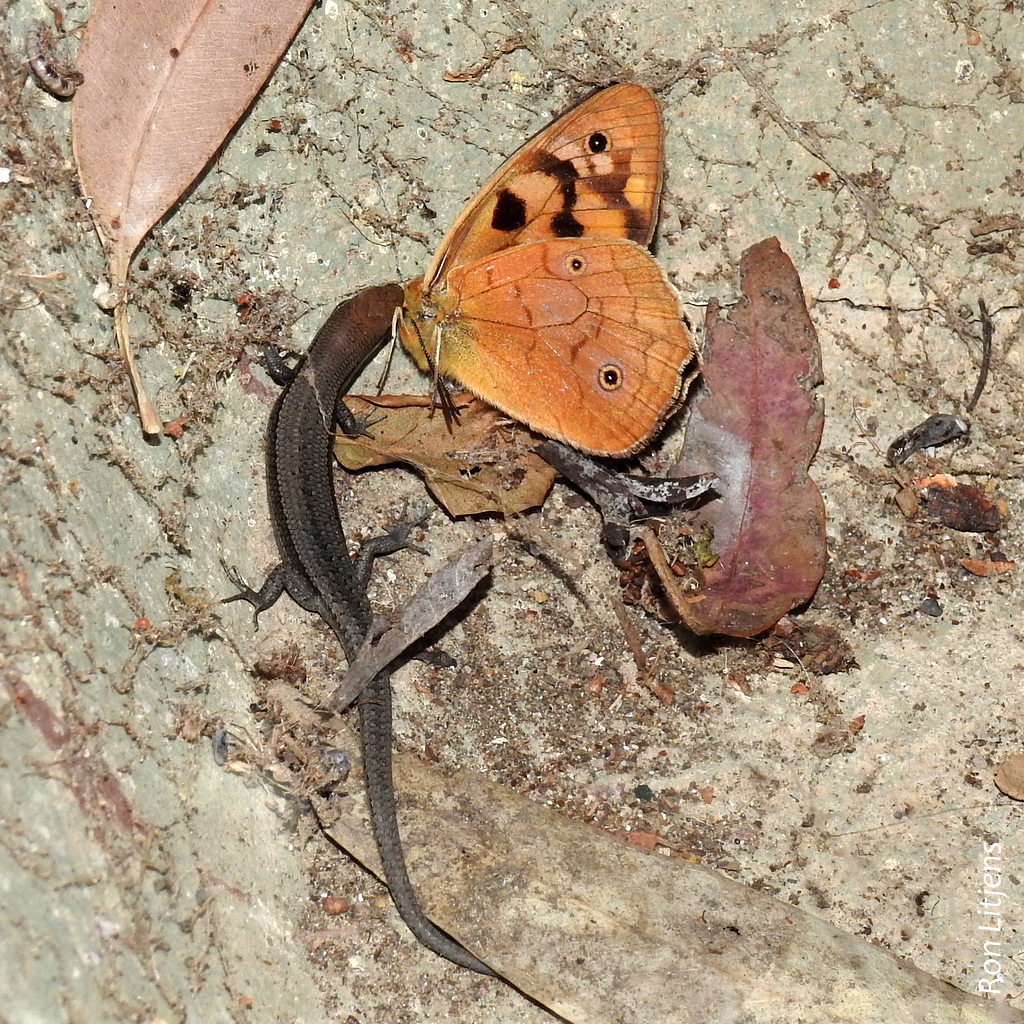
I hadn’t really thought about it but lizards are carnivores, in particular insectivores. They will eat caterpillars, grasshoppers, flies and cockroaches as well as other invertebrates such as worms, slaters and spiders. This was forcefully brought home when I witnessed a mighty struggle between a skink and a Shouldered Brown (Heteronympha penelope) butterfly (pictured left). The spectacle lasted over a minute but in the end the skink managed to bite off the head of the butterfly. Lizard 1, Butterfly 0. Unfortunately my attempt to photograph the scene disturbed the lizard and it disappeared into the garden leaving what I thought was a headless butterfly corpse.

The next day the headless butterfly body was still alive walking and flapping around (pictured right). For many creatures the respiratory system is controlled by the brain and the head contains the respiratory opening. Removing the head results in rapid suffocation. However this is not true for insects. They breathe through holes on the side of their bodies, called spiracles. Respiration and other functions are controlled by brain cells (ganglia) distributed throughout the body. So for a short period of time the butterfly can continue to function.
What about the butterfly? Well, it won’t suffocate but it will probably die of starvation – its mouth was in its head!
Squatting is the easiest
For the humble bee there is a range of accommodation options to house your young. Social bees such as the Western Honey Bee (Apis melifera) are social creatures and build large communal hives that house the queen, drones and worker bees who look after the young. However of the 1700 species of Australian native bees only 11 are social. The rest are solitary.
These bees individually build nests to house their young. The Blue-banded Bee (Amegila sp.) for example builds its nest as a tunnel in the ground (or in the lime mortar of very old building, click HERE to view). Each egg is provisioned with a pollen food store and sealed with a series of sealed cells filling the tunnel. Other species bore holes in wood or in the fleshy stems of plants. It’s a lot of work.
Cuckoo Bees (and a whole range of native wasps) bypass this building effort by laying their eggs in the nests of other bees before the cells are sealed. After the nest is sealed the cuckoo bee larvae hatch and consume the eggs of the original bee and the associated food stores. Though this strategy bypasses the nest building effort it is fraught with danger as laying the eggs in another’s nest can lead to ugly confrontations.
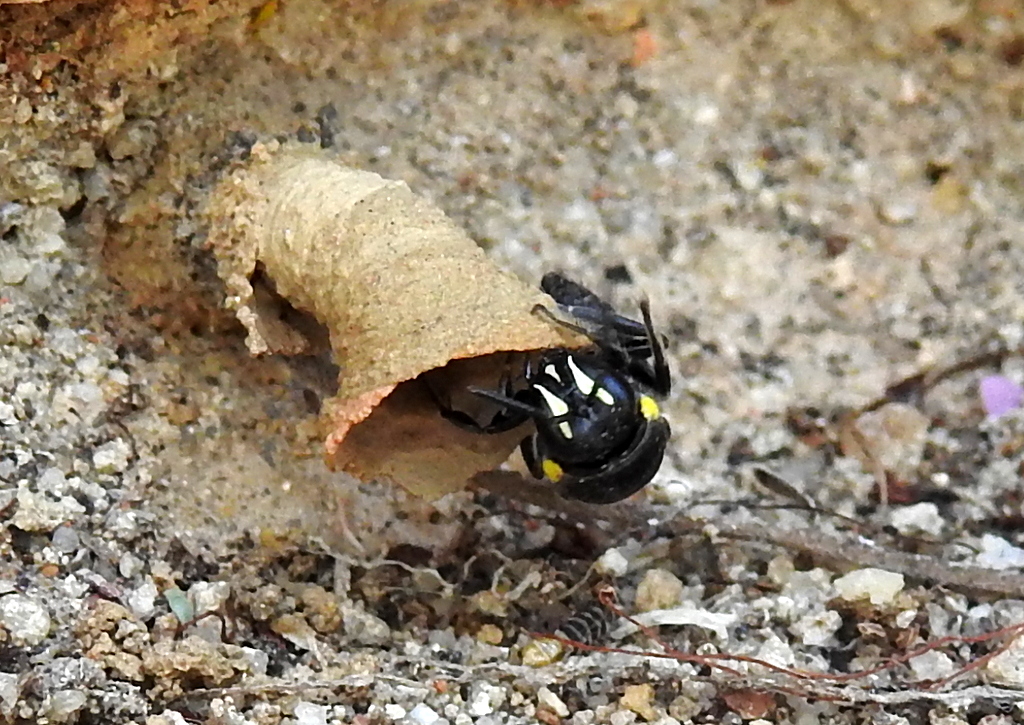
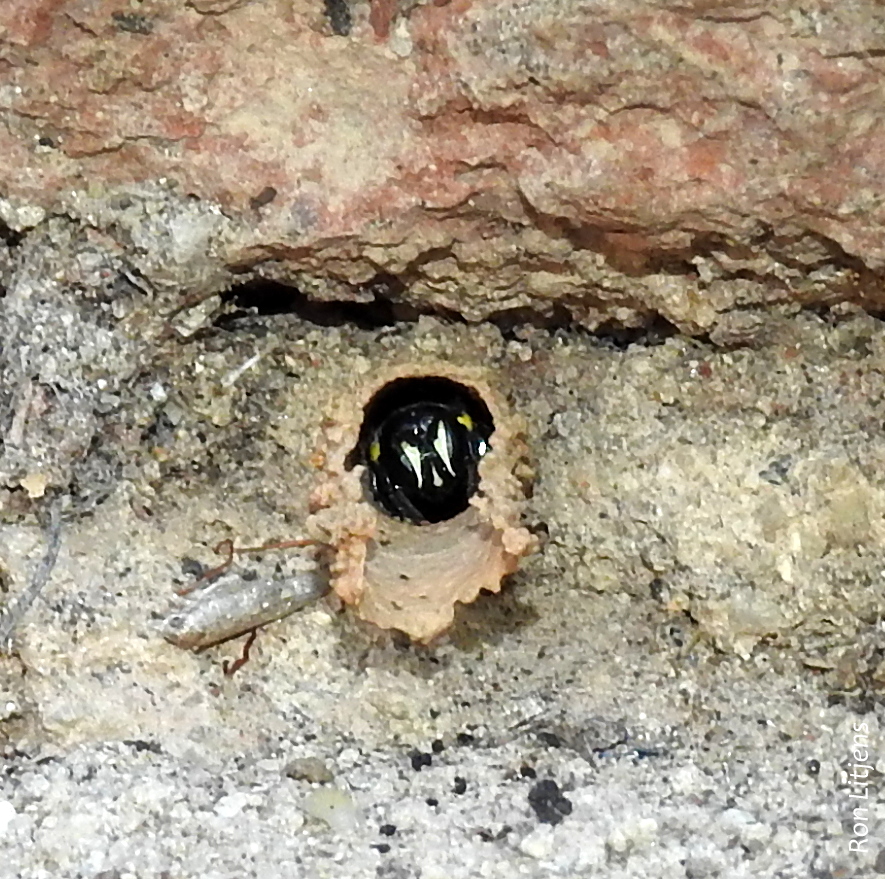
One species of bees has an easier strategy still. The Cloudy Masked Bee (Hylaeus nubilosus) finds an abandoned nest of a potter or mud dauber wasp and moves in. No construction costs, no fighting with the neighbours (or the residents).
Squatting has its advantages.
Fairies in the garden
Sweet Bursaria (Bursaria spinosa) is shrub of the Pittosporaceae family with profuse white flowers. It is my insect-attracting plant of choice at the moment. Above a local grove of Bursaria there was a shimmering of tiny creatures moving so quickly it was difficult to tell what kind of creatures they might be. It was not until one of them settled of a flower that I could see it was a tiny moth – a Fairy Moth (Nemophora sparsella) to be exact (pictured below).
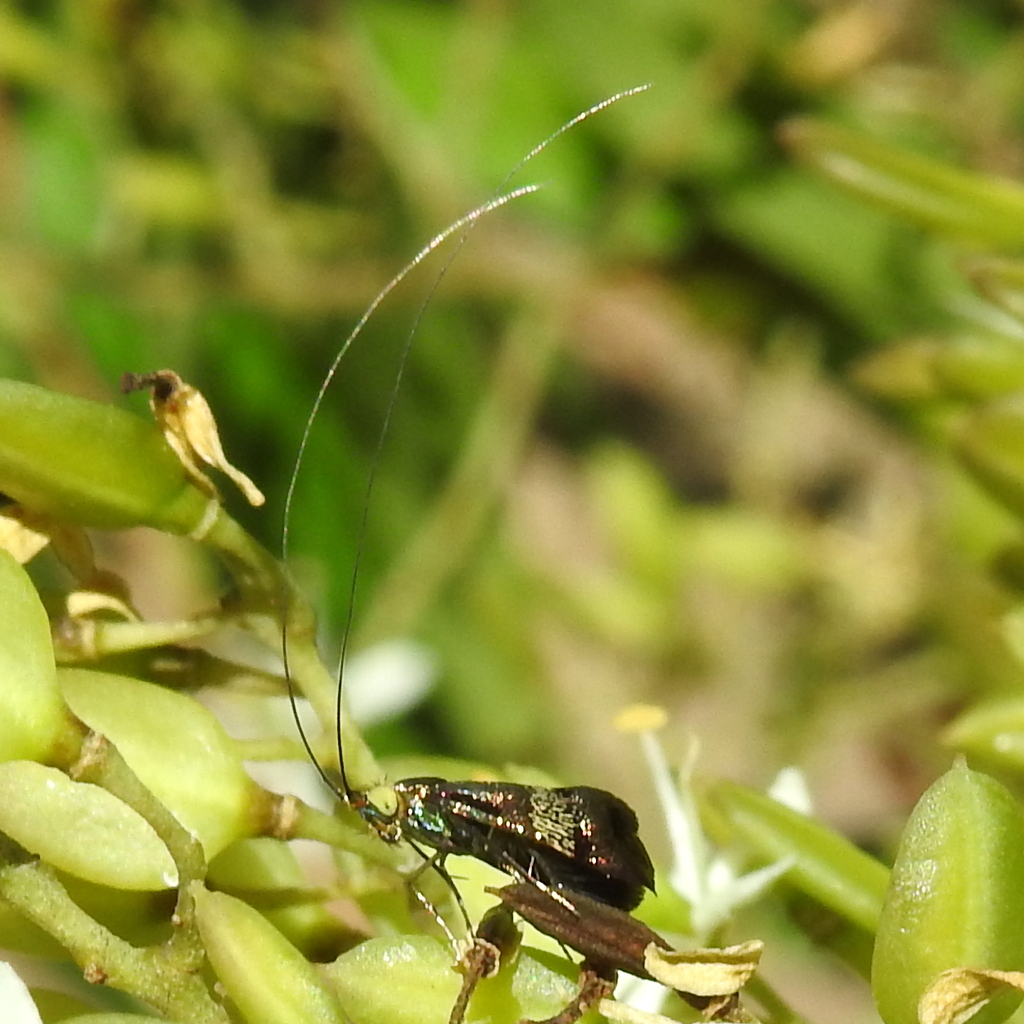
This Fairy Moth is about 10mm long and is distributed along the eastern Australia from Tasmania up to southern Queensland. The forewings are metallic purple in colour with a transverse gold band. The alternative name is Longhorn Fairy Moth because the antennae length in the males is up to 3 times the length of the wings.
So if you see a shimmering in your garden out of the corner of your eye it’s probably a Fairy Moth … or possibly something more magical.
Little Or Yellow
The two equal-smallest birds in Australia are the Weebill and the Yellow Thornbill. In fact, the Yellow Thornbill (Acanthiza nana) used to be called the Little Thornbill as it is fractionally smaller than the other thornbills. And since it has practically nothing else to distinguish it, no stripes or eyebrows or wing-bars, it was called Little and then it was decided the name Yellow was more appropriate. It is yellowish but not as yellow as, say, a Golden Whistler or Yellow Robin; it can appear brownish- or greyish-yellow. The best distinguishing feature is the lack of any distinguishing feature.
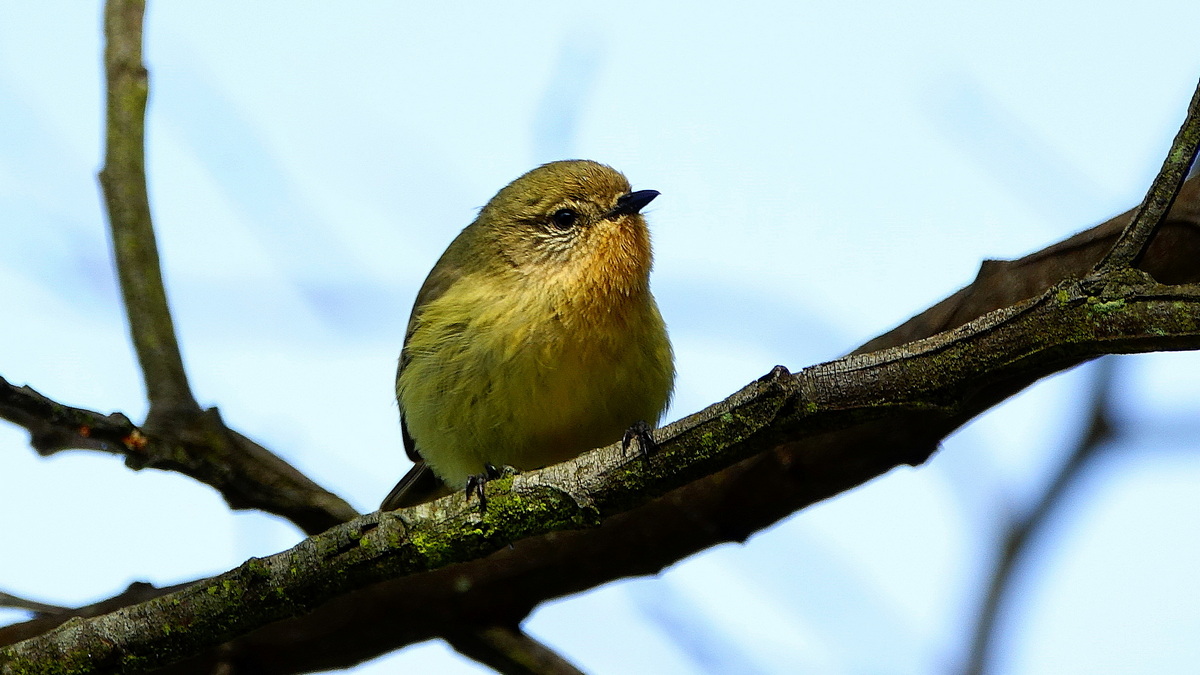
This is a thornbill that is only seen in trees – never on the ground. Furthermore, I recently learned that their preference is for Wattle trees rather than eucalypts. They like the feathery-leaf types, like Black or Silver Wattle.
They are often found in Yea Wetlands (in the wattle trees!) and are possibly common in the area. But they are thornbills after all – small active birds in the canopy – and hard to distinguish at a distance. They are also hard to photograph and I felt very privileged to get these photos when I located a small group that locals said are always around this particular copse of wattles.

Small. Unobtrusive. Plain. No distinguishing features. This is not going to be on anyone’s list of favourite birds but they are ours – endemic to south-eastern Australia. They are unique to this part of the world.
Japanese Visitor
Today’s topic features a bird that is rare in our district, but then it is rare nearly everywhere. The Latham’s Snipe (Gallinago hardwickii) with striking stripes and a long beak flies to Australia from Japan each Summer and feeds along grassy waterways and edges of swamps and lakes.
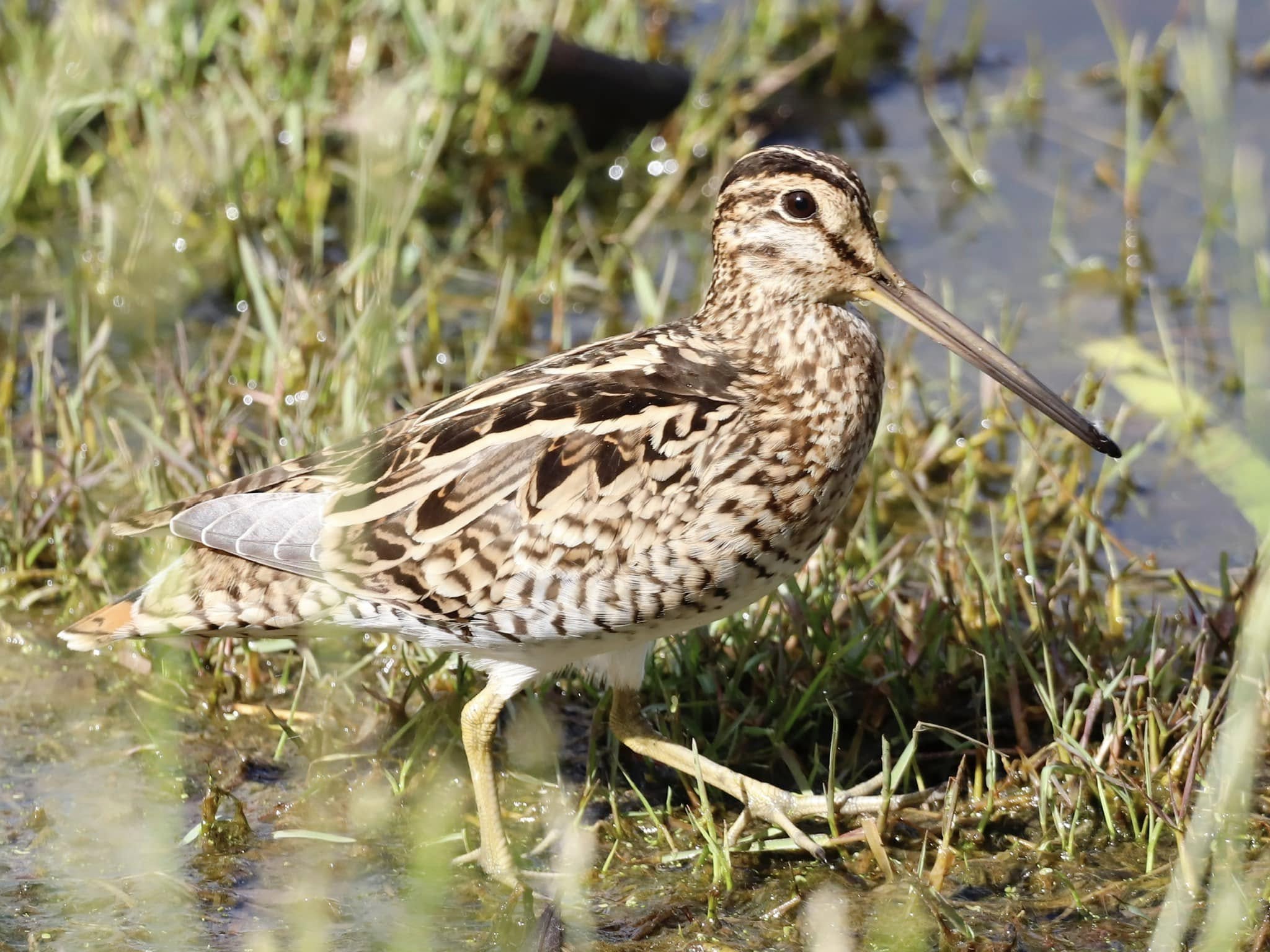
They are a shy and cryptic bird. Usually, they spot you … well before you spot them. Once you get within about 20 metres or so they are off in a zig-zagging whirr. It was considered a great skill to shoot them in the old days before hunting was outlawed. Their eyes are strategically placed to enable them to see up and behind almost as well as ahead.
I saw one up Deepdene Rd in a wetland overflow. That’s typical: a bit of water, a lot of grass, sometimes on mudflats probing the mud with that strong beak. This summer there have been reports of significant numbers of Latham’s Snipe in some wetland areas; it’s a good year for them. So I hope more are found in the district this year.
Latham’s Snipe are non-breeding visitors to Australia, tripping down to the south-east of the continent from their breeding grounds in Japan and Russia. It’s a remarkably long trip, and one female was fitted with a tracking device. She flew three days non-stop from Japan to northern Australia.
The birds leave again to head north in late February/early March, arriving back in their breeding grounds in Japan and far-eastern Russia by April/May. The entire global population, estimated to be somewhere between 25,000 and 100,000 individuals, is thought to visit Australia during our warmer months.
It’s always magical to spot a snipe. There are even rarer ones on our continent – Painted Snipe, Pintail Snipe – but this one (that you are most likely to see) is distinguished and rare enough to be greatly rewarding.