Who’s calling?
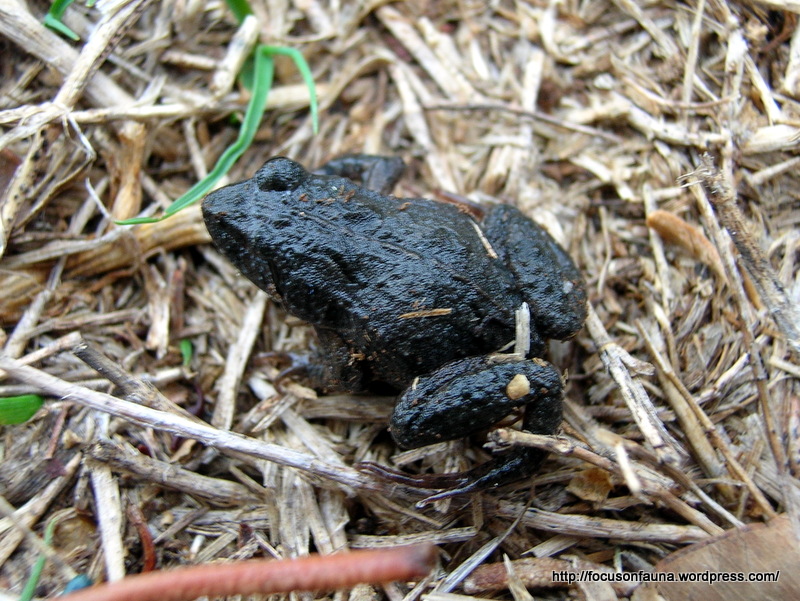
Bibron’s Toadlet ?
So we have yet to find the ubiquitous but cryptic Victorian Smooth Froglet. However, we did find the dark frog pictured above, which in the blown-up image doesn’t seem particularly small, until you see the comparison with a 5 cent piece in the photo below. We think (but are happy to be corrected) that it is a Bibron’s Toadlet (Pseudophryne bibronii) because of the coarse black and white marbling on its belly and the boomerang-shaped ridges on its shoulders, features typical of a Bibron’s Toadlet. It did tend to hop though, whereas Bibron’s Toadlets are reputed to prefer walking to hopping.

Anyway, we had a call but no frog, and a frog but no call! Further investigation however revealed that in amongst the numerous Victorian Smooth Froglet calls, there was an occasional short ‘cre-e-ek’ that seemed to correspond roughly to the field guide description of Bibron’s Toadlet’s call.
The audio below gives the VSF’s call, both individually and collectively, followed by what we assume is the BT’s call recorded at the wetland.
For more information on these notoriously secretive frogs, and indeed on all Victorian frogs, go to http://frogs.org.au/frogs/of/Victoria/
The Goulburn Broken Catchment Management Authority, in partnership with Museum Victoria, has developed the iSpy Frogs app which covers 20 frogs found within the Goulburn Broken Catchment. It is currently only available for Apple iPhone, iPod and iPad devices and can be downloaded free from the App Store.
The big and the small of it
 Beetles belong to the order Coleoptera (from the Greek koleos meaning sheath and ptera meaning wing). The name describes the two hard wing covers that protect the flying wings underneath. The Coleoptera make up more than 30% of the total number of animals on earth. So you would expect they would come in all different shapes and sizes.
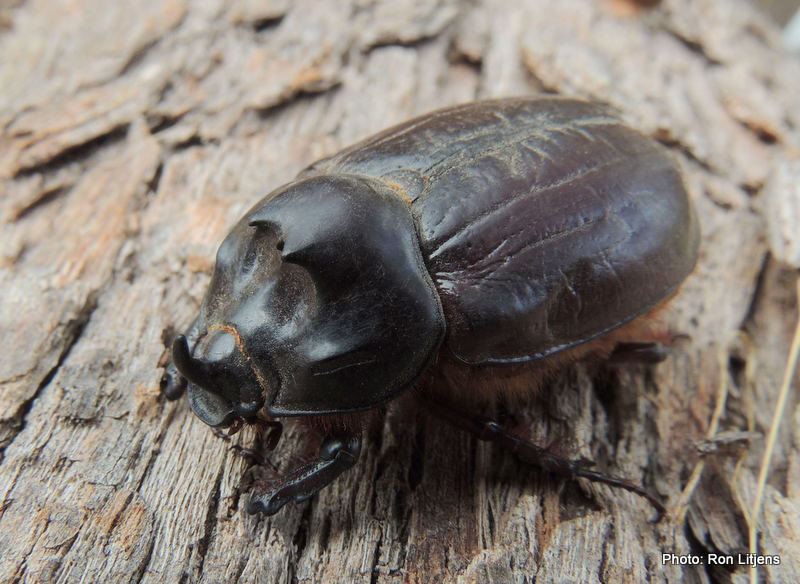
This was evident when I was riding my bicycle recently and was hit in the helmet by a Rhinoceros Beetle (Dasygnathus trituberculatus), (pictured above), a member of the Black Scarab family. At over 3 cm long it is not the biggest beetle around, but it is large enough to give you a loud thump on the head. The male beetles have a single horn on the front and two forward-facing horns on the thorax. The horns are used for digging and for fighting other males during the mating season. These beetles, gram-for-gram, are some of the strongest animals on earth in terms of load-carrying ability.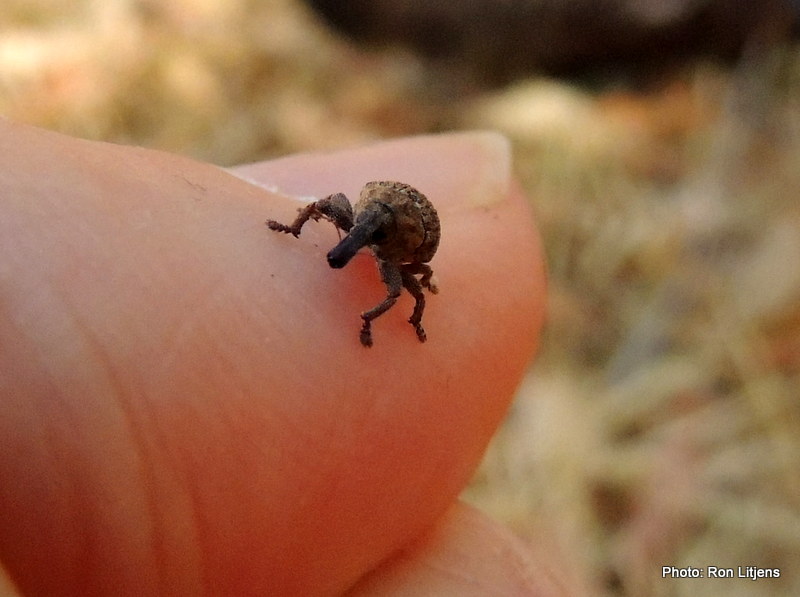
Compare that to the weevil (species unknown, pictured right) that invaded our picnic a couple of days after my bicycling encounter. At barely 2 mm long, this weevil is one of over 60,000 species worldwide. Weevils are herbivores — which is why you might have found them frolicking in your flour canister. So when I found this critter on my sandwich, it was a relief to know it wasn’t after the salami. That’s my favourite bit.
How much can a koala bear?

Forget Pink. I prefer the classics…maybe Mussorgsky’s Night on Bare Mountain
When it comes to listening to the music of Pink* it seems a koala can’t bear much. Driving up Junction Hill at lunch-time with the CD system in the truck playing (too) loudly I noticed a wombat-like creature hitch-hiking on the road ahead. As I got closer it proved to be a Koala (Phascolarctos cinereus), (derived from the Greek words phaskolos meaning ‘pouch’ and arktos meaning ‘bear’, and the Latin word cinereus meaning ‘ash coloured’). It didn’t appear too perturbed until I wound the window down. The dulcet tones of Pink seemed to give it fright and it didn’t stop galloping until the music was switched off. Then it proceeded to climb a tree and sat there looking at me.
Koalas feed mainly on eucalypts but will eat a wide range of plants in conjunction with their gum-leaf diet. In the Flowerdale area the main food sources include Victorian Blue Gum (Eucalyptus globulus ssp. bicostata), Manna Gum (E. viminalis ssp. viminalis) and Mountain Grey Gum (E. cypellocarpa). If you want to know what they eat where you live, check out the Australian Koala Foundation website (www.savethe koala.com/about-koalas/trees-koalas). The foundation has issued a National Tree Protection List by region that outlines the trees koalas prefer in your ‘hood.
As koalas spend the major part of the day sleeping and are usually only active at night when they feed, seeing one moving about in daylight hours was a real treat even if its grasp on pop music was questionable.
*Pink is a R&B/pop musician named by Billboard magazine as the #1 pop musician of the decade. Still no idea? – you need to get out more.
Kite flying

Whistling Kite

The whistling kite can sometimes be confused with the similar-sized Little Eagle – for instance there was some discussion and consultation with experts before the bird in a previous post (see HERE) was positively identified as a Whistling Kite. As well as a different under-wing pattern, Whistling Kites have a longer, more rounded tail and a less robust appearance. The kite’s body plumage tends to be more uniform in colour than the eagle and it lacks the barring across the tail that the Little Eagle has.
The bird pictured appears to be immature, as shown by the spots on the upper wings.
Whistling Kites are of course a lot easier to identify when they are actually whistling – a very distinctive call that can be heard by clicking on the arrowhead of the audio bar below.
To all the unbelievers
For all those who thought the recent photo of the Rakali (Hydromys chrysogaster) in our dam (click HERE to view) was one of:
a. a teddy bear being pulled through the dam on a piece of string (as if)
b. a cushion with a black button sewn on it, similarly being pulled through the dam on a piece of string (double, as if)
c. a funny (Rakali-shaped) floating log
d. a cosmetically enhanced otter
e. anything other than a genuine, true-blue, Australian Native Water Rat,
these photos are for you.

A cushion I am not

Pick a Box
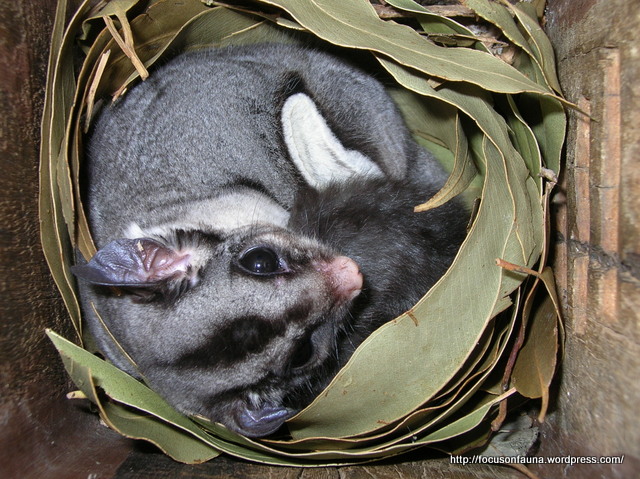
Sugar Glider
Inspired by Ronlit’s recent post It’s back!, and with the first frost of the year the other night, we thought it was time for a maintenance check on our fauna nest-boxes, and an inspection for any occupants. This proved to be a rewarding experience – of the 13 boxes we have installed, 6 were occupied by Sugar Gliders (Petaurus breviceps) and a seventh had a well-constructed Brush-tailed Phascogale (Phascogale tapoatafa) nest of shredded-bark with lots of fresh scats (droppings) and a strong smell, so probably had a phascogale in residence.
The boxes are of various designs with different sizes, shapes and entrance-hole location and diameter. The Sugar Gliders don’t seem to be too fussy, as long as there is a warm dry space inside. However, if you are considering installing nest-boxes, it pays to do it right. There is some really good information on nest-boxes in a pamphlet available from the Strathbogie Ranges-Nature View website as a pdf download called Nest-box Know-how which was developed from a forum at Violet Town last year .
The occupied boxes are shown below with their corresponding occupants. Several of the boxes, some made by Rotary, were donated following the Black Saturday fires.
-
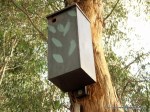
- A well-used (and badly decorated) glider box
-

- A jumble of Sugar Gliders
-

- Glider/phascogale box
-

- Typical Sugar Glider cup nest of eucalypt leaves
-

- Home-made box designed for treecreeper or owlet nightjar
-
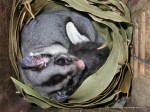
- Sugar Glider
-
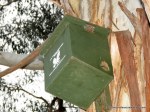
- Well-designed glider/phascogale box provided by La Trobe Wildlife Sanctuary
-
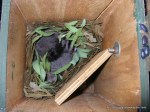
- Sugar Glider – note entrance hole behind baffle
-
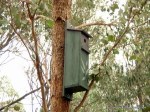
- Glider/phascogale box
-
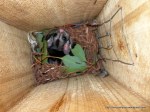
- Sugar Glider – note wire ladder to help the glider exit
-
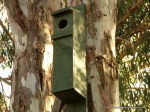
- Box designed for rosellas
-

- Sugar Glider and remains of former rosella occupant – who needs leaves?
-

- Specially designed phascogale box with rear entrance and baffle
-

- Brush-tailed Phascogale nest – the entrance baffle is obscured
To B(arbed wire) or not to B(arbed wire)

What a way to go
Moving to a rural community one becomes very much aware of the raging debate about the use of barbed wire in fencing. It seems that farmers are pro-barbed wire as it is said to deter livestock from pushing through fences. On the other hand, there are those who posit that many a possum or sugar glider has been shredded by the dastardly invention. As I have no personal experience of either, I have reserved my judgement and sat on the fence (a non-barbed-wire one of course).
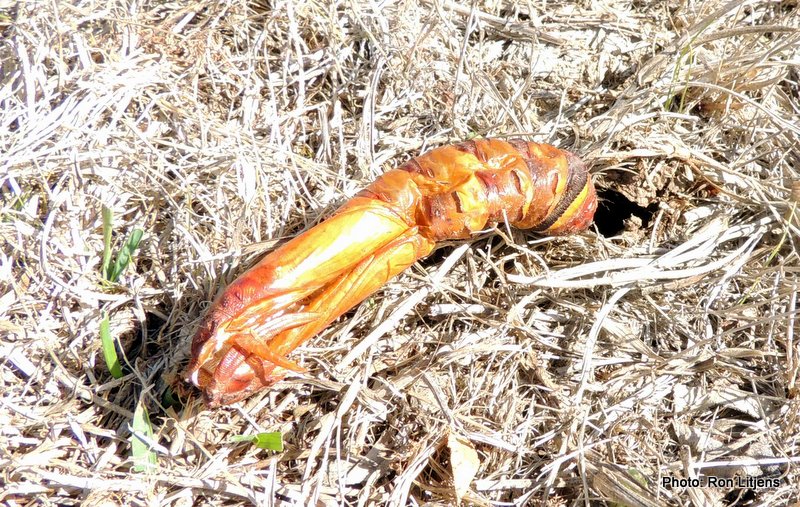
Empty pupal case
However…walking along our perimeter fence I have just found in the space of several metres not one but two Rain Moths (Trictena atripalpis) hanging lifelessly, hooked through the abdomen by barbed wire. Rain Moths are so called because the adults emerge from their pupal stage after rain. At this time of the year you can see the abandoned pupal cases sticking out of the ground.
Some will say that they are only moths. All I know is that when I eventually depart this place I hope it is not by hanging upside down, skewered through the stomach.
To B or not to B. It’s still the question.
Homing huntsmen …not a story for arachnophobes!!
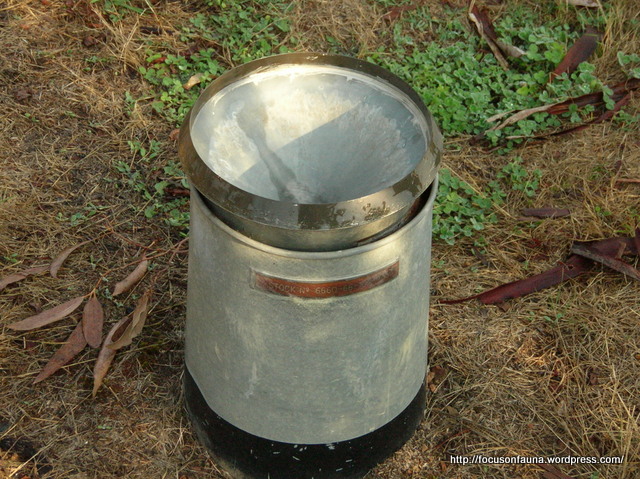
Standard rain gauge and spider home
Being the local rainfall observers for the Bureau of Meteorology can have some little hazards now and then. What may just look like a standard rain gauge pictured at left is in fact home to a family of aptly-named Social Huntsman spiders (Delena cancerides). On lifting the lid to read the gauge a few weeks ago we noticed dozens of small pale spiders living inside the gauge, together with some larger reddish-brown ones.
In deference to the feelings of one of the observers (the resident arachnophobe), the spiders were carefully relocated to some timber on the ground a few metres away. When the gauge was checked the next day, there they were – back again! This time they were relocated to a flaky-barked Yellow Box tree a bit further away, thought to be ideal habitat. But, you guessed it, the next day – homing huntsmen, albeit in reduced numbers!
So, we have now accepted the situation – the spiders have grown, are less flighty and are down to about six – and we are down to just one on rainfall-recording duty.
-
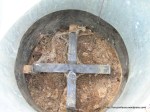
- Ideal spider habitat showing an egg sac and some shed skins
-

- Typical spider egg sac
-
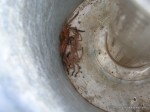
- Huntsmen socialising
-

- Social Huntsmens’ ability to flatten their bodies allows them to fit in small nooks and crannies such as under bark
-
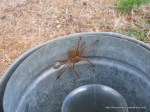
- Adult huntsman
-

- Large adult huntsman
The Social Huntsman is endemic to Australia. It is one of 94 described species of ‘Huntsman’ spiders in the family Sparassidae. Its gregarious habit is somewhat rare in spiders. For more information on huntsman spiders from the Australian Museum click HERE.
It’s back!

Australian Owlet-nightjar
By now you are probably all sick and tired of reading about the rosella nest box in the tree next to our deck. Recent posts have described the departure of Chubster the Common Brushtail Possum (click HERE) simply because it became too large to fit through the entrance hole of the nest box. Chubster’s departure was followed by the arrival of two Common Ringtail Possums (click HERE to view post). Their tenancy was also short-lived as the box proved to be too hot for both of them together over the summer. It did however provide hours of endless fascination as we watched the tossings and turnings of the two possums within the box trying to keep cool. About a month ago they too moved out.
This week we noticed a familiar face peering out of the nest box opening…that of an Australian Owlet-nightjar (Aegotheles cristatus). One had been the resident of the box 2 years ago. When it left we placed two smaller Owlet-nightjar-specific nest boxes in the nearby trees with the hope of attracting it back, but to no avail. These nocturnal birds have been around as we have heard their distinctive call (click on the arrowhead in the audio bar below to hear one example of its call). Now it’s back, obviously preferring the more spacious abode offered by the rosella box. This bird is a little smaller and a little browner than the previous incarnation.
So if this continuing saga is not boring you and you want a piece of the excitement, install a nest box around your place where you can view it easily. You never know who your neighbours will be.
That’s not at all what we expected

Rakali
We returned home from a two-week trip last night and decided to wander around the property in the forlorn hope that the Powerful Owls had returned for another season. Alas, not…yet!
My approach to one of our dams precipitated a sudden splash followed by a trail of bubbles across the water surface. Even though I have seen Common (Eastern) Long-necked Turtles in the dam before (click HERE to view previous post) their method of retreat is usually to silently slip below the surface, no splash nor bubbles, until the perceived danger has passed.
Thinking nothing more about it I continued walking but then noticed a flurry of activity on one of the branches of a submerged tree. And there it was, totally unexpected: a Native Water Rat or Rakali (Hydromys chrysogaster). Being mainly a carnivorous eater feeding on frogs, crustaceans, fish, aquatic insects and sometimes birds, I am surprised that our small dam could support such a creature.
In my haste to get a better photo I fell in the dam (saved the camera), which of course caused the Rakali to head for cover. I did manage to see its distinctive white tail as it crawled up the opposite bank and into a hole in the wall.
And to think, I spent many summer twilights sitting on the banks of the King Parrot Creek hoping to photograph a Rakali. It was probably waiting for me back at home.