Fish found near Flowerdale

Mountain Galaxias – photo by Rosta Buc
Rosta from Junction Hill, east of Flowerdale, sent us this picture of a school of small fish she noticed in a pond that forms part of an intermittent creek on her property (click on the photo for a better look). They were described as being about 90 mm long and very speedy, and she wondered if they were native Mountain Galaxias (Galaxias olidus). Joanne Kearns, a freshwater ecologist from the Arthur Rylah Institute, was able to confirm that they do indeed appear to be Mountain Galaxias, and it is not unusual to find them in pools along non-flowing watercourses. According to Jo they are actually very tough little fish; they can tolerate water temperatures up to 32 degrees Celsius and can survive several months (in the summer period) in isolated pools of water. Individuals have even been known to survive in wet mud at the bottom of a drying pool! So they are quite remarkable fish.
For more information on Mountain Galaxias click on the link to the Murray-Darling Basin Authority’s fact sheet below. One disturbing fact is that introduced trout pose a real threat to native galaxiids.
Blog to continue …


Apologies for the lack of new posts on the blog recently. The Focus on Fauna Fire Recovery Project officially ended with the “Final Fling” and film launch at Strath Creek in April (see post HERE). However, we plan to keep the Focus on Fauna website active, posting stories of wildlife recovery and general natural history interest in the fire-affected areas around Strath Creek, Flowerdale and beyond.

We will have a couple of new contributors to the blog:
Chris Cobern, the Upper Goulburn Landcare Network’s Fire Recovery Coordinator, who has been involved in the installation and monitoring of wildlife nesting boxes, and who has been recording many interesting images on remote cameras in the Kinglake Ranges/Toolangi area.
Ron from Flowerdale (Ronlit), who has, together with Kate, been an enthusiastic participant throughout the Focus on Fauna project, and who has provided many fascinating wildlife stories and images, particularly about the pair of Powerful Owls resident on their bush block (see HERE).

Foxhole?
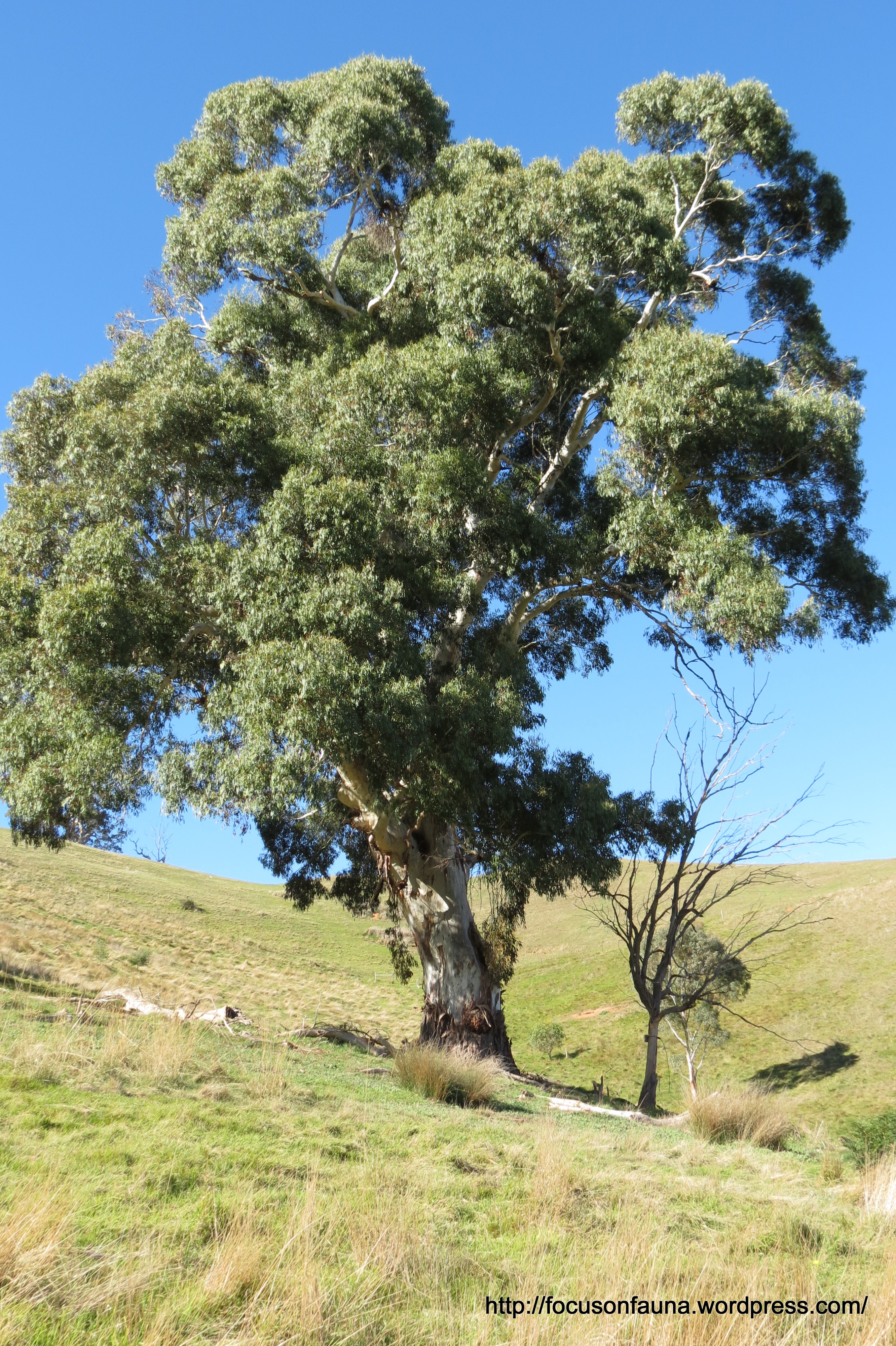
 This magnificent old Candlebark tree (Eucalyptus rubida) near Strath Creek is hollowed out near the base and has a long narrow opening about a metre above the ground, leading to quite a large level platform inside the tree. To see what animal(s) might be using the hollow, we set up a remote motion-sensitive camera on the trunk of a small dead tree nearby. The camera showed that the hollow is fairly regularly visited by a Red Fox (Vulpes vulpes), both at night and during the day. It is unclear yet whether the fox is using it as a den or just checking out the hollow for possible prey, although it is probably too low for most animals to feel secure. There is no obvious fox smell inside, and every time we visit the hollow, it is vacant.
The abundance of foxes in the district was highlighted during our Focus on Fauna surveys, when foxes were recorded at 17 out of the 22 properties where remote cameras were set up for week-long observations.
Bird-bath biodiversity
If you have been following previous posts on Ron and Kate’s bush block bird-bath at Flowerdale, you will know that they have recorded on a remote camera a wealth of visiting fauna. To add to the list of about 25 native birds, ringtail and brushtail possums, sugar gliders and a brush-tailed phascogale, not forgetting mice, rats and a frog, they now have a delightful new arrival – an antechinus, most probably an Agile Antechinus (Antechinus agilis). So the bath is clearly becoming a biodiversity hot-spot !
To see a close-up photo of the Agile Antechinus, have a look at the previous post Antechinus using nestboxes.
Some good news on ‘maccas’
Researchers from Arthur Rylah Institute have once again been monitoring the endangered Macquarie Perch (Macquaria australasica) in King Parrot Creek and have good news to report. Preliminary results show a tally of 54 Macquarie Perch at 6 sites, which is the highest number recorded since annual surveys began in 2006. The number is certainly well up on last year, when only 19 were caught.
The highest number of maccas was just downstream of Burslems Bridge (21), with a further 9 netted at the nearby “Callandoon” site. This stretch of creek has previously been found to be a major spawning site for the perch. Other survey sites along the creek from Flowerdale down to Kerrisdale all recorded significant numbers of Macquarie Perch. Most of the fish were around 200 – 230mm long (from 2 to 4 years old), but a couple of maccas were up around 40cm. One disappointing result was that only 2 juveniles were captured – it is not clear at this stage why there were so few, but it tallies with similar results in Hughes and Seven Creeks.
It was of great interest that two of the captured maccas were tagged fish that had previously been caught at the same location in 2010, and had grown well over 100mm in just 2 years! The ARI researchers are testing a new tagging method this year. This involves an external tag (see pictures in slide show) with a unique fish number as well as “DSE, REWARD” and phone number on it. If an angler catches a tagged fish, it is hoped it will be reported to DSE and there is less likelihood of the fish being taken illegally. To encourage reporting, the angler will be rewarded with a stubby holder or lure! The reported tag information can provide valuable data on fish growth and movement between survey periods.
Other positive results from the surveys were that no carp were found upstream of the Goulburn Valley Highway, and 2 platypus were recorded. Unfortunately the survey team also found illegal nets set in the creek as well as a considerable amount of abandoned fishing line.
A timely reminder here that this once-widespread fish is now confined to a few isolated populations and is a threatened species. It is strictly prohibited to take Macquarie Perch from all Victorian waters, except Lake Dartmouth, the Yarra River and the Upper Coliban Reservoir.
Film Launch & Final Fling
On Friday 13th April, Focus on Fauna held a ‘final fling’ at Strath Creek to celebrate the end of the project and launch a short film. In somewhat of a party atmosphere, about 70 people joined us to watch the film and be treated to a fascinating presentation on Powerful Owls by local enthusiast Ron Litjens.


You too can watch the video below. The download size of this video is 280 MB.
Enjoy
Further remote camera images and photos sent in by community members can be viewed below.
Creeping, crawling, buzzing …

Hawk Moth caterpillar - photo Kay Granter
Some small critters have been brought to our attention recently, including this large caterpillar photographed at Strath Creek by Kay, whose daughter and dog seem to be equally curious. Our friendly and helpful moth expert Peter Marriott, author of the Moths of Victoria series of books, has identified the caterpillar as most likely that of a Hawk Moth, Psilogramma casuarinae. This species has only been discovered recently in the north of Victoria, too late to be included in Peter’s volume on Hawk Moths. The mature larvae can actually be either green or pink.
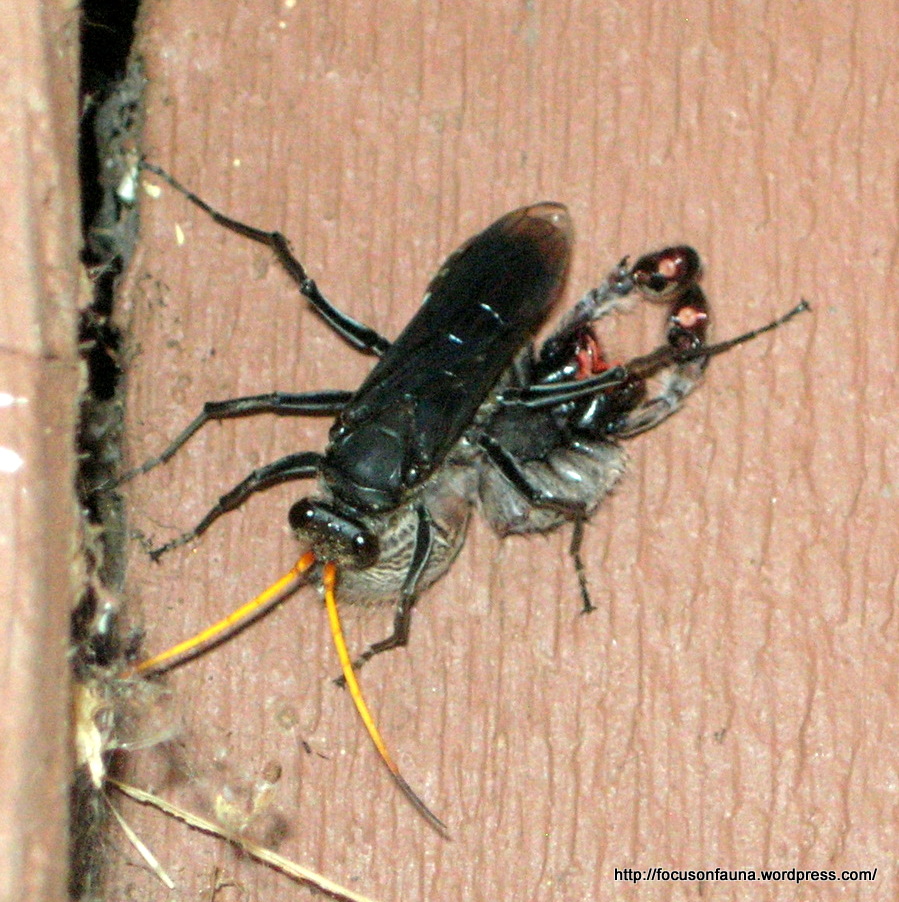
Black Spider Wasp - photo by Ron Litjens
We also received from Ron at Flowerdale a photo of a Black Spider Wasp, Fabriogenia sp. Ron informs us that they are solitary wasps, and soon after mating the female looks for a single spider on which to lay her eggs, while the males die !! In this picture, the wasp has cut off the spider’s legs, so that it can fit into the nest.

Foliate Jumping Spider - photo by Laurie Macmillan
Perhaps Ron’s wasp wouldn’t bother with the tiny Foliate Jumping Spider, Clynotis severus shown below, which was photographed by Laurie near Strath Creek, very bravely managing to overcome her arachnophobia!
Scarlet Robins calling

Male Scarlet Robin - photo by Ron Litjens
Scarlet Robins can now be seen and heard in farmland areas around Flowerdale and Strath Creek. They tend to move down from their higher, more forested summer breeding areas in autumn to forage in more open habitats throughout winter, where they can often be seen perched on fence wires.
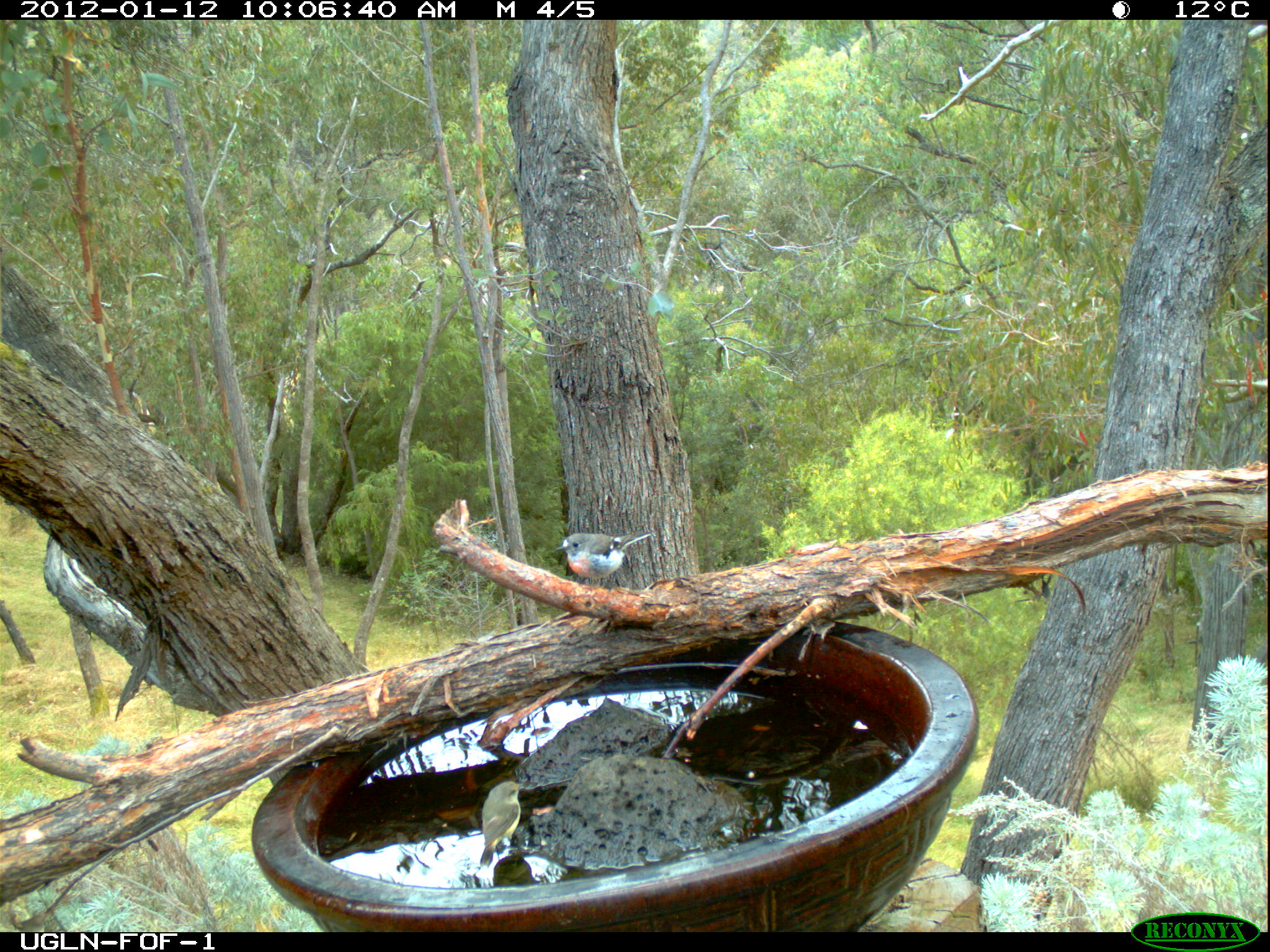
The picture at left shows the more colourful male. The somewhat duller female can be seen perched on a branch at a bird-bath in the remote camera image below – click on the photo for a closer look.
To hear the robin’s distinctive call, click on the arrow on the icon below.
An ancient owl & a spooky coincidence.

Owl, Chauvet Cave, France; 28-30,000 years old!
This is the oldest known human depiction of an owl anywhere in the world- about 30,000 years old! It comes from one of the limestone caves in southern France, inhabited by humans during the last ice age.
Last Friday, Friday the 13th of April, was the final fling for our Focus on Fauna project. Despite the ominous overtones provided by the date, the night was a great success. There’ll be more written about it later, but I thought I’d share this with you. The last presentation of the evening was given by Ron Litjens, about the recent fascination that he and Kate have developed for a pair of Powerful Owls that regularly roost on their property. Ron is collecting some really interesting data about the habits of this pair of owls and it was a thoroughly enjoyable talk – you can see some of Ron’s owl pics on previous posts on this site.
I got home late that night and only then noticed the image on the daily calendar we keep (above) – an owl on Friday the 13th, the night I’d just heard a talk about owls – spooky!! They are awake when we’re asleep, have silent flight, can rotate their heads through 360 degrees, their large eyes make them appear wise and they’re constantly asking the question “who?’. Little wonder that owls figure large in human mythology and Ron, and Kate, can take comfort in being part of a long tradition of humans being fascinated by these remarkable creatures.
For more about Chauvet Cave, the owl and the humans that lived there, you can ‘visit’ the cave and see the owl for yourself, or read about the cave on Wikipedia.
Falcons too …
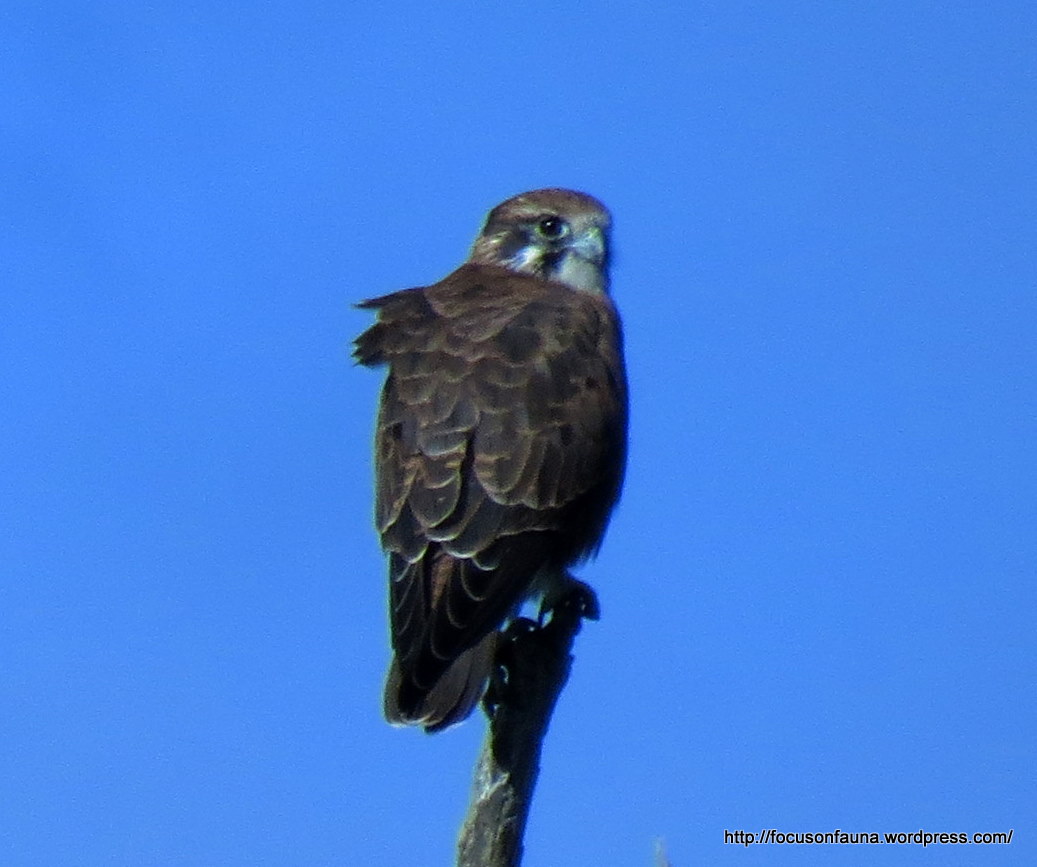
 Just to emphasise the value of isolated paddock trees, even dead ones, as perches for birds of prey, this pair of Brown Falcons was spotted in the same dead tree as the Black-shouldered Kite featured in the post “Top of the tree” on 29th March.





 Focus On Fauna