Koala at Flowerdale
 This Koala (Phascolarctos cinereus) turned up unexpectedly at a large Flowerdale grazing property last weekend. The property backs on to the Mt.Disappointment State Forest, and the owners have undertaken considerable revegetation work over the years to improve the connectivity of remnant habitat areas – to the benefit of this koala and other wildlife such as Sugar Gliders and Brush-tailed Phascogales, which have recently been recorded close by.
When disturbed, the koala hurriedly scrambled up a young Blackwood tree (Acacia melanoxylon), as seen here – not its preferred habitat! But there are large old Swamp Gums (Eucalyptus ovata) beside a nearby creek and Long-leaf Box (Eucalyptus goniocalyx) not far away, both species that are commonly used by koalas for food [Lee & Martin, The Koala – a natural history].
Brushtail Possum family at Strath Creek
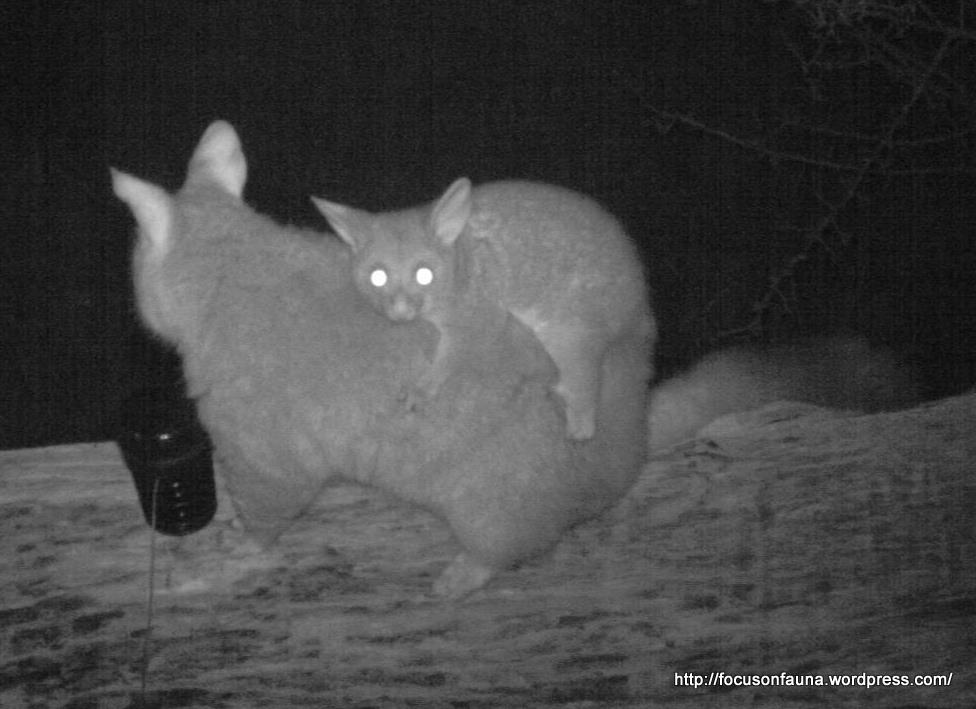 Two remote cameras set up on a steep burnt slope on a property just west of Strath Creek captured hundreds of night-time images of a family group of Common Brushtail Possums (Trichosurus vulpecula). The video clip below shows the female possum with her young riding on her back. It is noticeable from the lack of eyeshine that the mother has a damaged left eye.
After emerging from the pouch at 4 – 5 months old, a young possum stays close to its mother for another 2 months or more, often getting a ride like this, before becoming independent.
The video may take a few moments to load.
Wallaby fight at Devil’s Glen
The owners of the property featured in a recent post (see Wallaby life near Junction Ridge) have managed to capture this rare video footage of two male Black Wallabies (Wallabia bicolor) engaged in a ding-dong battle close to their house. It’s to be hoped there was no permanent damage to either of the contenders !
Video © Rick Clark
All that’s left of … ?
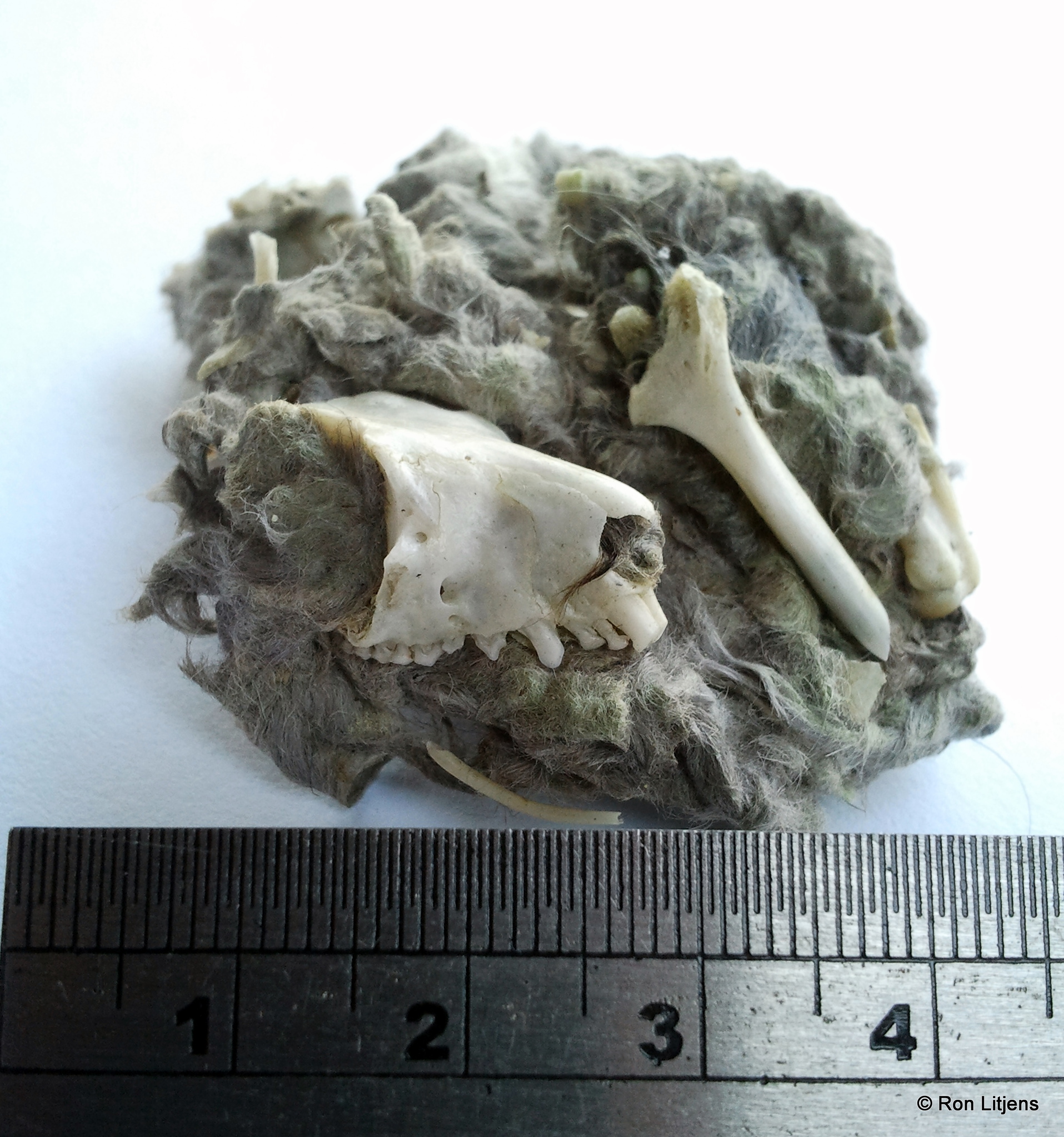 The Powerful Owls resident at the Junction Hill end of Flowerdale (see previous post HERE ) seem to have voracious appetites, judging from the whitewash and regurgitated pellets found by the landholders on the ground below the owls’ roost sites. The pellet pictured here shows that some prey are consumed whole, including the head!
Can anyone comment on what the skull and bones might belong to ? The scale shown is in centimetres.
Echidna mating season
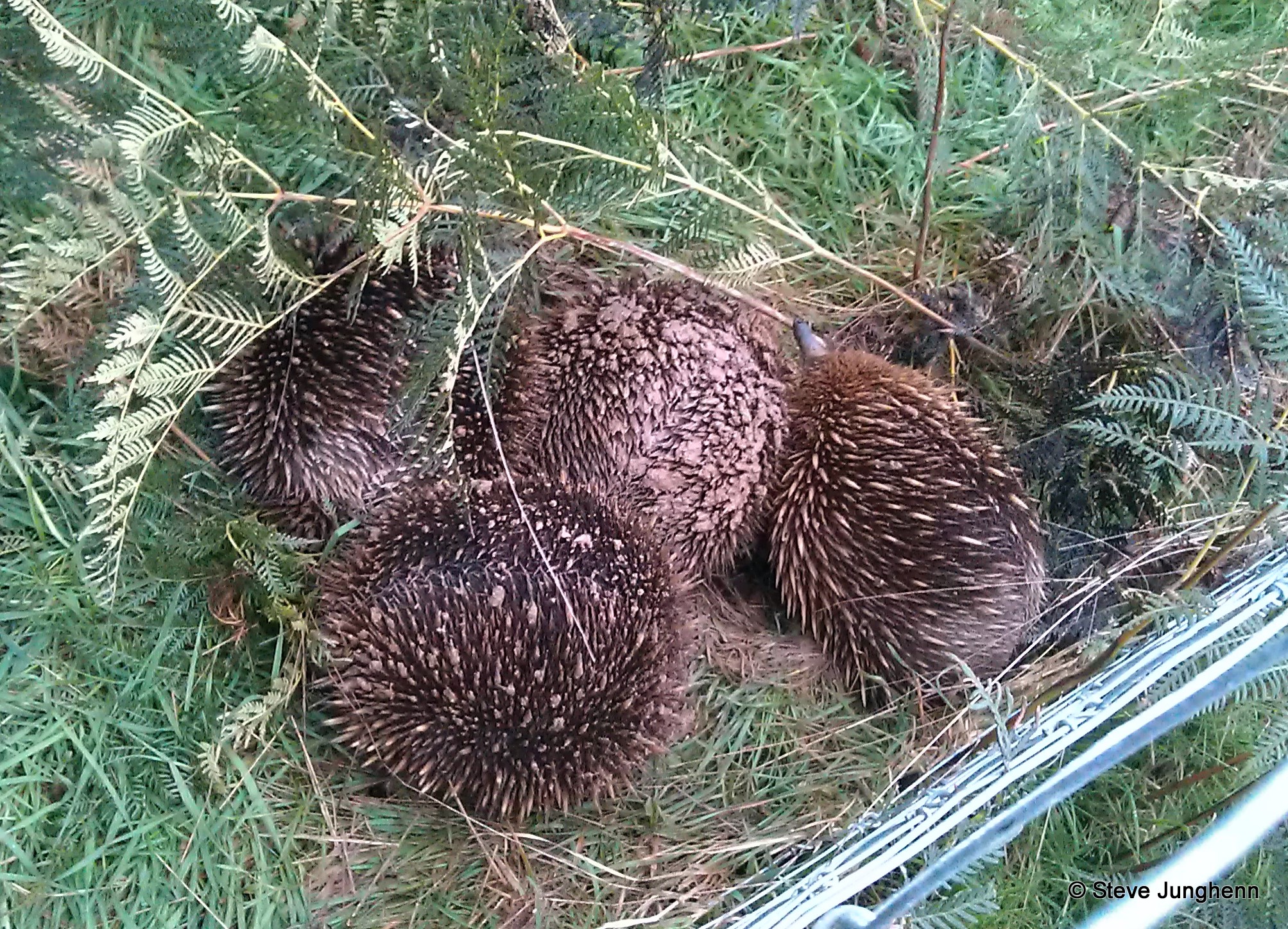 This photo, taken in early August at a property on Spring Valley Road, Flowerdale, appears to show a female Short-beaked Echidna (Tachyglossus aculeatus) surrounded by three males. During oestrus she may be followed for several days by the males. It is unclear whether she mates with more than one male, but after copulation she has no further contact with the males. She will lay only a single leathery-shelled egg.
Click HERE to see a previous post on echidnas at Flowerdale.
Wallaby life near Junction Ridge
 The Black Wallaby – also known as Swamp Wallaby (Wallabia bicolor) was the predominant species recorded recently by remote camera on a property on the northern slopes of the Yea Spur. The site is just beyond the northern extent of the Black Saturday fires, and has extensive areas of Red Box (Eucalyptus polyanthemos) woodland.
Several video clips of the wallabies are shown below – they may take a few moments to load.
Kangaroo activity at Flowerdale
 Over the course of a week, one of our remote cameras recorded around 1700 images showing the daily activities of a mob of Eastern Grey Kangaroos (Macropus giganteus) on a Flowerdale property off Moores Road. The site was obviously a regular haunt of the kangaroos, and the fallen tree where our plastic scent-lure was attached was right across their well-used trail.
The background shows the face of the hills that were burnt in the 2009 fires.
The videos may take a short time to load.
Nesting time
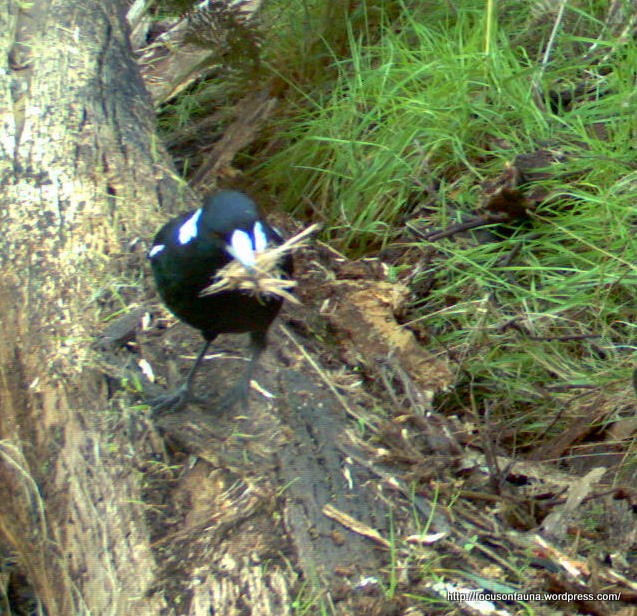 As well as allowing us to record a range of rarely-seen nocturnal animals, our remote cameras are also providing an insight into the ordinary day-to-day activities of some creatures – such as this Australian Magpie collecting nesting material.
From the camera’s time-stamp, it seems the magpie has a regular morning collection at around 9.30am from the same spot, and sometimes works an afternoon shift at this site as well.
It is always fascinating to watch and record nesting behaviour – any observations or comments would be welcome.
The video below may take a few moments to load.
Echidnas out and about
As shown below, our remote camera recorded one Short-beaked Echidna (Tachyglossus aculeatus) on 12th August, then a pair two days later, on a revegetated section of Fryers Creek, a tributary of King Parrot Creek. For echidnas, mating occurs between June and September, and they are normally solitary outside this period. Are these two just passing acquaintances, sharing a shelter site for warmth, which they sometimes do during winter, or can we expect an increase in local echidna numbers shortly ?
The video clip may take a short while to load.
More Owlet-nightjars
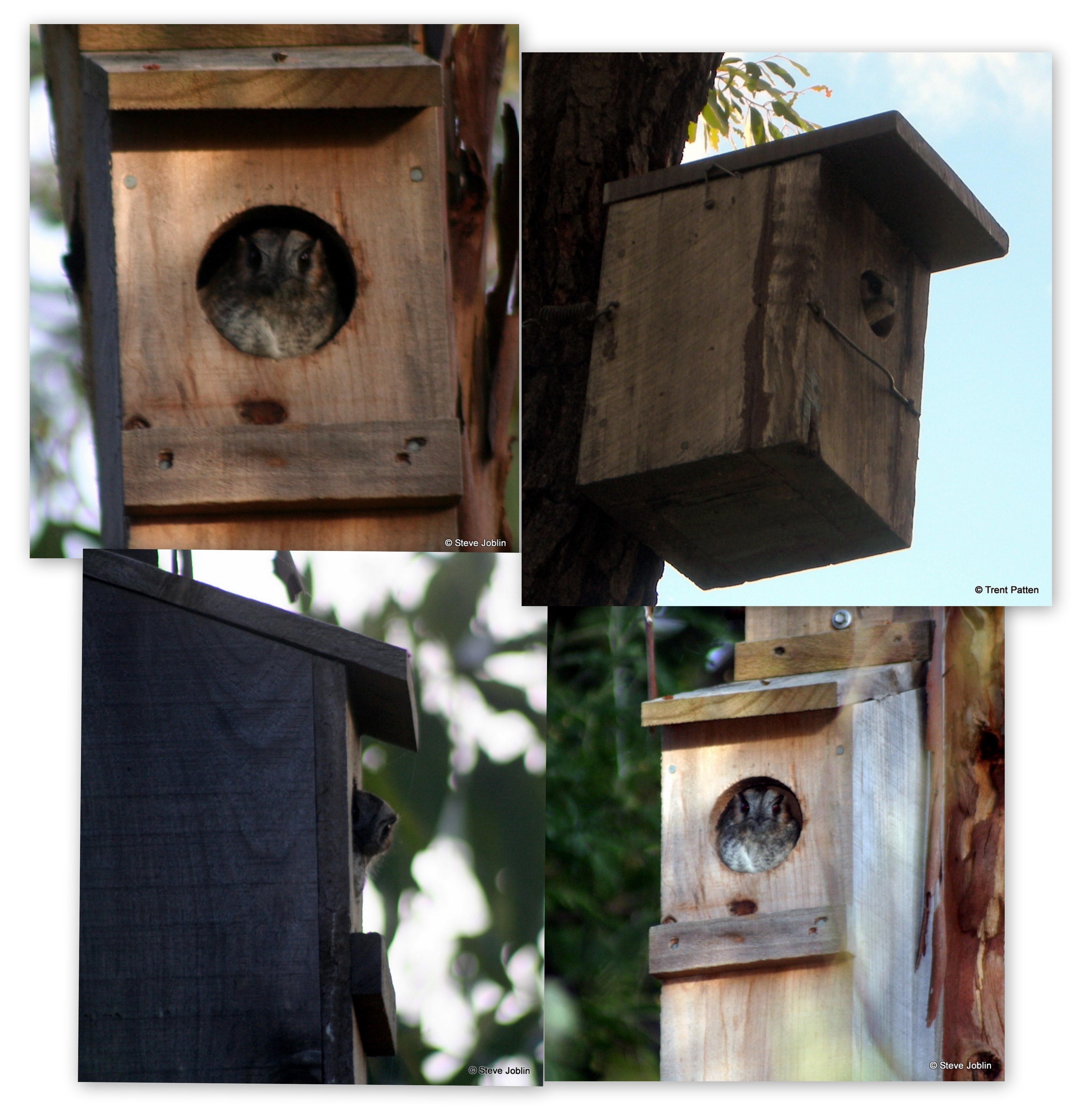 Reports keep coming in of Australian Owlet-nightjars in the Flowerdale/Strath Creek area. These engaging little birds have readily taken to roosting in nestboxes installed since the 2009 fires. Many natural tree hollows were destroyed in the fires, so artificial nesting sites would be much in demand by the many creatures that had previously relied on hollows for shelter. It will be interesting to see if the birds actually use the boxes for nesting in the upcoming breeding season.
These photos were taken at properties in Spring Valley Road, Flowerdale and Upper King Parrot Creek Road, Strath Creek.
Click HERE to see a previous post on an owlet-nightjar at Flowerdale.
For detailed information about the Australian Owlet-nightjar, and to hear its call, click the following link to the Birds Australia Birds in Backyards website.




 Focus On Fauna