Strike up the band…
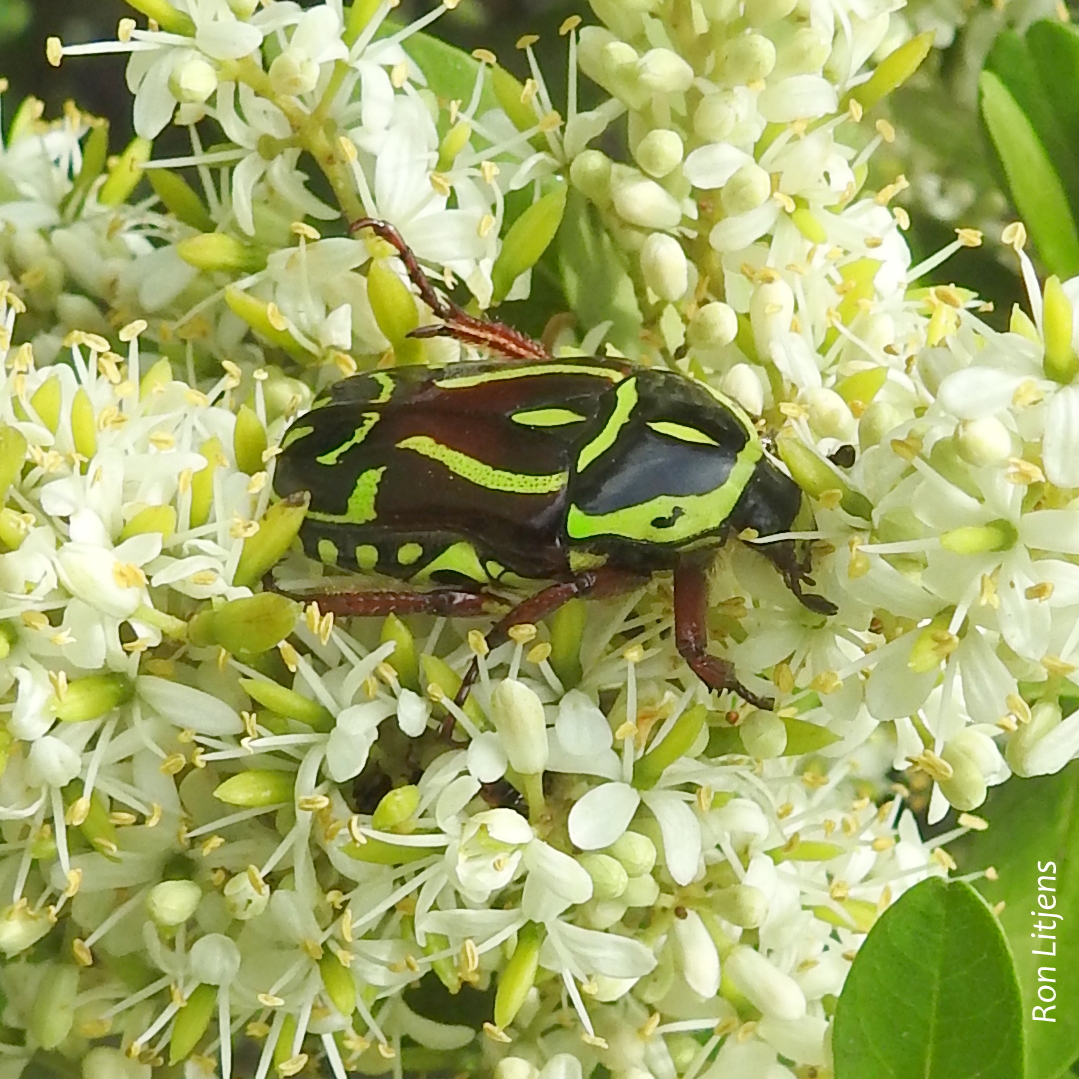 …the fiddlers are in town. Fiddler Beetles (Eupoecila australasiae), pictured left, are so-called because of the violin-styled motif on the hard outer wing cases, and are also known as the Rose Chafers. They are members of the Scarab family of beetles of which there are over 2000 species in Australia. Scarabs are probably better known as one of the sacred symbols in Ancient Egypt.
Flower Chafers, of which the Fiddler Beetle is one species, are a sub-group of the scarab family. The word chafer comes from the Old High German word chevar meaning gnawer and beetles such as cockchafers are notorious for eating the roots of grasses, thus destroying lawns.
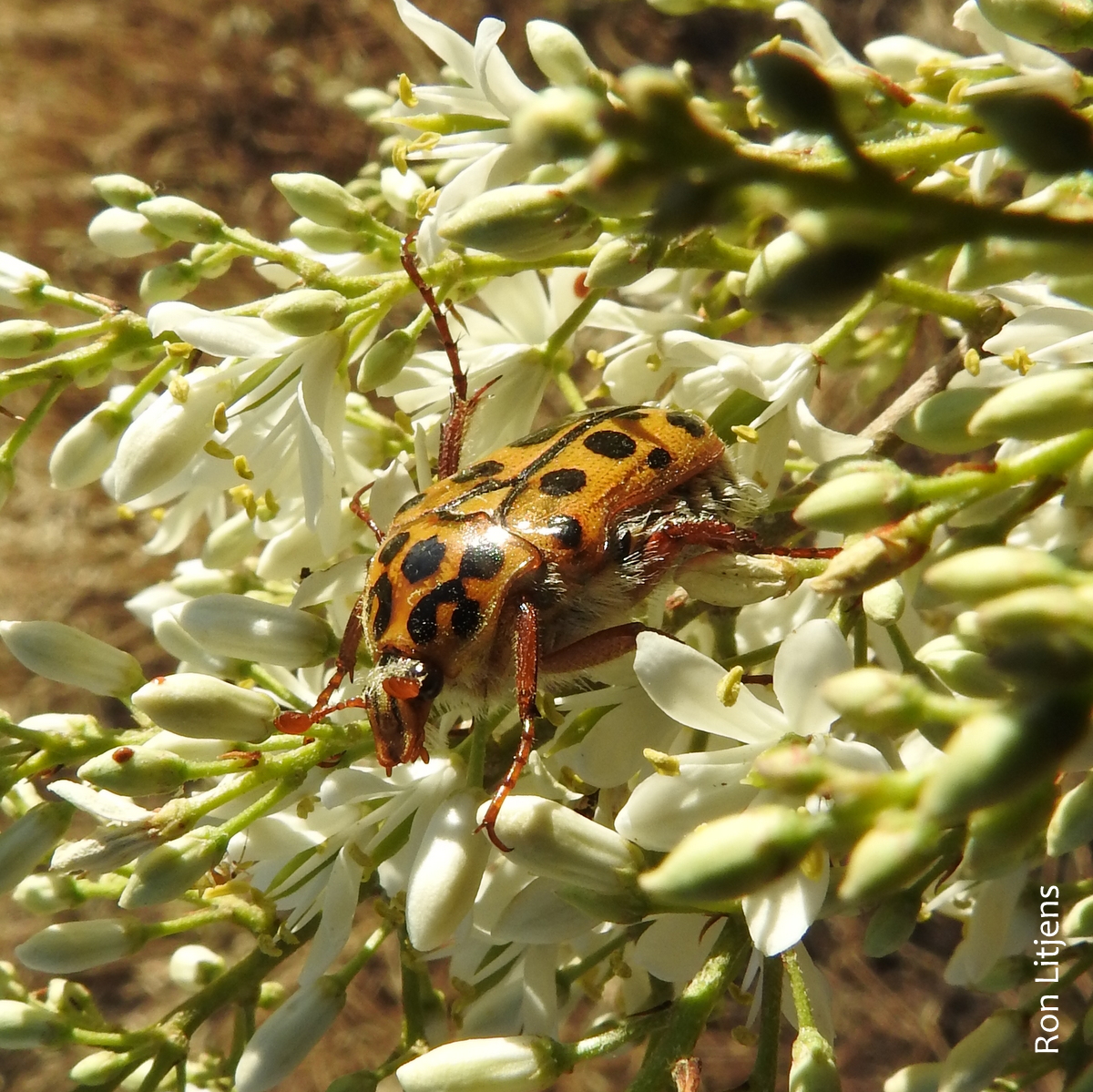 Most scarabs are nocturnal insects but the flower chafer group are daytime nectar feeders particularly on the flowers of Eucalyptus and Angophora and therefore are important pollinating species. They are also distinguished by flying with their outer wing-cases closed (most beetles open their outer wing-cases when flying). The pupae feed on decayed wood and emerge as adults in early summer.
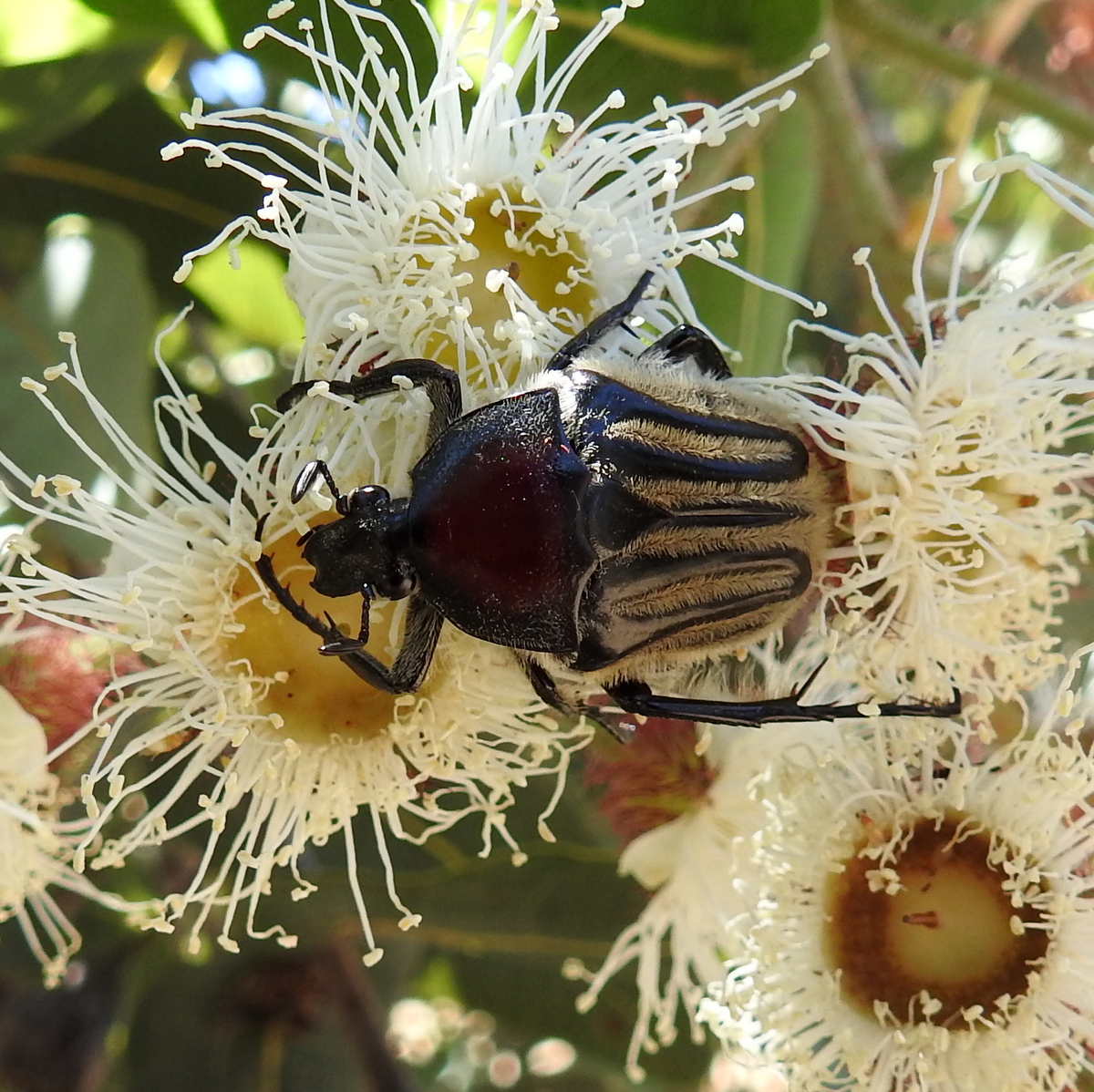
At this time of the year a number of flower chafers are active including Punctate or Spotted Flower Chafer (Neorrhina punctatum), pictured right, and the Grey-furrowed Rose Chafer (Trichaulax philipsii), pictured below left, most notable because the grey furrows are actually densely packed hairs on the wing-case.
And this time of year would not be complete without a mention of the Christmas Scarab (Anoplognathus sp.) pictured below. Not a flower chafer, it is a nocturnal feeder causing the characteristic shredding of Eucalyptus leaves, a serious problem when beetle numbers get out of control.
It is so representative of my Christmases as a kid, it should wear a red cap with a white pom-pom.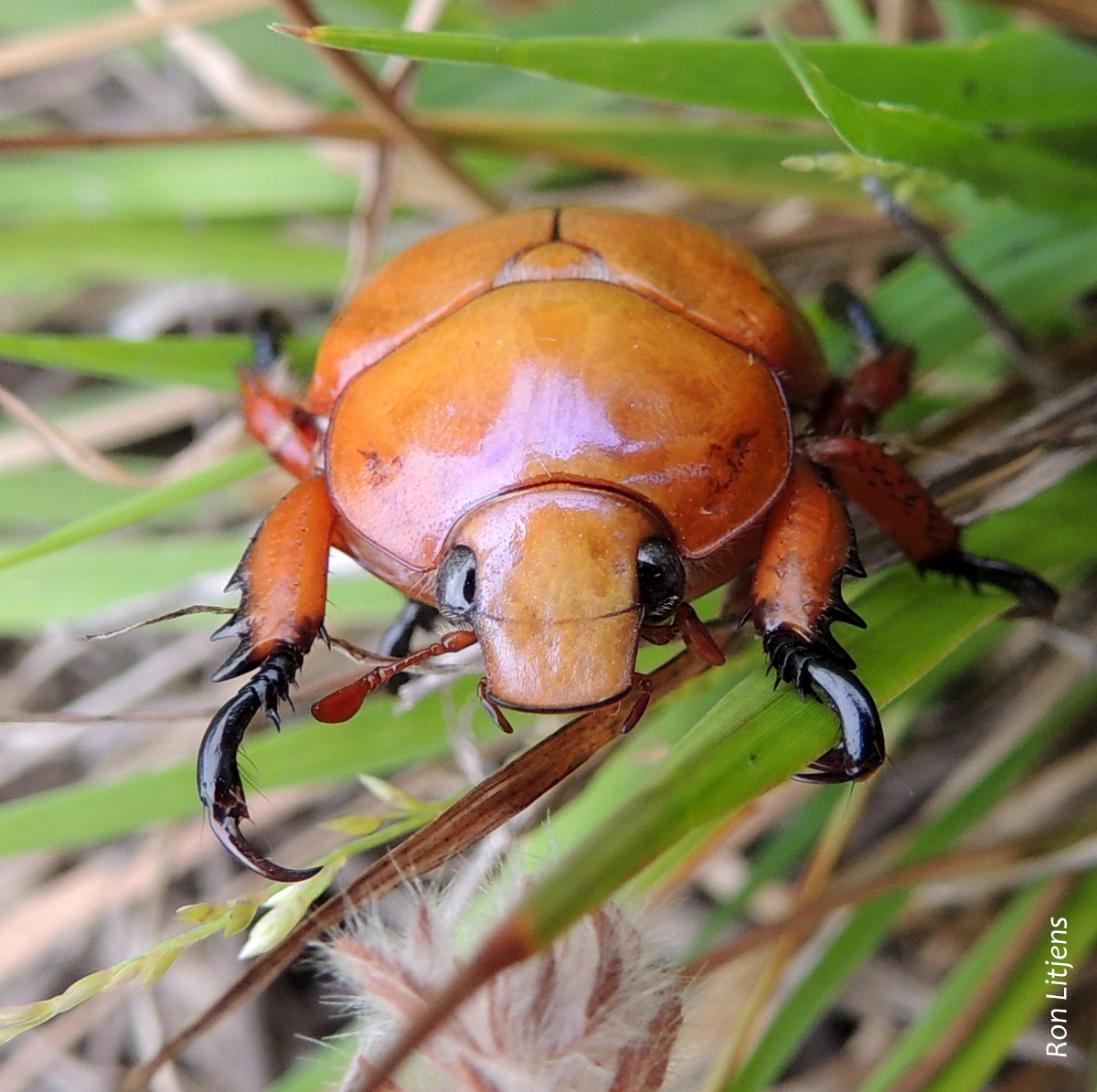
Call of the Wild
 When I was young I used to watch wildlife shows, particularly those set in Africa. I can still see the cheetah hiding in the long grass with nothing but its eyes and ears visible. And then with a burst of speed it would leap out and bring down some hapless eland.
The picture left depicts the same scene, but in the insect world. The labybird beetle, in this case a Transverse Ladybird (Coccinella transversalis) is eyeing off lunch (and probably dinner as well) in the form of aphids.
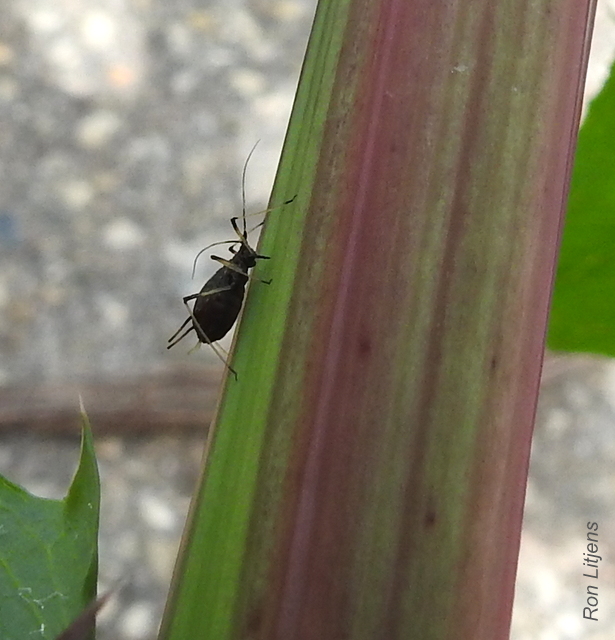 Aphids (pictured right) like cicadas and gumtree hoppers are sap-sucking insects. Many species feed on one type of plant only. Aphids are detrimental to plants in a number of ways – they suck the sap, they can transfer diseases between plants and they also produce a honeydew on which mold species grows.
For a number of reasons aphid numbers can increase rapidly. Sexual reproduction is not necessary for propagation. Females can produce live female nymphs in certain seasons thereby producing large numbers of aphids quickly. In other seasons the females mate with males to produce eggs and thus either male or female offspring. In addition, like gumtree hoppers some ants ‘farm’ the aphids offering them protection from predators in exchange for the energy-rich honeydew (pictured below left).
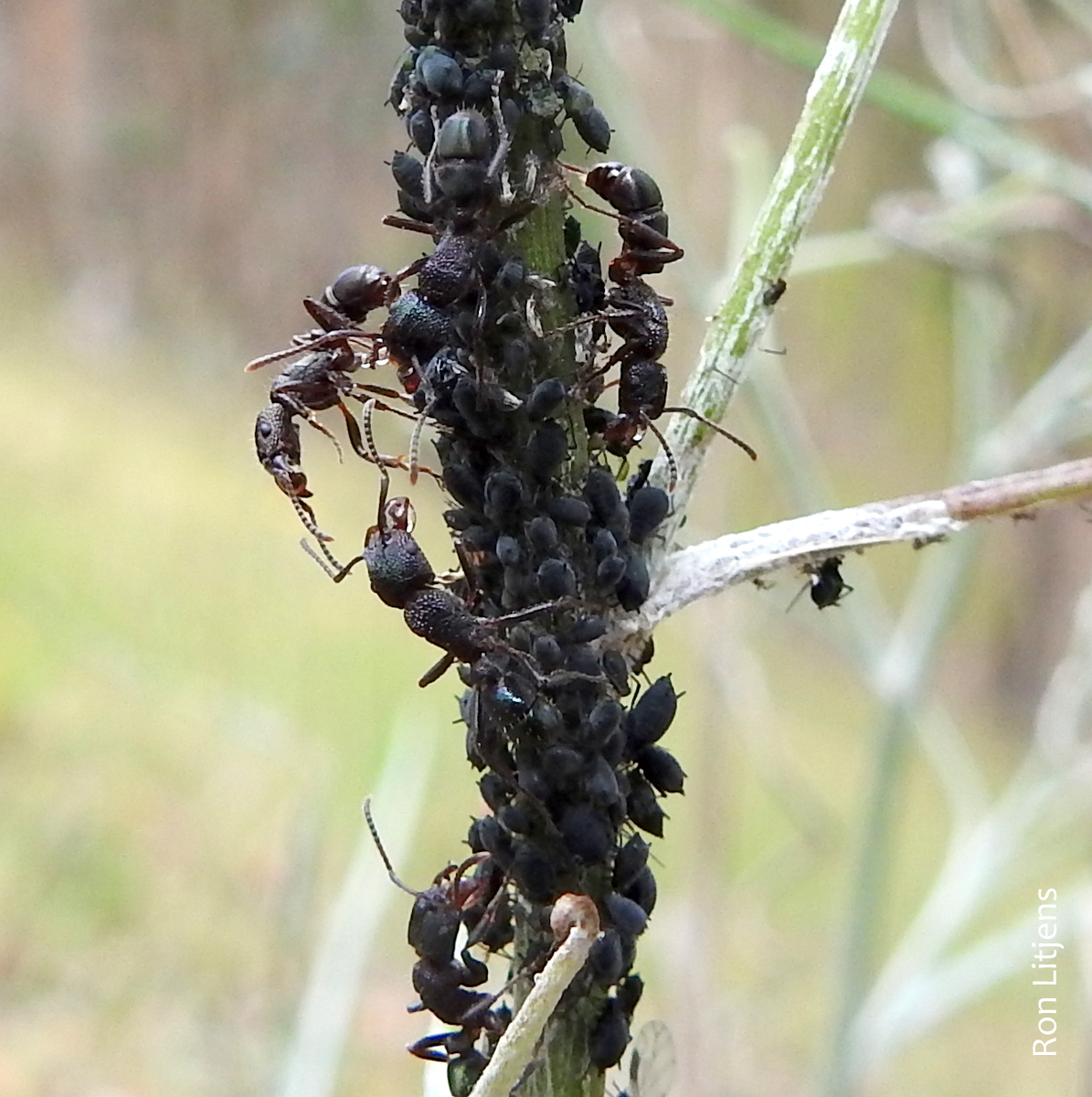 Luckily there are a number of natural predators to control aphid numbers. Adult ladybirds consume hundreds of aphids a week. Both ladybird and hoverfly larvae are voracious predators of aphids.
Unlike the cheetah you won’t see the ladybird pictured above hurtling towards its prey at 70+mph (even though it has two more legs). It will be more a casual stroll and then CHOMP.
A Piece of Aussie History
The Botany Bay Weevil (Chrysolopus spectabilis) pictured below, also known as the Diamond Beetle, is the first Australian insect to be described from the Cook expedition of 1770 (the species that is, not this particular insect). Only four other insects were collected on that trip.

 Botany Bay Weevils live exclusively on a few select wattles, several of which are found in the King Parrot Creek valley. The adults feed on the young leaves and the grubs live in the root system of the same plant.
As with other weevils I have photographed the response of this weevil when disturbed is to either drop off the plant and disappear into the long grass or cling onto something for grim death. Lucky it chose the latter…it’s easier to photograph.
Living in an original muddie
 An expedition with Sue to locate a White-faced Heron’s nest in the Strath Creek Pioneer Reserve yielded nothing, but on the way back we observed what looked like a mud nest of a White-winged Chough (Corcorax melanorhamphos) high up in one of the eucalypts. From our limited vantage point it was difficult to tell if it was from a previous season or this one. This week the tell-tale head of an adult looking over the nest rim (see picture left) confirmed an active nest site.
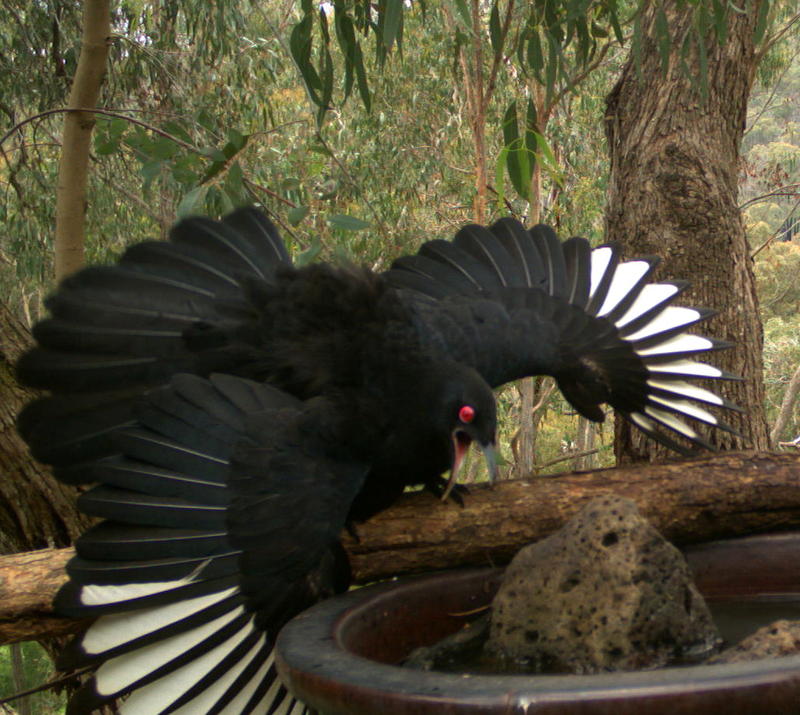 Choughs are ground-foraging birds that live in social groups of up to 20 individuals. Their diet mainly consists of seeds and invertebrates such as termites and beetles. At rest choughs are essentially black. The reason for the white-winged descriptor is obvious when the bird is flying or landing (see picture right). Choughs often get mistaken for the larger raven or currawong. Unmistakeable though are the red eyes of the adult which bulge when the bird is excited.
The nest is built of grass and mud or sometimes manure. From 3 to 5 eggs are usually laid by a single female in the group. Nest building is a shared group activity as is nest guarding and rearing the young. This is necessary as chick predation by birds such as currawongs is a major danger. The last time we documented a chough’s nest, three chicks survived in the nest.
We will update you as things progress this season.
Spare the fuzzy ones
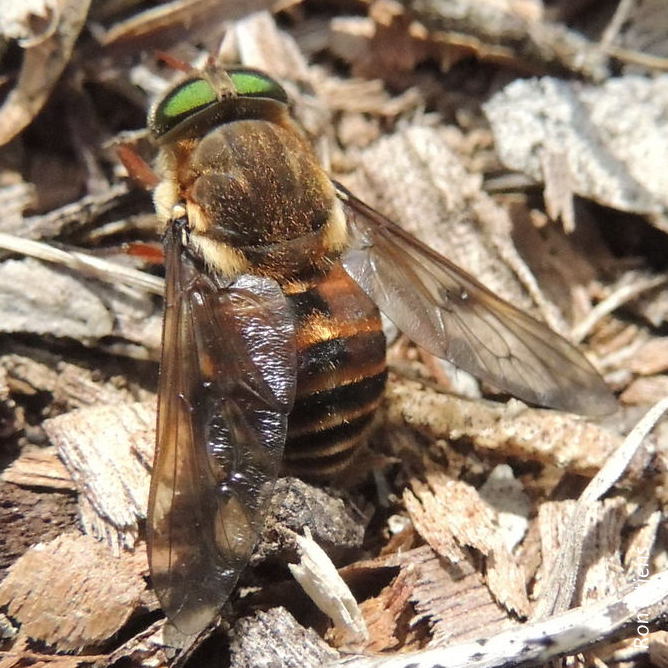
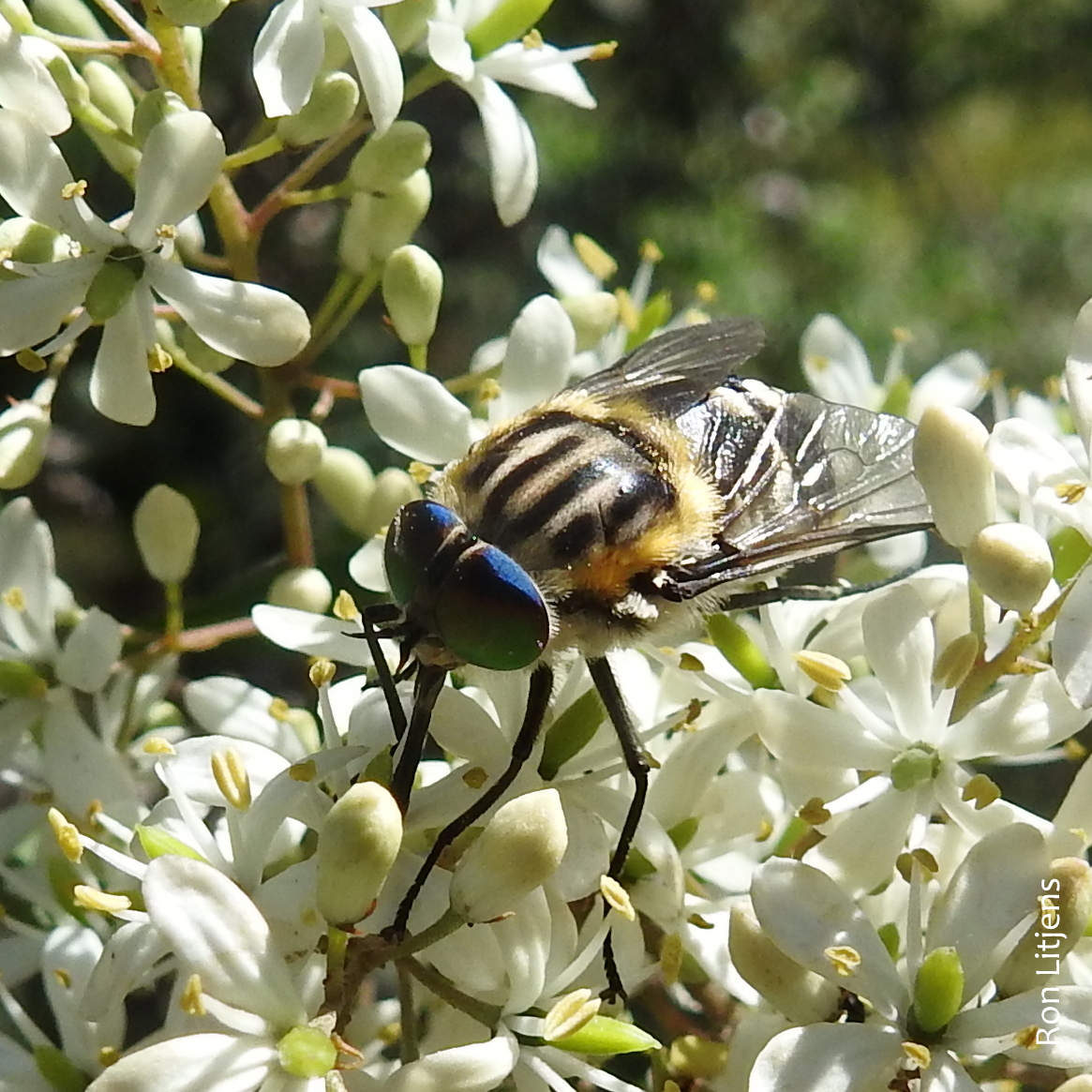 During the warmer months of the year the bite from the Australian Common (AC) March Fly (Tabanus australicus) can take the shine off a BBQ and in my experience many of these flies are pre-emptively despatched during the course of a lazy summer’s afternoon outdoors. In reality it is only the female fly that bites. She requires blood with which to develop eggs and obtains it by biting warm-blooded creatures, including us. The male is a nectar feeder.
.
.

Flower-feeding March Fly
Australian Common March Fly
Telling the difference between the AC and the FF March Fly can be difficult. The FF March Fly is ‘fuzzy’ being covered with dense hair to mimic a bee. The abdomen has large distinctive cream circles on a black background (pictured above). The AC March Fly (pictured left) has stripes on the abdomen. In close up the differences are obvious but when walking through the bush it’s still hard to tell.
Ultimately, to tell the difference you may have to wait until the fly decides to suck on a flower or on your leg.
FoF Entertainment Review
Event: Ecdysis – the musical
Genre: Drama
Classification: G – General exhibition, suitable for the whole family
Director: Mother Nature
Cast: Members of the Aeshnidae, Cordulegastroidea and Libelluliodea families (i.e. dragonflies)
Soundtrack: Various frogs, crickets & cicadas
Year: 2018
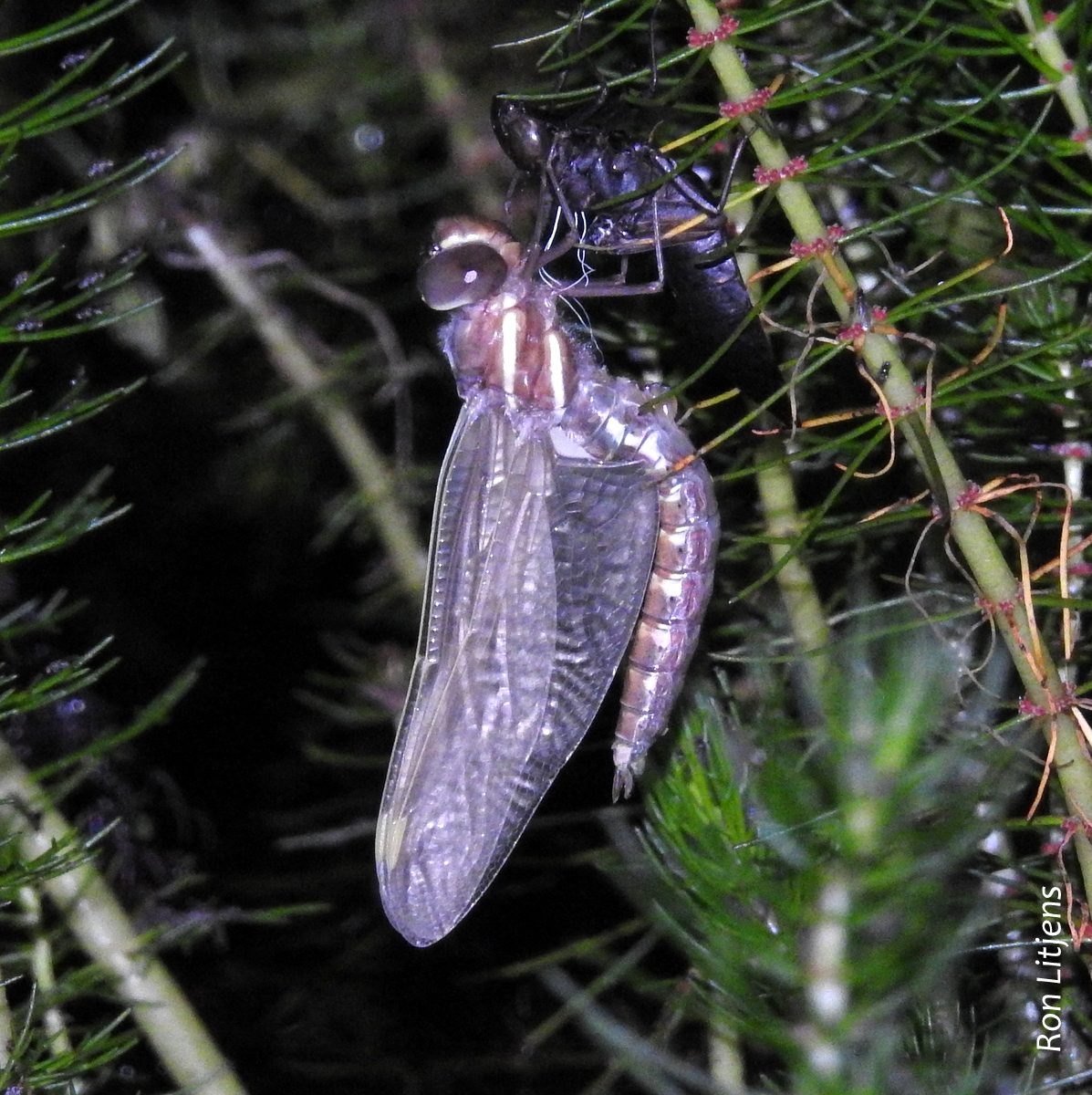
Plot summary: Ecdysis (the musical) is the coming of age story of a dragonfly as it transitions from nymph to adult. This process as the title suggests is called ecdysis. Dragonflies can spend between months and years of their lifecycle underwater as nymphs, depending on the species. During ecdysis the nymph leaves the water on a piece of vegetation. The adult emerges through a split in the back of the nymphal exoskeleton (see picture below). The wings are very small. Over the course of several hours internal hydraulics pump up both the body and the wings. I won’t give away the ending.

 Rating: Five stars
Showing: NOW. On warm nights after dark, at a dam or wetland near you
Reviews: “By far and away the best couple of hours I have spent in a long time and the backing track was great” R. Litjens
“Truly the greatest show on earth” O. Donata
In a hole in the ground there lived a …
These opening words of Tolkien’s The Hobbit could equally apply to the little Spotted Pardalote that arose apparently out of nowhere from the grass in front of us while we were trying to photograph a White-winged Triller for a previous post on this blog.
 In fact the pardalote emerged from the insignificant hole in the ground, pictured left, that marks the start of its nesting tunnel. The nest itself is made of shredded bark lined with softer material in a spherical chamber at the end of the tunnel, which can be as much as one metre or more long. The bird pictured here is a male with its rich yellow throat, but both parents are involved in nest construction and incubation.

The other pardalote in this district, the Striated Pardalote, sometimes also burrows into the ground, usually a creek bank, to build its nest, but more often it nests in a tree hollow.
So keep your eye out this summer, not just for snakes on the ground, but even for tiny colourful birds!
The Often Overlooked
In the valley the three snakes to watch out for (according to popular wisdom) are the Red-bellied Black, the Eastern Brown and the Tiger Snake. All three are classed as dangerously venomous and depending on the local environment one of the three will dominate. All are snakes of the Elapid family. That is having hollow syringe-like fangs at the front of the mouth that inject venom from a gland at the back of the jaw.
But spare a thought for the often overlooked fourth – the Lowlands Copperhead (Austrelaps superbus) so named, surprise, surprise for the colour of its head (see picture below) – a marking which may or may not be distinctive. The Copperhead is also an Elapid snake regarded as dangerously venomous and like the Black and Tiger snakes bears live young. The Eastern Brown Snake lays eggs.

 Restricted to south-eastern Australia there are three species of Copperheads. They can tolerate temperatures far lower than the Black, Brown and Tiger Snakes. Therefore it is not uncommon to find them basking in the sun during seasons where one would not expect to see snakes. A daytime hunter, they are also known to hunt at night if the day temperature has been too hot. The Copperhead diet mainly consists of frogs. They are good swimmers and will also catch tadpoles for food.
These details do not bode well for one of my favourite pastimes, sitting on the side of a dam after a hot day watching the dragonflies emerge…stay tuned.
Whistler v. Triller

Rufous Whistler
In a revegetated gully at the back of our place there is a wealth of bird chatter at present. But the songs of two birds in particular dominate for much of the day, and it sounds like a battle to see which can impress the most. They are the Rufous Whistler and White-winged Triller.
Click on the audio icons below to hear their resounding calls which are well worth a listen.
Rufous Whistler:
White-winged Triller:

White-winged Triller
Both these birds are spring/summer migrants to Victoria, spending the colder months in the warmer climes of northern Australia. The male triller pictured here (it’s elusive – hence the long-distance shot!) is in its pied (black and white) breeding plumage. From March to August it changes its outfit to mainly brown and grey, more closely resembling the female. The male Rufous Whistler retains its impressive plumage throughout the year.
As a songster, the Rufous Whistler probably wins the day, but the White-winged Triller is certainly no slouch in the vocal stakes.
The Box – The Young and the Restless

Grasshopper instar
After the ’09 fires a grove of Yellow Box saplings started growing on our property. Being a mecca for young invertebrates and therefore birds and other creatures I began monitoring the fauna that lived there. Now the saplings are trees and hard to access. So recently I found three Grey Boxes (Eucalyptus microcarpus) that have just started their life. Only knee high they make it easy to check for critters and I can sit down and photograph – a real luxury. Once again I am going to see what lives in these very young trees. I will call this series The Box, after a TV series broadcast when I was young which I was never allowed to watch because of something that they now call Adult Themes.

Gumtree Hopper instar
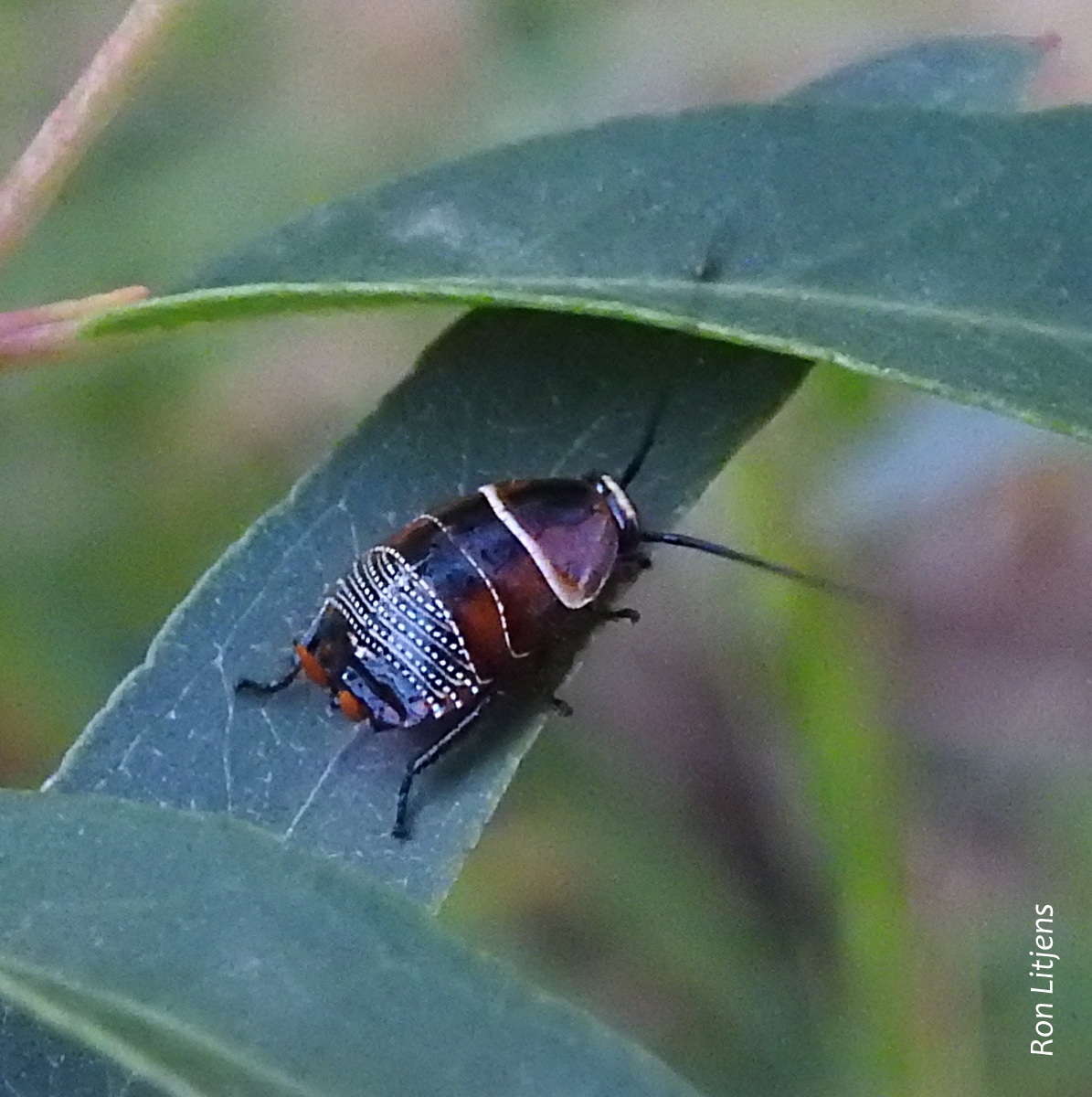
Many insects mature through a series of stages called instars. As the instars grow they becomes too big for their external skeletons (exoskeletons) and therefore have to moult and form new, bigger ones. This is called incomplete metamorphosis. In most cases the instars look like smaller versions of the adult, just without wings. The wings appear after the final moult.
Spring is the time when insects lay eggs and the young hatch. It is also the time when eucalyptus trees are growing the tender new shoots on which some of these instars feed. A close look at the box trees reveals a veritable nursery of young instars, some of which are pictured. The adult cockroach can be seen HERE. To date each insect has not moved from the plant it was first observed on.
Austral Ellipsidion Cockroach (Ellipsidion australe) instar
Maybe they become restless when they are teenagers.




 Focus On Fauna