A new pest?
 Here’s a mystery – four of these slugs (see pictures) turned up on our back doorstep a few days ago and they appear to be Black Slugs, also known as Black Arion, Arion ater, although at about 3.5cm long, they were considerably smaller than the reported size at maturity of up to 15cm, or even longer! The mystery is: how did they get there?
They are an introduced species native to Europe and, according to Museums Victoria, as recently as 2009 they were not considered to be established in Australia. However, since then they seem to have popped up, sometimes in large numbers, in various places in Victoria and around Sydney and Adelaide. The Atlas of Living Australia has 29 records on its data base.

The Black Slug has no natural predators in Australia and has the potential to be a highly invasive pest. They can reproduce rapidly under favourable conditions. They are hermaphrodites and each partner in a mating pair can produce fertile eggs, up to 150 in a clutch.
In the UK, this slug is considered either as a garden pest or as an important component of woodland ground fauna, depending on what perspective is taken. Its omnivorous diet includes leaves, stems, dead animal or plant matter, earthworms and fungi. Its effect on our natural environment is unknown, but it does present a risk to seedlings and crops.
We would be interested to hear of any other local sightings of this slug. If you do find one, be aware that the slime should be avoided – use gloves when disposing of it.
Since we haven’t imported any garden soil or pot plants recently, the mystery remains as to how they arrived!
So that’s how it does it
Long time readers of this blog will recognise, in the photo below, the nest-box and the critter loitering in the entrance. Every June/July for the past five or so years an Australian Owlet-nightjar (Aegotheles cristatus), pictured, roosts for several weeks in this nest-box near our house. The smallest of Australia’s nocturnal birds it is extremely curious and if we happen to walk past the nest-box during the day it immediately pokes its head out of the entrance to see what is going on.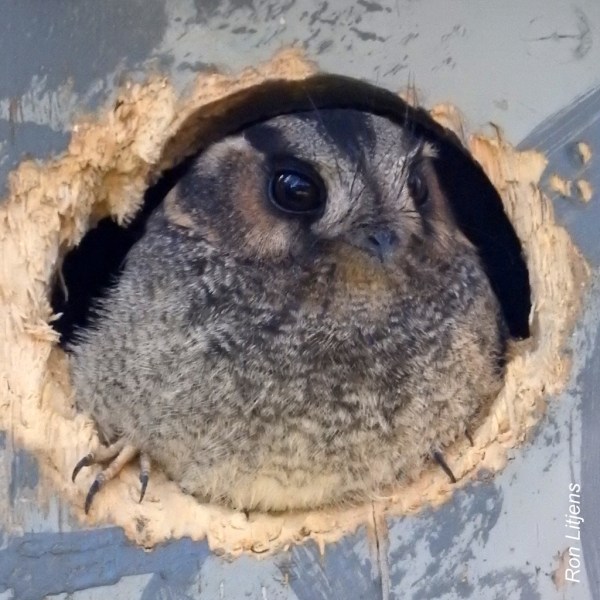
The nest-box in question is built for a Rosella (so the guides tell me). It is much deeper than it is wide. I also have in trees near the house two Owlet-nightjar nest-boxes which are much wider than they are deep but nothing has ever inhabited them. I have often wondered how the Owlet-nightjar could sit looking out of the nest-box opening for long periods of time. I assumed that it had feet like a White-throated Treecreeper.
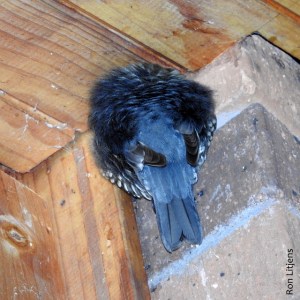
 The White-throated Treecreeper (Cormobates leucophaea) spends its life scaling the trunks of trees looking under bark for the insects on which it feeds. A look at the photo (right) shows that the toes are particularly large compared to the size of the body, perfectly adapted for the task of cling to vertical surfaces. In addition, their legs and feet are controlled by special tendons so that when a bird bends its legs the feet automatically close. In this way the treecreeper can sleep whilst attached to vertical surfaces. The photo below shows a treecreeper that often sleeps under the eaves of our house.
 But a careful look at the ONJ photo shows its feet (with little toes) gripping the opening of the nest-box. Evidently it does not have the feet/toe locking mechanism of the treecreeper but in an effort to check out the neighbours simply perches on the edge of the nest-box entrance and crams its body through the opening.
Being a busy-body comes at a cost.
A Pox on You
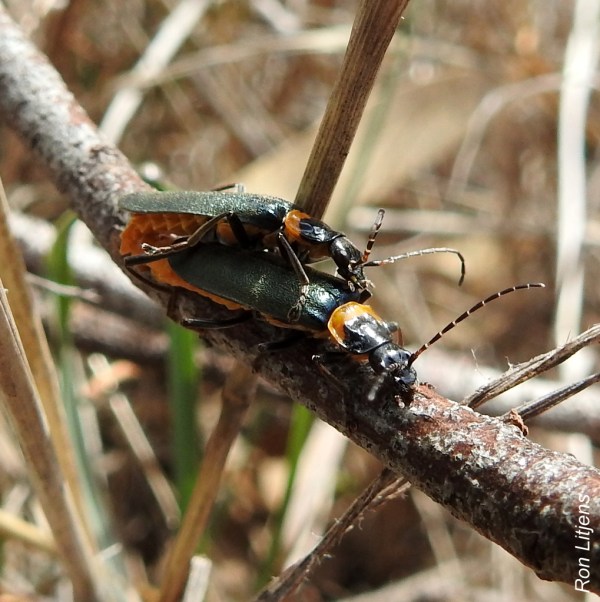
 Well at least the plague. Well not even that. How about Plague Soldier Beetles (Chauliognathus lugubris)? The term ‘plague’ does not stem from the fact that they spread disease rather than, for reasons unknown, in early autumn they appear in swarms of vast numbers, usually copulating.
The adult insect is omnivorous, feeding on other insects and the nectar of plants. The sheer number of beetles makes you wonder whether any of the vegetation will remain when the beetles go, but the only danger to plants is sometimes weighing them down to the point of breaking.
When swarming, the beetles appear less interested in the food and more interested in mating.
I know some people like that.
Not a misnomer
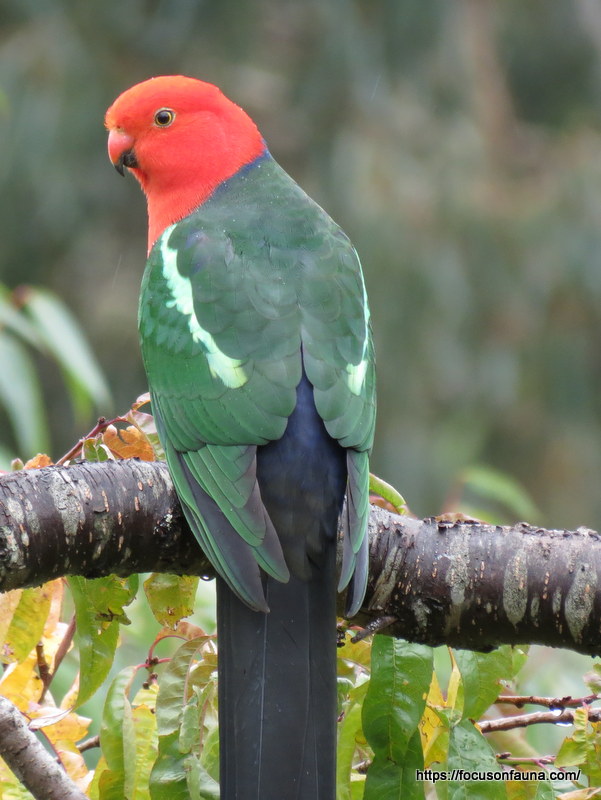
Australian King-Parrot (male)
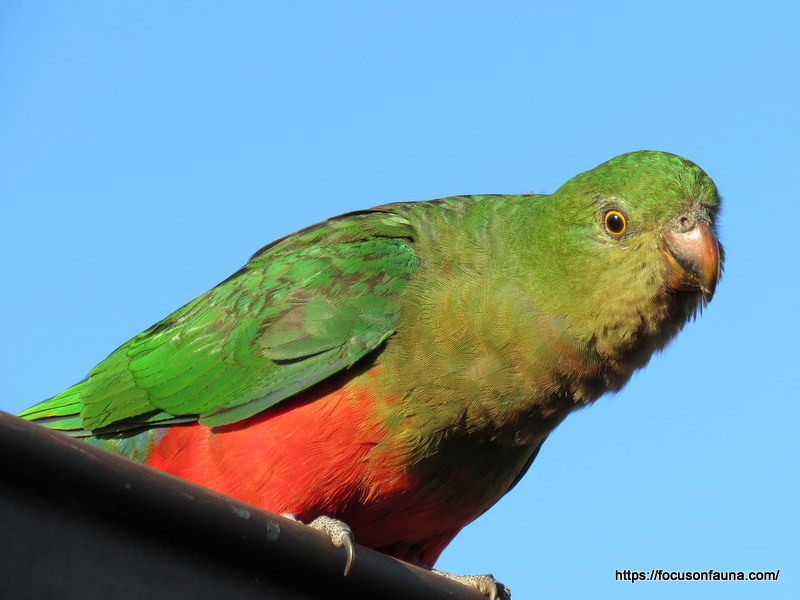
Australian King-Parrot (female)
We surmised that Hume and Hovell, who named the King Parrot Creek when they crossed it on their epic journey in 1824, may have misidentified the birds they saw – perhaps they were young Crimson Rosellas, we thought, birds that are common in the valley today. The explorers birding skills, or lack thereof, may have matched their questionable navigation skills – after all, they thought they had reached Westernport Bay when in fact they were at Corio Bay, almost 100 km to the east!
Anyway, that was until the early 2000s, when we became aware of a few reports of King Parrots turning up in the valley. We recorded our first visitor in September 2003 and have had intermittent visits ever since, like the superb male shown above that landed in a nectarine tree in our garden a few days ago. Numbers of KPs are now regularly seen or heard around Strath Creek and Flowerdale. No doubt they have been encouraged by the supplementary feed left out by some residents, but it is fair to assume that the extensive revegetation, encouraged by Landcare, that has occurred in the last 25 years or so, especially along the creek banks, is a significant factor in the return of King Parrots to the eponymous valley. They are, after all, essentially a bird of forested habitats, as well as being opportunists.
So, apologies to Hume and Hovell, their naming of the creek was most likely quite appropriate, or at least it is now.
Their most common call is a series of high-pitched whistles, a recording of which can be heard by clicking on the audio below. They also make a harsher contact call in flight that we’ve not yet managed to record.
Hidden treasures

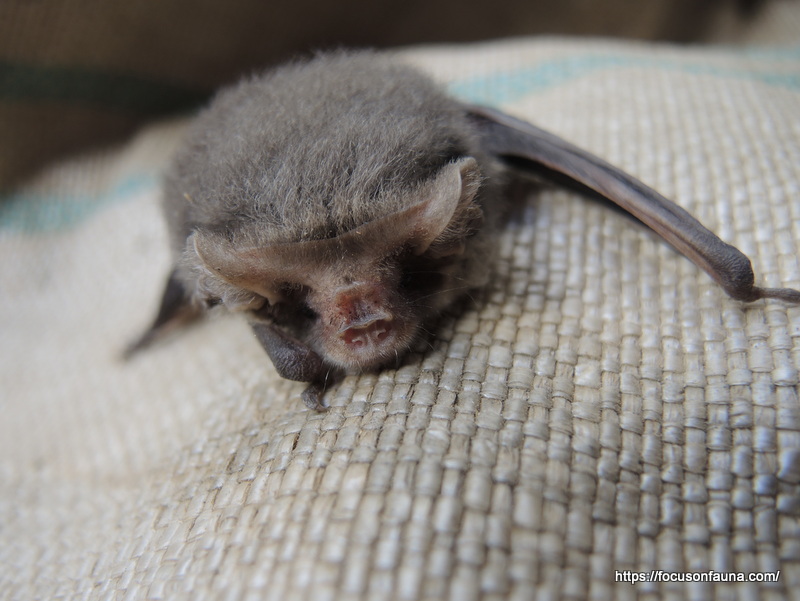 We’re used to seeing small bats whizzing around at dusk over the summer period, but at this time of year you are more likely to come across one hiding sleepily in a wood-pile or even up the sleeve of a hanging overcoat, as we found a few years ago.
The microbat pictured here was one of a pair rudely disturbed from a state of torpor in a pile of wool-packs in our shed. It’s a Lesser Long-eared Bat (Nyctophilus geoffroyi) with its long ears curled down much more than if it were active.
The Lesser Long-eared Bat is at home in a variety of habitats and has a wide distribution covering most of Australia. It has adapted well to both agricultural and urban environments, with a willingness to use a range of different roost sites. However, tree hollows and bark fissures are its main natural roosts and, as with other microbats, scattered paddock trees and bush remnants play an important role as both roosting and foraging sites.
Below is another bat (we think also a Lesser Long-eared) found among some stored timber in the shed at almost the same time last year.
Thanks to Lindy Lumsden from the Arthur Rylah Institute for the identification.
The Kraken Wakes
The book (or was it the movie?) which most influenced my childhood was Day of the Triffids by John Wyndham. Even today I keep one eye closed when I watch meteorite showers just in case the story is portentous. Another book by the same author is The Kraken Wakes, the kraken being a mythical sea monster.
Well, you don’t have to go as far as the sea to encounter voracious aquatic predators. You have to look no further than your nearby lagoon or in this case horse trough. Judy from Limestone, the individual who recently brought us the maggot eating insects found in carrion has just sent in a photo of a water beetle devouring the floating body of a European Honeybee (Apis mellifera). This water beetle appears to be a Diving Beetle (Dytiscidae sp.).
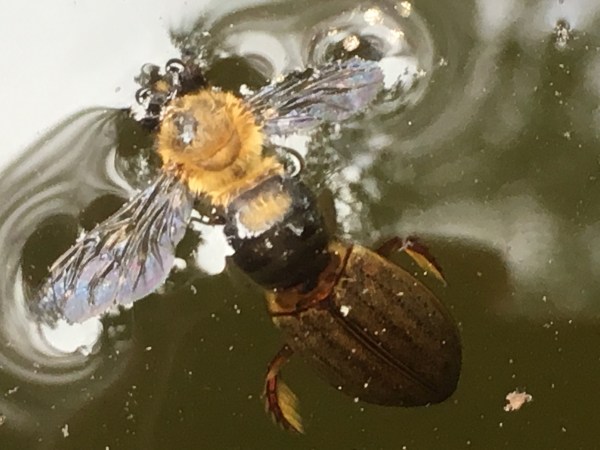 Diving Beetles are regarded as beneficial insects as they predate on flies and mosquitos as well as their larvae. The adults eat a variety of insects, frogs and small fish and also keep the water clean by scavenging dead bodies (of animals!). The young of this beetle are known as Water Tigers and have been mentioned in a previous post. The back legs have a number of hairs on them so they can effectively swim and catch prey.
Enough about the beetle – I am hanging out to see which dead-devouring creature Judy comes up with next.
Laying mantis
 Pruning in the garden can be hazardous for the pruner’s fingers, but in this case it was the well-camouflaged inhabitant of a shrub that was in danger from the secateurs of Susan at Strath Creek. She discovered, just in time, a praying mantid that was in the process of laying eggs, or at least constructing an egg sac known as an ootheca – see photos.
The ootheca is a spongy pouch that is glued to twigs or leaves and hardens to form a protective case for up to 400 eggs, depending on the species. The female uses appendages called cerci at the end of her abdomen to spin and shape the foamy ootheca. These cerci can be seen in the photo below.

Praying mantids (order Mantodea – meaning prophet) can sometimes be confused with other insects with elongated bodies such as stick insects, mantis flies and even some grasshoppers and crickets. Distinguishing characteristics of the mantids include mobile triangular-shaped heads with large compound eyes, strong forelegs with spines for catching prey, long thin antennae and, of course, construction of an ootheca. And a fascinating fact from Michelle Gleeson’s wonderful book Miniature Lives: “Praying mantids have a specialised hearing organ between their hind legs, allowing them to detect the ultrasonic calls used by bats to locate their prey. This provides mantids with an early warning system, giving them time to flee or drop to the ground before the bat can swoop.”
We won’t attempt to identify Susan’s praying mantid as there are about 160 species in Australia, most of which belong to the family Mantidae.
Generally speaking praying mantids should be welcome in the garden because they consume a variety of insect pests, such as aphids and thrips. But Susan will have to wait a while for an increase in her mantid population, because, depending on the species, the eggs can take up to 6 months to hatch!
[Just to clarify (or confuse?): both the terms praying mantis and praying mantid seem to be widely used interchangeably, although perhaps mantis should be confined to members of the genus Mantis, one of a number of genera in the family Mantidae?]
I won’t tell – part II

3rd instar
Last month I wrote a post describing how, for a number of reasons, I had secretly released some newly hatched insects into my wife’s vegetable garden. Of course my cover was blown when she happened to read the post in question (who would have thought!). However I got into serious trouble when soon afterwards the little critters which had initially disappeared turned up in great numbers as instars of the vegetable pest, the Southern Green Shield Bug (Nezara viridula) and proceeded to damage our tomato crop.

4th instar
The term instar is used to describe the larval form of insects that moult several times before becoming an adult. The number of instar states differs with species. This shield bug has 5 instar states (some are pictured) each of which last about a week. The lifecycle from the egg to hatching the adult is between four to five weeks.

5th instar
Like all bugs the Southern Green Shield Bug has piercing-sucking mouthparts. They pierce the plant or fruit and pump digestive enzymes into it allowing the bug to suck out the liquefied food. The surface area of the fruit around the puncture mark becomes brownish or black in colour and very often sunken, causing a dimpled appearance – not good for the market value of the fruit.

adult
As we are not selling the tomatoes I feel that there has been no harm done and we have progressed the field of science by identifying what insect the eggs were from.
That opinion is not shared in this household.
The Lady’s many costumes
Until recently Ladybird Beetles all looked the same to me but a closer look shows the lady has a number of outfits.
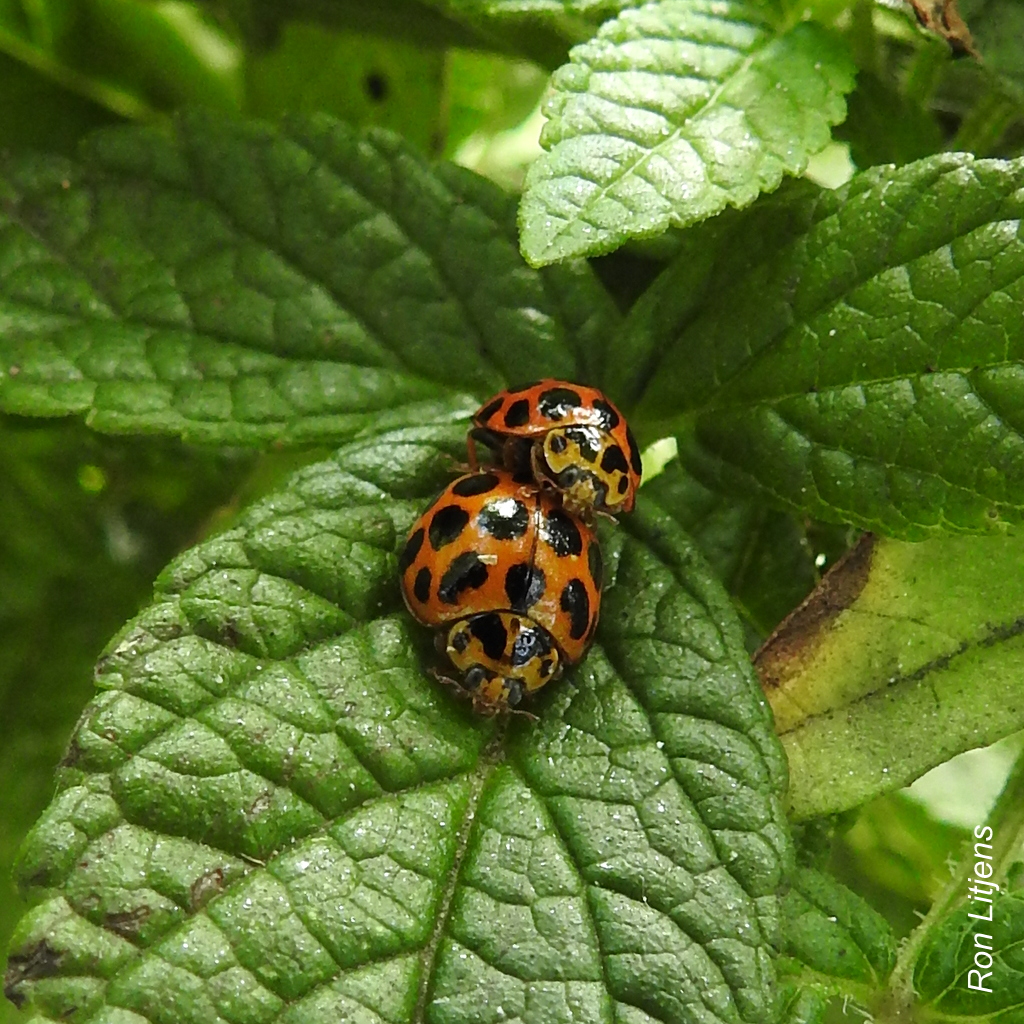
Common Spotted Ladybird
Ladybirds are a family of beetles (Coccinellidae) commonly found on roses and in vegetable gardens. They are considered beneficial insects as the adults and their young are voracious feeders of soft-bodied invertebrates such as aphids and mites but also consume flower nectar, water and honeydew from aphids.

Transverse Ladybird
The majority of ladybirds are red/orange and black but there are a variety of designs. Pictured are three such beetles found in our vegetable garden at the moment – the 23-spotted Common Spotted Ladybird (Harmonia conformis), the Transverse Ladybird (Coccinella transversalis) and the White-collared or Spotted Amber Ladybird (Hippodamia variegata).
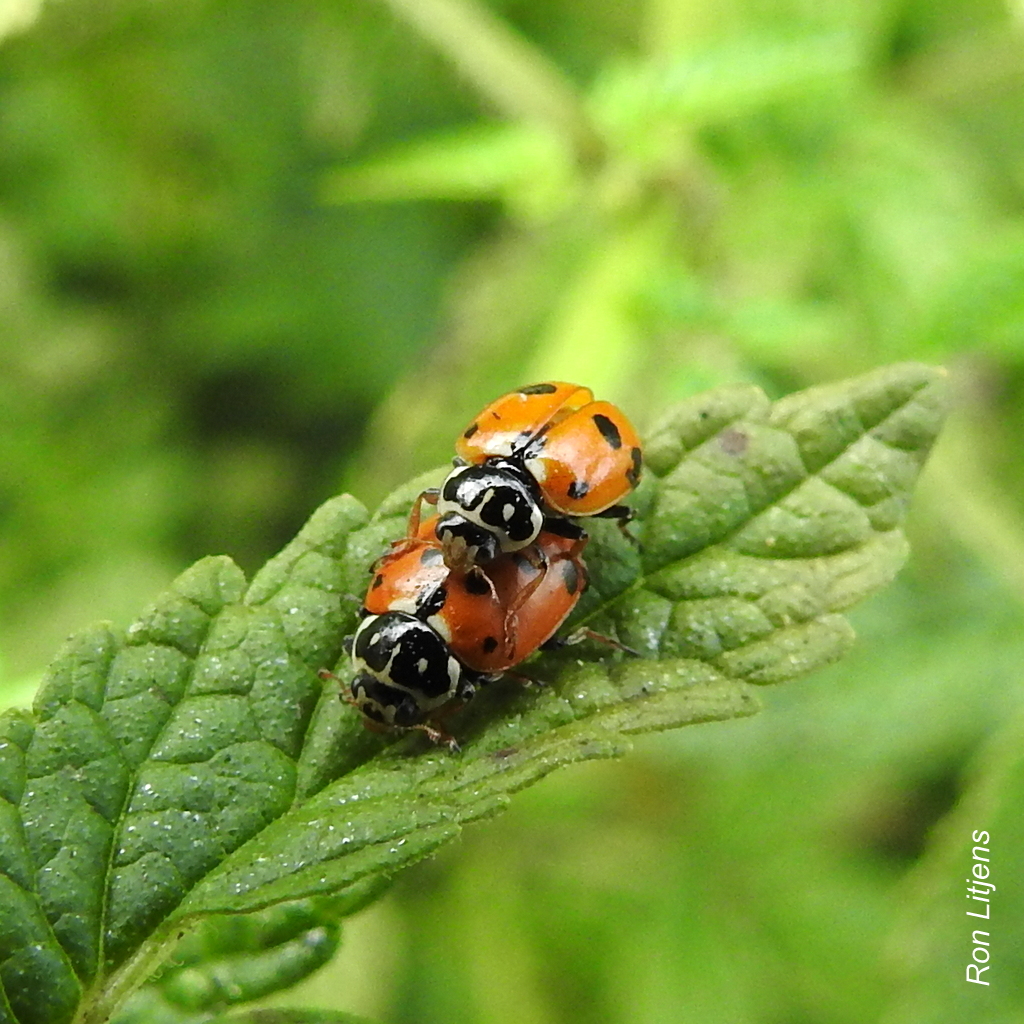
Spotted Amber Ladybird
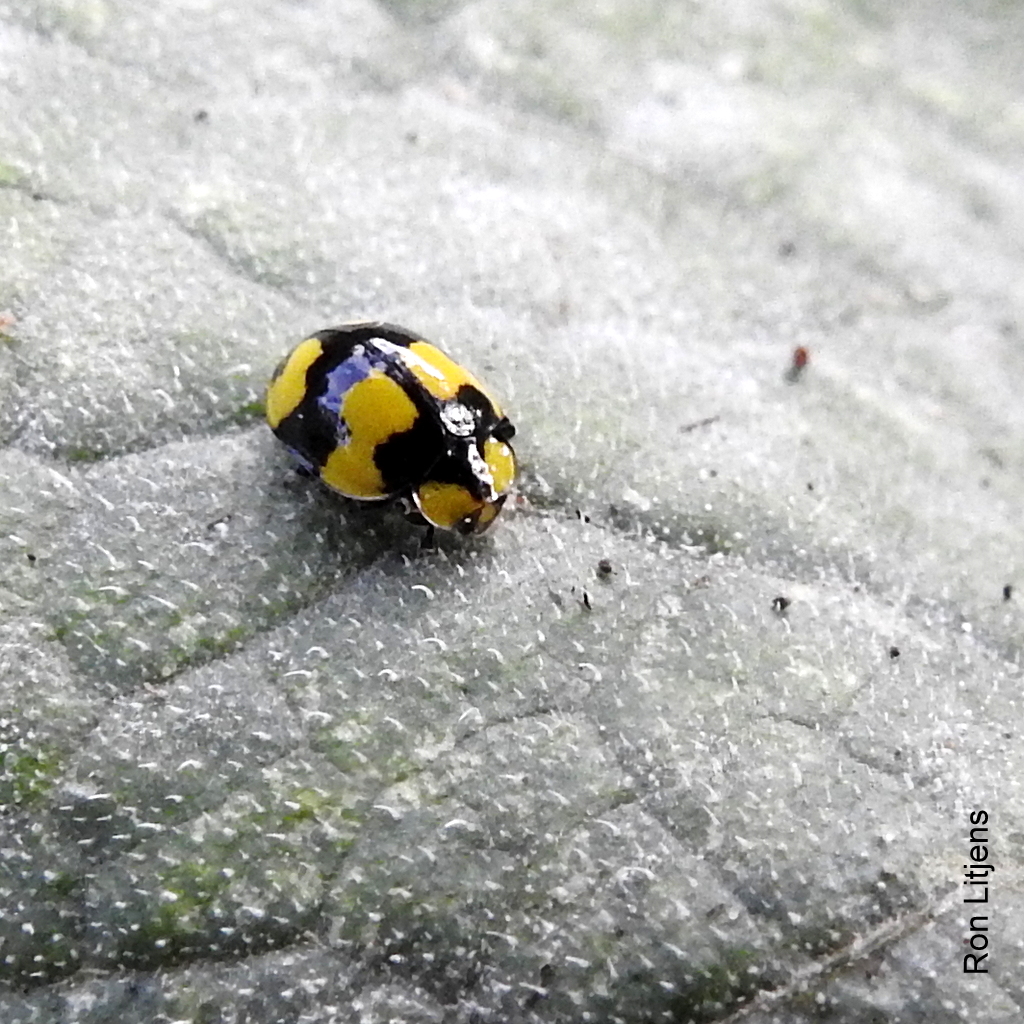
Fungus-eating Ladybird
Of course as any lady knows, if you want to stand out in the crowd you have to dress differently. Also in our vegie garden is the yellow and black Fungus-eating Ladybird (Illeis glabula), pictured right. As the name suggests it feeds on fungus and black mold on leaves.
Vegetarians always stand out in a crowd!
Cute, but …

European Goldfinch – in Jean-Paul Gaultier outfit?
And they are extremely wary, flying off in a swirling flock to the nearest tree when disturbed. This makes photographing them difficult, with our limited zoom capacity – thus the poor long-distance shots shown here.

Just a few of the large flock of goldfinches
Introduced as far back as the 1860s, the Europeant Goldfinch has not been as successful as some other introduced birds in spreading across the country, and they are mostly confined to south-eastern Australia.
It’s hard not to like these pretty little birds with their tinkling song (click on the audio bar below to hear it). Perhaps in recognition of this, the collective name for goldfinches is a “charm”.
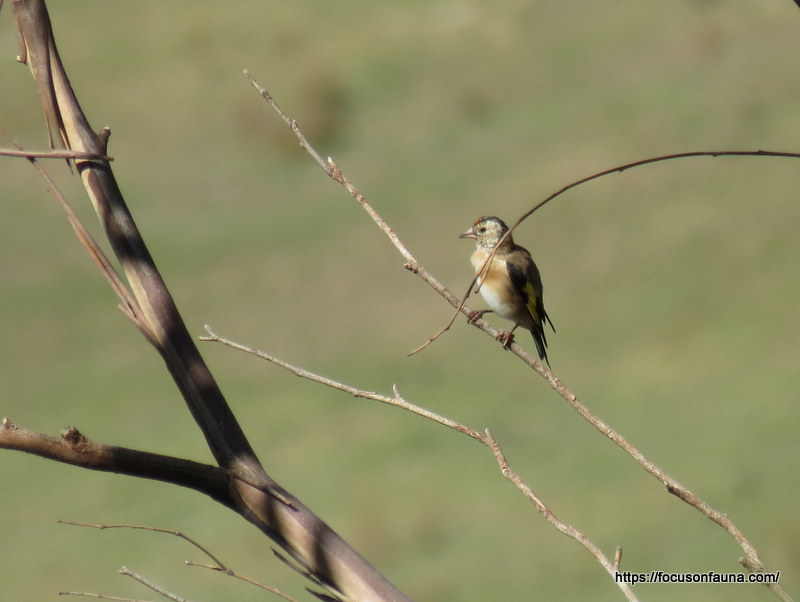
A rather drab-looking immature goldfinch
So we feel a bit ambivalent about these birds – cute to look at and listen to, but, as with many other introduced species, we’d probably be better off without them.
For more information on the goldfinch, and a much clearer picture, go to BirdLife Australia’s Birds in Backyards website.