Honeyeaters
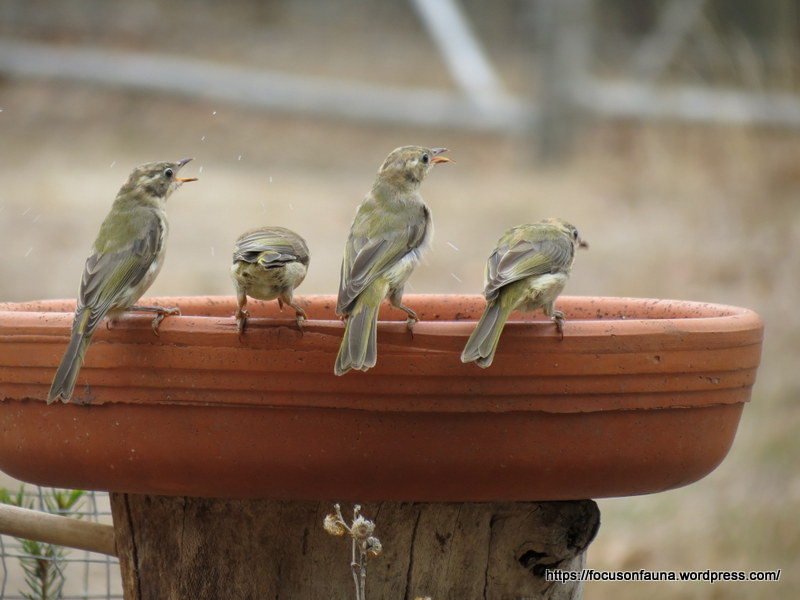
Brown-headed Honeyeaters
While weeding in the garden one of us even experienced its reported habit of taking human hair for nesting material – unfortunately from the one who could least afford to lose any more!
Brown-headed honeyeaters live and travel in close-knit communal groups, usually of 10 – 20, and are noted for huddling along a branch when roosting at night.
As usual, bird baths make good sites for photography, and we managed to get some shots of Brown-headed Honeyeaters on their own, as well as with a closely-related White-naped Honeyeater and some Yellow-faced Honeyeaters.


A wetland visitor
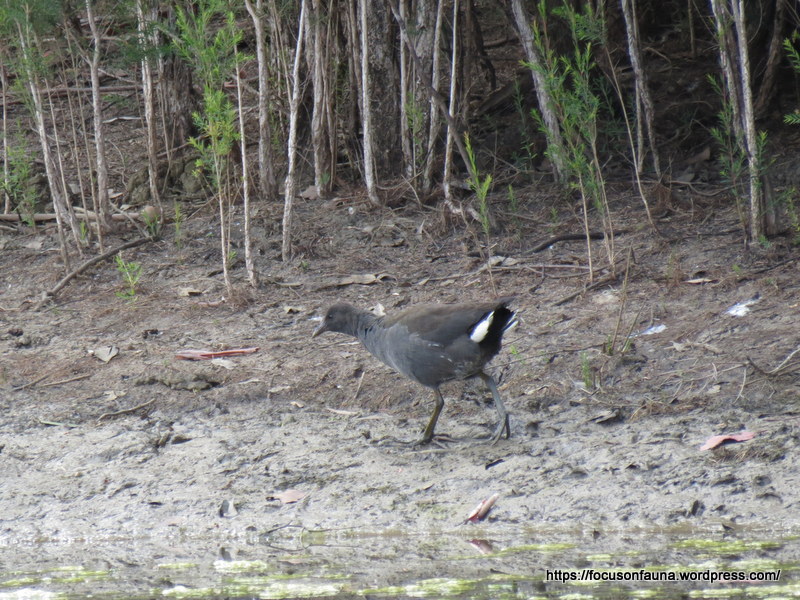
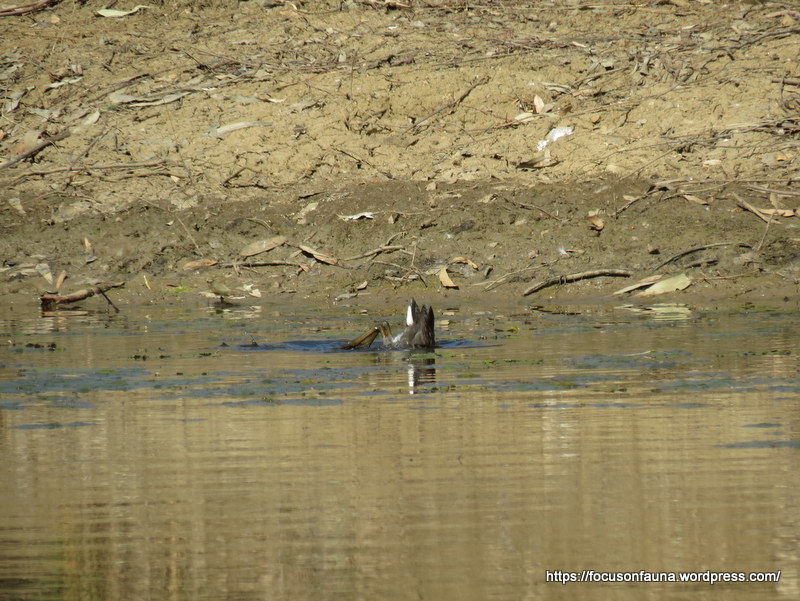
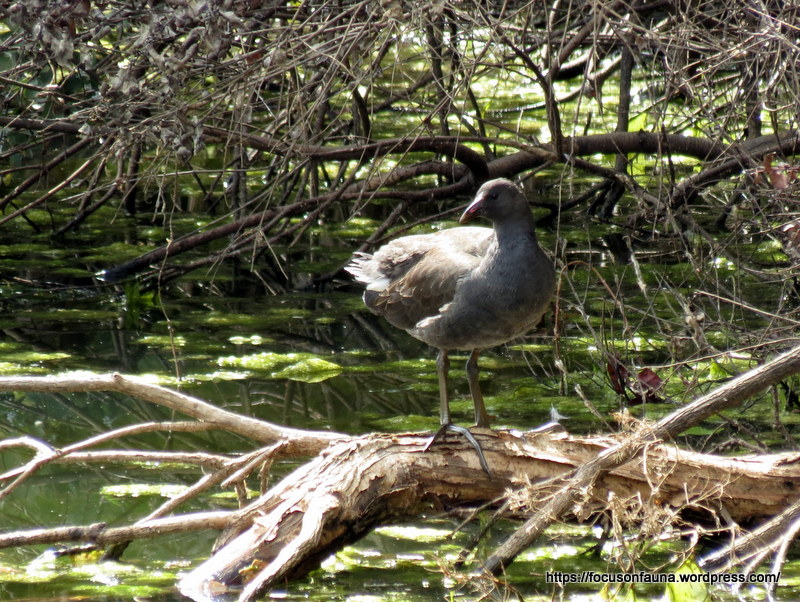 With dams getting very low, there is now plenty of soft silty mud exposed on the edges for wetland birds to forage for small invertebrate prey. We have just acquired a lone Dusky Moorhen that regularly patrols the perimeter of our largest dam. With its very large feet, walking in the soft mud is no problem – click on photo at left. This bird is immature and is yet to develop the distinctive red frontal shield of adult birds.
Our bird is relatively unconcerned with human presence, but still keeps a safe distance. If unduly disturbed, it prefers to duck into the cover of stands of Swamp Paperbark and River Bottlebrush on the banks, rather than take to the water.
It does however swim at times, and dives among the Floating Pondweed – see below.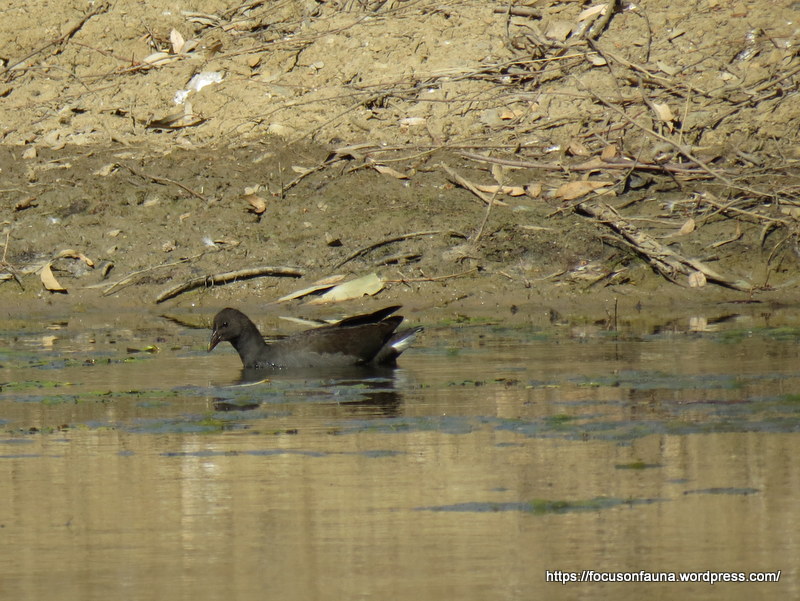
Losing those post-summer blues?
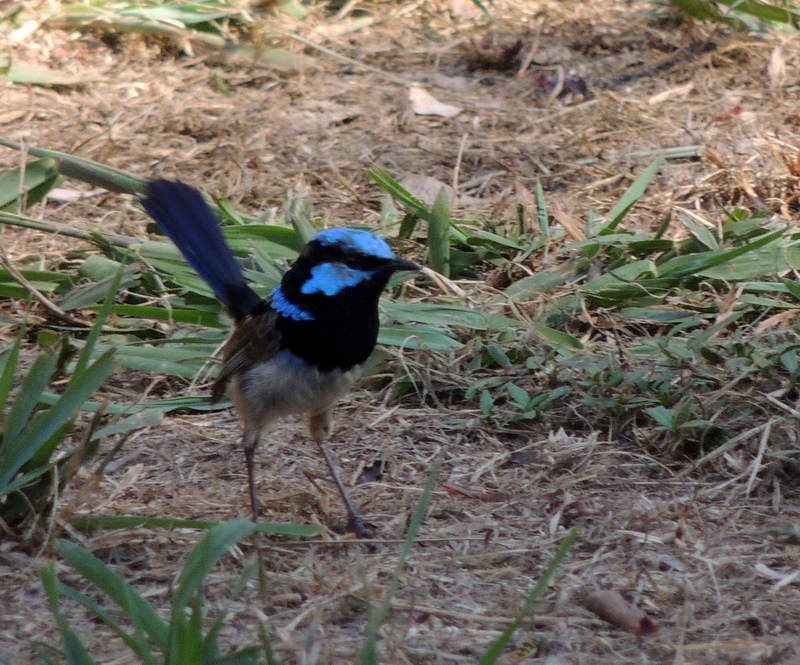 Got the post-summer blues? Well do what the Superb Fairy-wrens do and simply shed them.
Blue wrens have been one of the constants in my life, although those on the west coast of Australia are different from the blue wrens here in central Victoria. The blue wrens here are Superb Fairy-wrens (Malurus cyaneus), cyaneus being Latin for dark-blue. The male is conspicuous with its bright blue and black breeding plumage (pictured left), while the female is grey-brown (pictured below). During the summer breeding season the sexes are easy to tell apart.
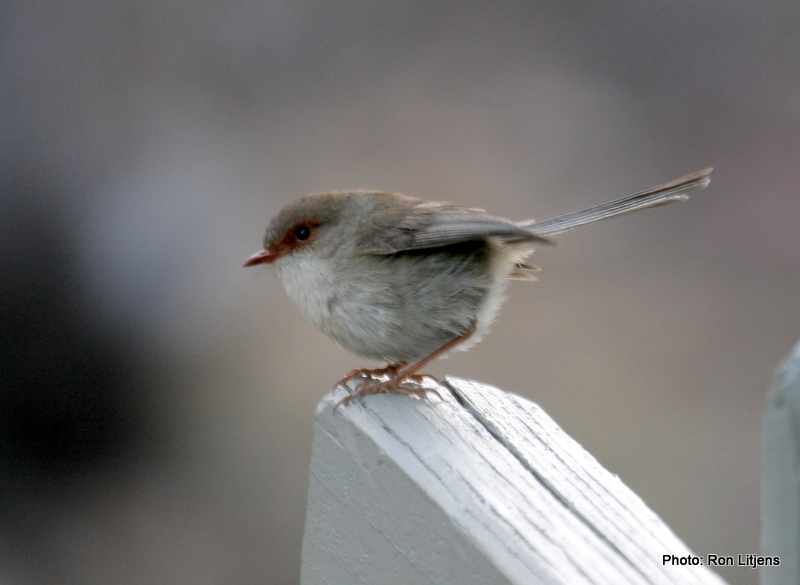 At the end of summer all the male Fairy-wrens, except the apex males, moult their familiar blue breeding plumage in favour of grey-brown plumage. At the moment hopping around the bush there is a motley collection of males at various stages of losing their ‘blues’ (see below). During winter, immature and adult males can be identified by the slightly blue tail and the black beak. The females have a brown beak and brown lores (the area between the beak and the eyes). Next spring the breeding males will again don their nuptial plumage to attract the females.
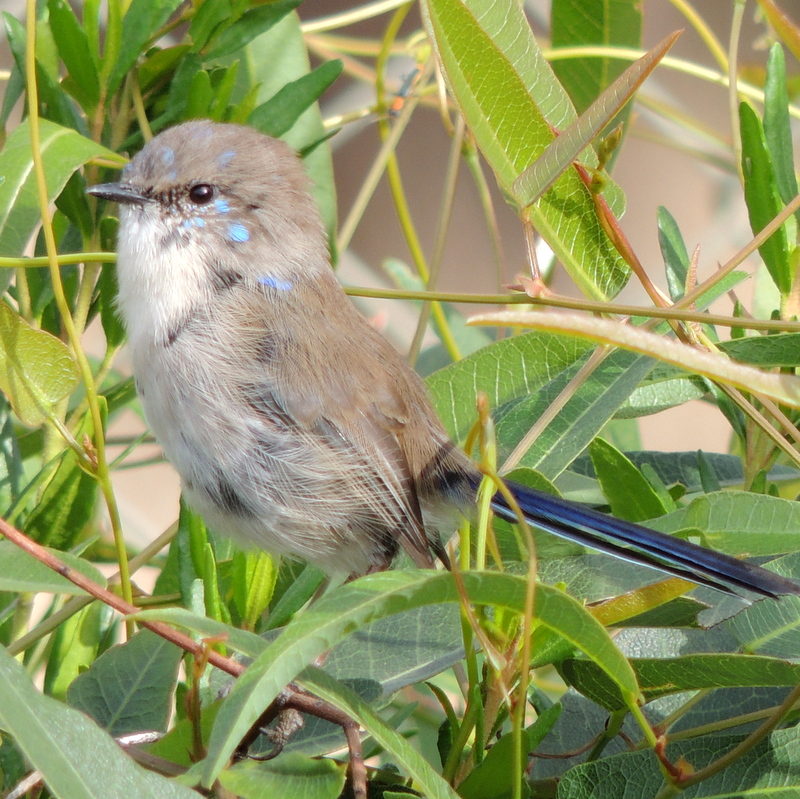 So if you are suffer from those post-summer blues don’t worry. As any fairy-wren or whiskey drinker will tell you, all you need to drive those blues away is a good ‘moult’.
Eye-catching
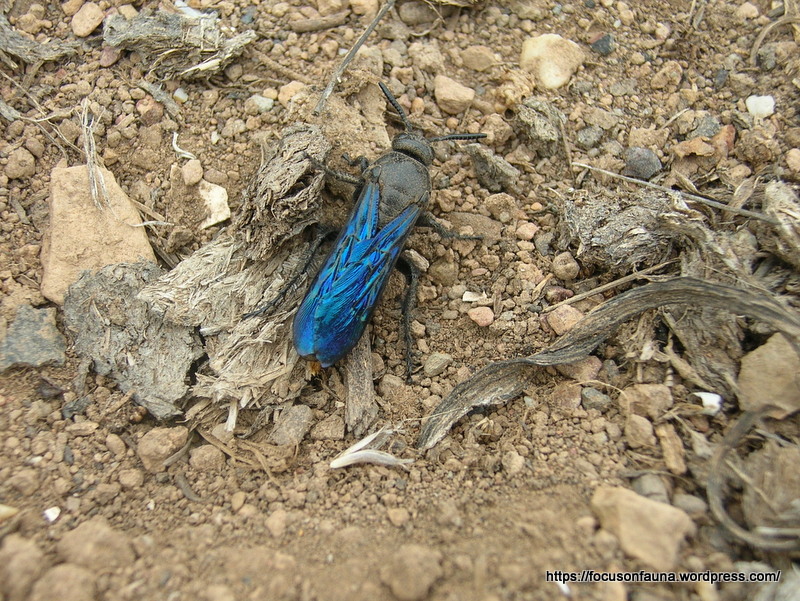 Continuing the wasp theme, this striking blue-winged wasp was photographed just before disappearing underground in our vegetable patch. It’s a native Black Flower Wasp (Austroscolia soror), belonging to the family Scoliidae. It is a parasitoid and burrows with its strong legs into soil, or compost heaps, looking for scarab beetle larvae. It paralyses the larva with its sting and lays an egg in it. Upon hatching the young wasp has a ready food source to munch on.
Black Flower Wasps are usually solitary. They are large (about 3cm long) and hairy, but they are not aggressive, although females can sting in defence. Adults feed on flower nectar.
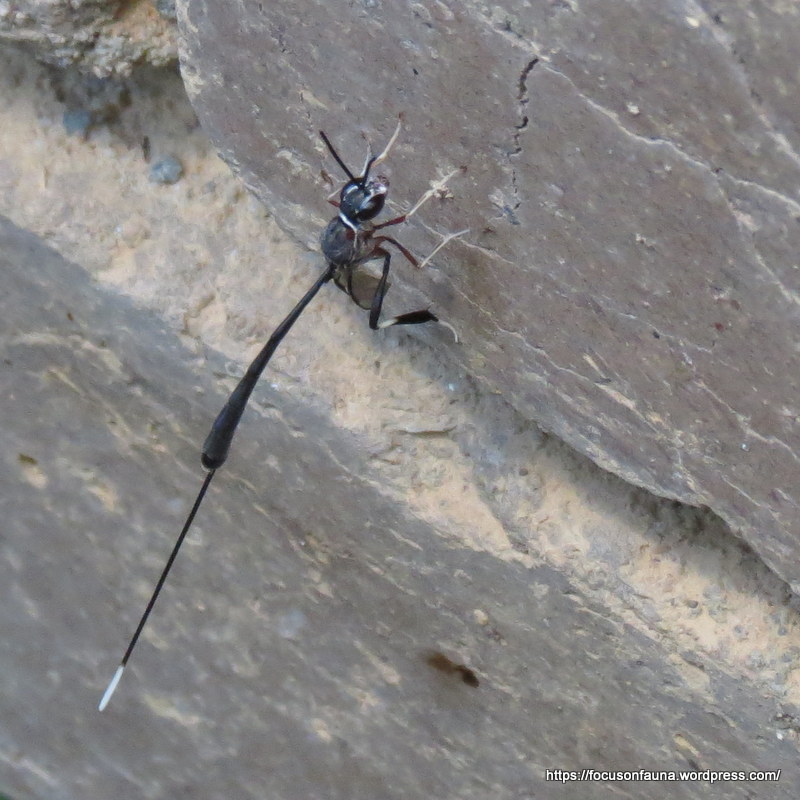
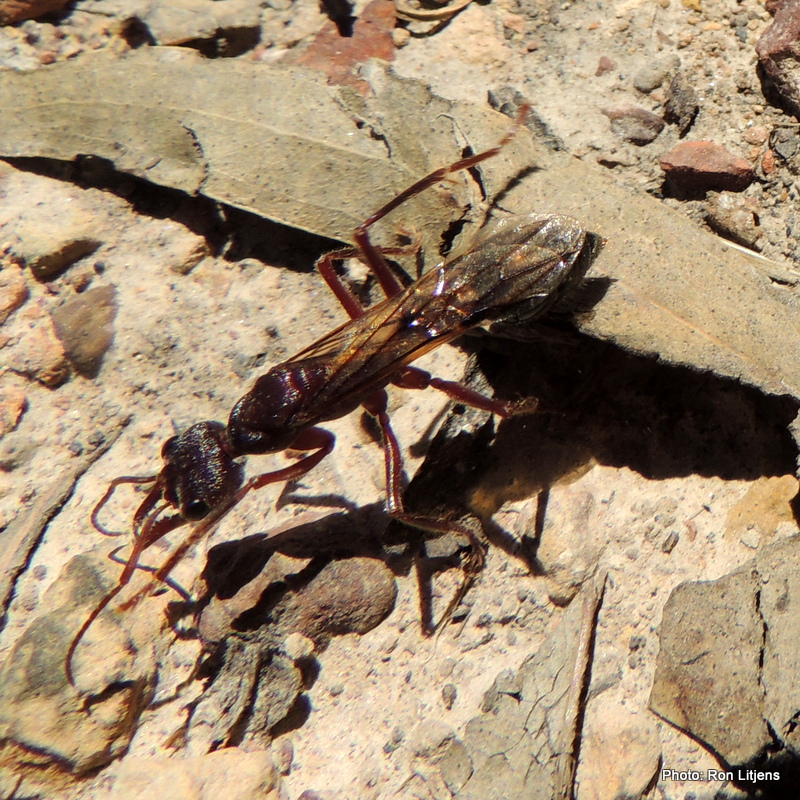
Another solitary parasitoid non-aggressive wasp caught our eye recently – this one we think was an ichneumon wasp from the family Ichneumonidae. There are something like 1500 species in Australia in this family, only about a quarter of which have been described. We’re not sure which species this is, and what species it parasitises. Any suggestions welcome.
I spied a wasp
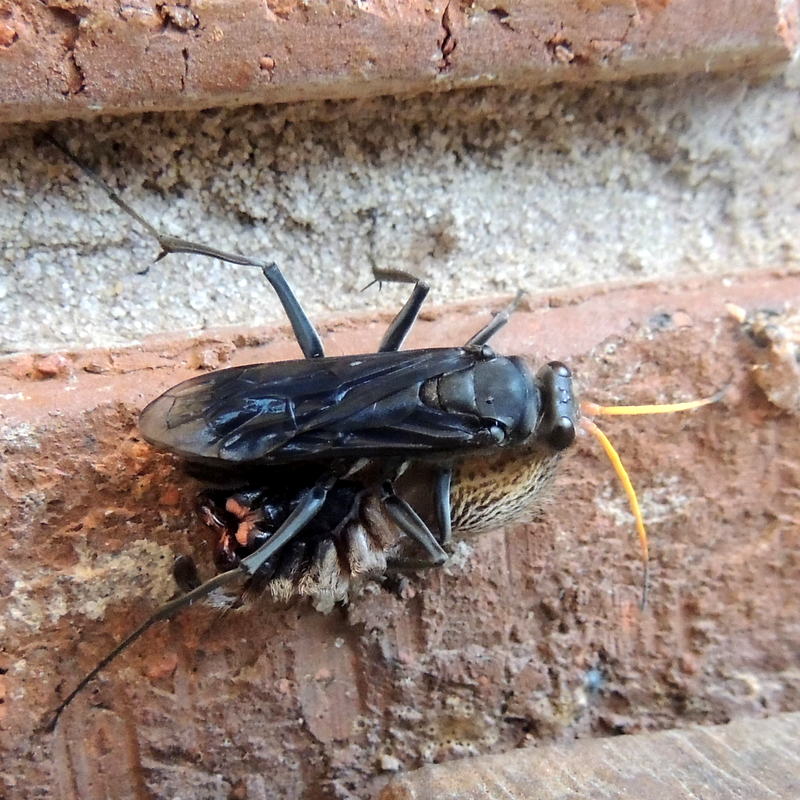 You may have noticed over the past couple of months a black wasp with bright orange antennae prowling around the place inspecting nooks and crannies. It is a Black Spider Wasp (Fabriogenia sp.) and as the name suggests it is looking for spiders.
After mating, the male dies (it will do anything to get out of looking after the kids!) and the female hunts for a single spider on which to lay her eggs. 
The picture above shows a female wasp dragging a paralysed spider to the nest. The spider’s legs have been removed so that it is easier to carry and so that it actually fits in the nest opening. Click to enlarge photo.
The nest is a burrow dug into sandy soil. The wasp uses its back legs to rapidly excavate a tunnel. The picture right shows the wasp leaving a burrow that has been tunneled under a clump of moss.
What I 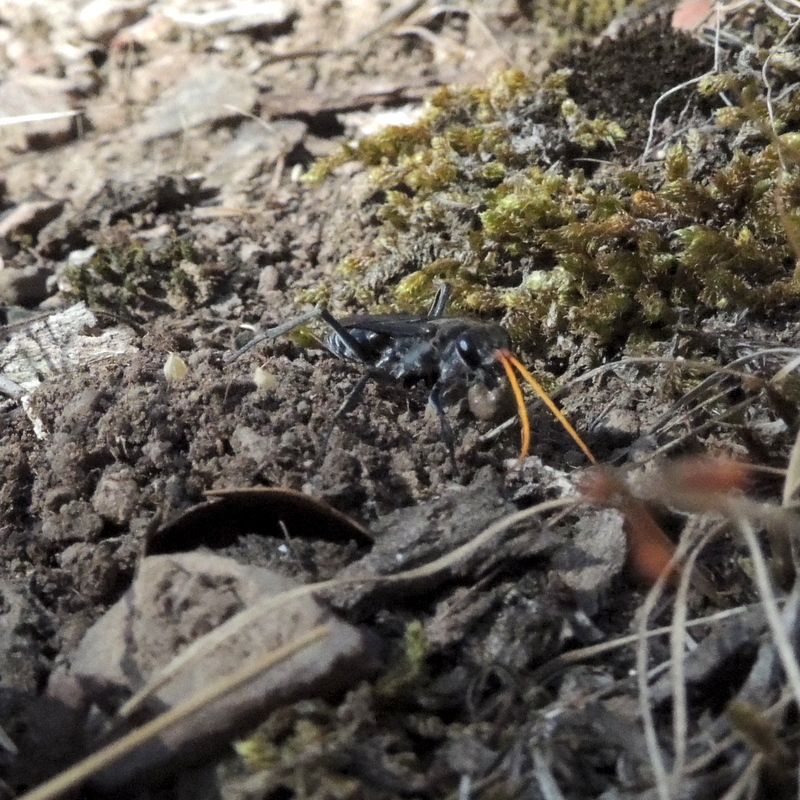 didn’t realise and only found out by watching this wasp is that once the spider has been deposited and the eggs laid the female wasp seals the spider and eggs into the burrow using wet mud, just as I have seen Potter Wasps or Mud-dauber Wasps do on the sides of our house. Pictured left is the female wasp returning to the burrow with jaws full of mud. Before entering the tunnel she would mould the mud into a convenient ball shape. And then it is off to source more mud (pictured below).
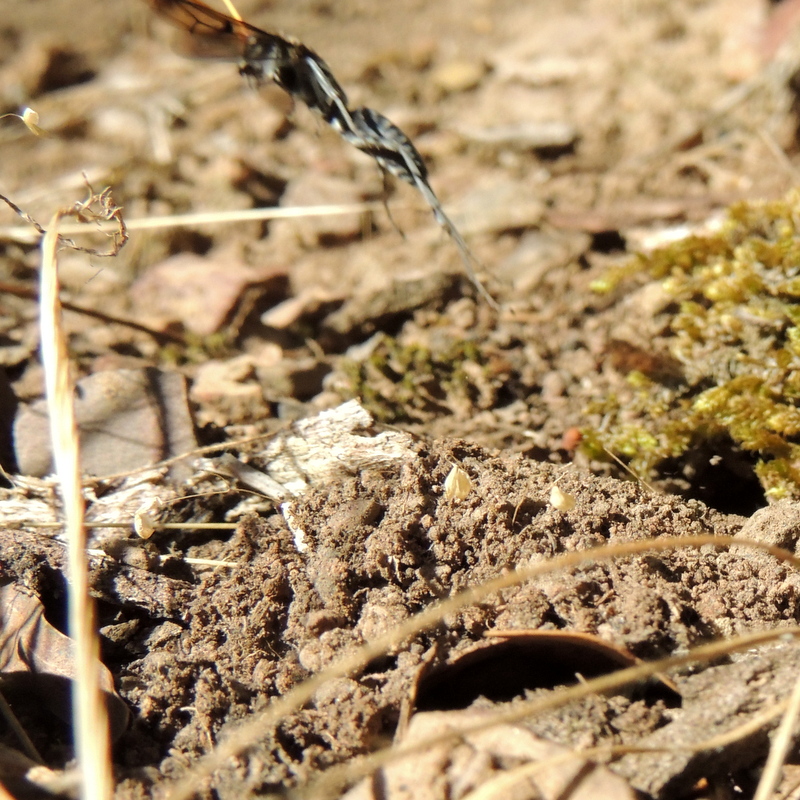
Up, up and away
It reminds me of horror movies in the dim, distant past where people were bricked into basements.
Common or garden


 The fierce-looking fellow shown at left is in fact only about 90mm long and harmless. It’s what must be one of our most abundant and visible small veterbrate animals, the Garden Skink (Lampropholis guichenoti).
They are lovely reptiles to watch as they dart around amongst leaf litter after small invertebrate prey or bask in the sun on rocks.
They are oviparous, with females laying 4 – 6 eggs in spring, often in a communal nest. In a good season they can lay two clutches and can apparently even store sperm from a late-summer mating to fertilise their eggs in the following spring.
Another similar skink common in Victoria and often also referred to as a garden skink is the Delicate Skink (Lampropholis delicata) which is of a comparable size but is more of a bronze colour on the back and generally lacks the darker markings of the Garden Skink. Our resident small skinks, shown in the photos here, all seem to be of the (common or) Garden variety.
Really unruly
 I have unruly eyebrows (or so I’ve been told) and the older I get the more unruly they seem to become, much to the amusement of my partner. She calls them ‘Dutch eyebrows’ a generalisation which is no way based on fact but probably originated because she met a few more than two people with the aforementioned eyebrows and they all had Dutch ancestry (the others were probably my brother and my legion of uncles!)
I was recently relieved to find a creature with more unruly eyebrows than me, a Feather-horned Beetle (Rhipicera femorata). Granted, it doesn’t have eyebrows but very impressive antennae, but I’m not picky.

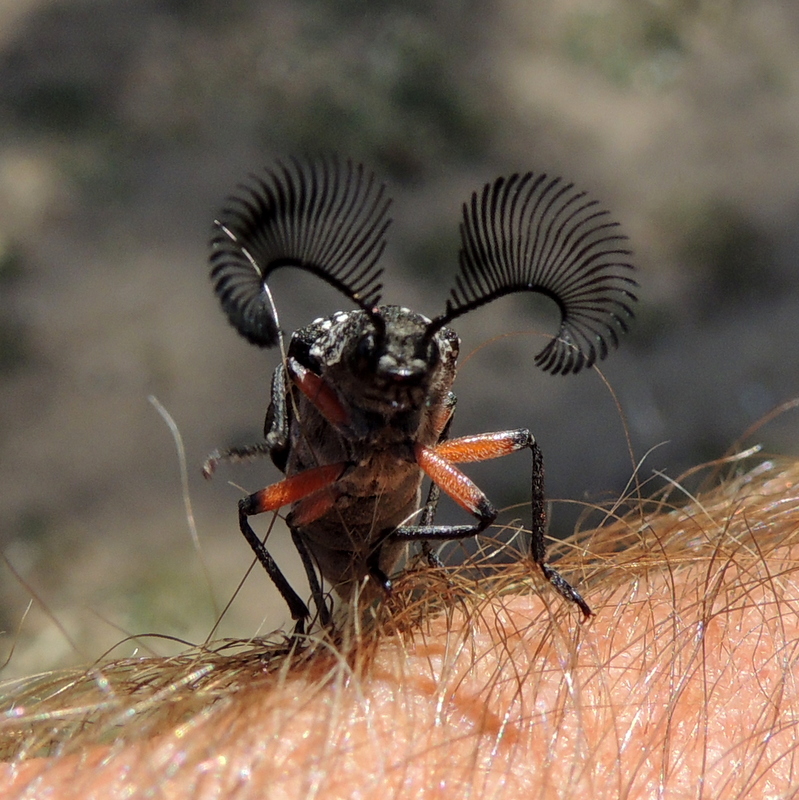 Not much is known about this genus of beetle. The male of the species has fan-like antennae, the female, rod-like ones. The white dots on the wing cases are actually patches of hair. It is suspected that the larvae are parasitic on cicada larvae. Not much to go on is it?
I don’t care. Whenever someone has a shot at me about my eyebrows I am going to whip out one of these photos and say, ‘You think that’s bad, check out this. That’s really unruly’.
Wetlands, wildlife and wildfire
 Strath Creek Hall is the setting for a talk next Friday by Jo Wood, Environmental Water Project Officer with the Goulburn Broken Catchment Authority – click on the flyer at right for full details.
Jo’s considerable experience includes preparing management plans for wetlands and monitoring wetlands using time-lapse cameras and acoustic equipment to record birds, frogs, vegetation and macroinvertebrates. In the last year she has also been involved with the recovery of wetlands near Shepparton after the Wunghnu fires.
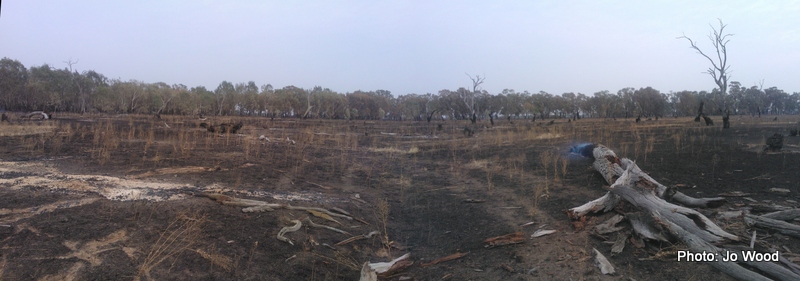
Black Swamp February 2014
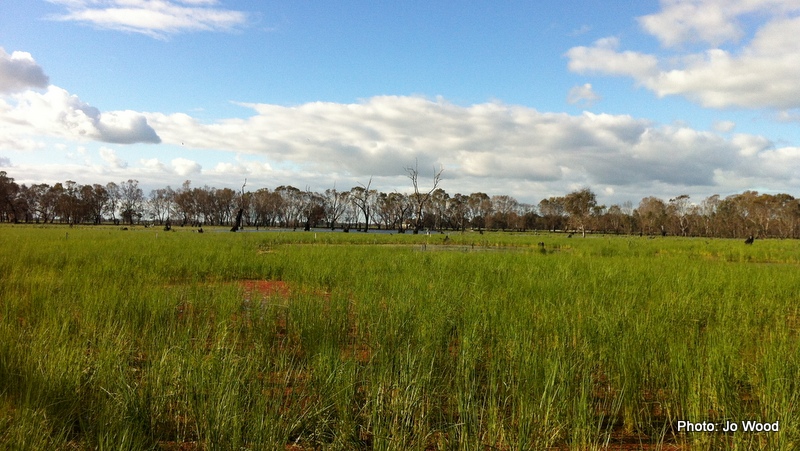
Black Swamp August 2014 after environmental water delivery
Clearing and drainage for agriculture and urban/industrial development has led to the loss of more than one third of Victoria’s wetlands since European arrival. Numerous farm dams have been constructed, but they rarely have the complexity or structural diversity of natural wetlands. The remaining wetlands, many of which are on private land, therefore represent a valuable sanctuary for wildlife and native aquatic and wetland plants.
Ronlit has provided us with some wonderful wildlife images from our local Yea Wetlands, where he is an enthusiastic volunteer.


Only a stone’s throw away
 In 2007 the Strath Creek Landcare Group published a booklet entitled Birds of the lower King Parrot Valley featuring the most common birds found in the district. The ‘centrefold’ and front cover displayed focal species, woodland birds that were probably once common in the valley but may be on the brink of local extinction. Readers were encouraged to look out for these species as the plantings in the valley should cater for the needs of these indicator species and attract them back.
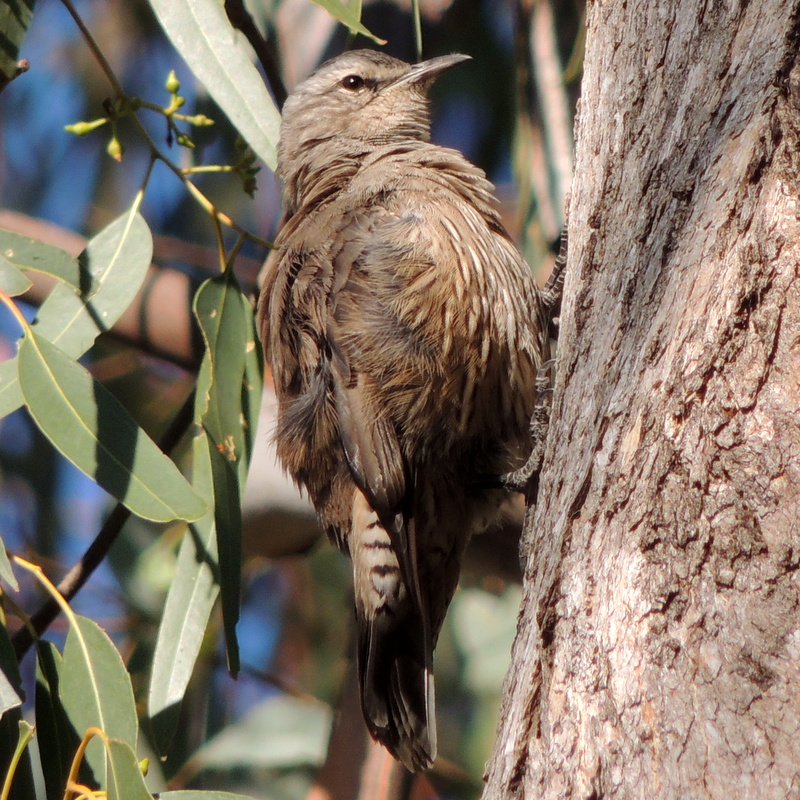
Of the five birds mentioned, four of them—the Crested Shrike-tit, Hooded Robin, Southern Whiteface and Jacky Winter—have been subsequently seen in the district. The Brown Treecreeper (Climacteris picumnus) has not. (The scientific name is derived from klimax meaning ladder, klimakter meaning rung and the diminutive of picus meaning woodpecker. If you have ever watched a treecreeper in action, it is a very apt description.)
We’re back….almost!
This weekend Macwake and I joined the Yea Birders for their monthly birdwatching outing. We started at the Goulburn Valley Highway at Ghin Ghin Road, moved to the Yea Sewerage Farm and then on to a section of the High Country Rail Trail. At our first stop what should we find but a flock of Brown Treecreepers. Google Maps tells me that the distance from there to Strath Creek is 25 km (via the King Parrot Creek Road). Presumably Brown Treecreepers would not use the road so the distance is considerably less.
So all you Flowerdalians and Strath Creekers, keep your eyes peeled. The Brown Treecreepers are only a stone’s throw away … if you have a good bowling arm.
Awesome and a little scary
 Imagine…the air is warm. There is not a breath of wind. And rising through the air on gossamer wings are thousands of flying ants on their nuptial flight. Zooming through these clouds of insects are Fantails and Thornbills making the most of an easy mid-morning snack. It is a scene most of us have experienced on a warm summer night. Now imagine that those ants are huge Bull ants (Myrmecia spp.).

How many ants? Count the antennae and divide by 2.
Over the long weekend on a walk along Cottrells Ridge Track at the back of Flowerdale, we found ourselves among several thousand mating bull ants. The larger winged females (pictured above) were at ground level or hanging from grass stalks while the smaller winged males swarmed in frenzied flight looking for partners with which to mate. Female ants were crash-tackled by up to six  males at a time (pictured above). The trick if you were a male was obviously to keep out of the way of the female’s pincers. Very often a female could be seen twisting around and unceremoniously removing an attached suitor and flinging him aside (pictured left). Many of the males in their frenzied state seemed to be trying to mate with sticks and rocks (pictured below).

Mating with a rock – it’s not gneiss
Standing in the swarming cloud taking photos was an awesome feeling, yet a little scary given the workers of these ants can give a nasty bite. But the circling males were not worried about a human intruder, having other things on their mind. In fact with all that ant-mating going on, it could be said the air had a sense of ant-i-climax.




 Focus On Fauna