Kite flying

Whistling Kite

The whistling kite can sometimes be confused with the similar-sized Little Eagle – for instance there was some discussion and consultation with experts before the bird in a previous post (see HERE) was positively identified as a Whistling Kite. As well as a different under-wing pattern, Whistling Kites have a longer, more rounded tail and a less robust appearance. The kite’s body plumage tends to be more uniform in colour than the eagle and it lacks the barring across the tail that the Little Eagle has.
The bird pictured appears to be immature, as shown by the spots on the upper wings.
Whistling Kites are of course a lot easier to identify when they are actually whistling – a very distinctive call that can be heard by clicking on the arrowhead of the audio bar below.
To all the unbelievers
For all those who thought the recent photo of the Rakali (Hydromys chrysogaster) in our dam (click HERE to view) was one of:
a. a teddy bear being pulled through the dam on a piece of string (as if)
b. a cushion with a black button sewn on it, similarly being pulled through the dam on a piece of string (double, as if)
c. a funny (Rakali-shaped) floating log
d. a cosmetically enhanced otter
e. anything other than a genuine, true-blue, Australian Native Water Rat,
these photos are for you.

A cushion I am not

Pick a Box
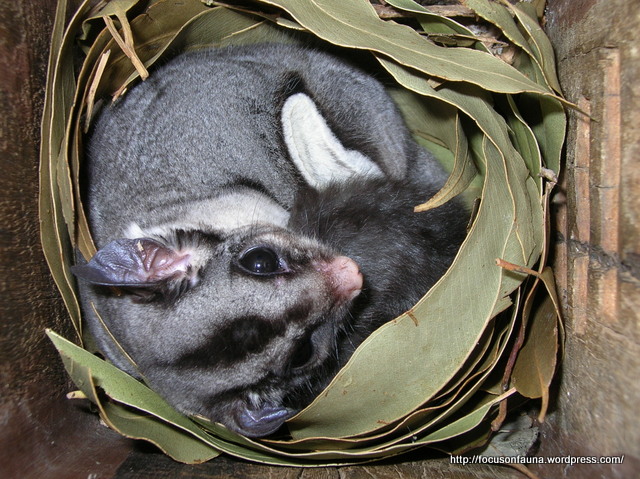
Sugar Glider
Inspired by Ronlit’s recent post It’s back!, and with the first frost of the year the other night, we thought it was time for a maintenance check on our fauna nest-boxes, and an inspection for any occupants. This proved to be a rewarding experience – of the 13 boxes we have installed, 6 were occupied by Sugar Gliders (Petaurus breviceps) and a seventh had a well-constructed Brush-tailed Phascogale (Phascogale tapoatafa) nest of shredded-bark with lots of fresh scats (droppings) and a strong smell, so probably had a phascogale in residence.
The boxes are of various designs with different sizes, shapes and entrance-hole location and diameter. The Sugar Gliders don’t seem to be too fussy, as long as there is a warm dry space inside. However, if you are considering installing nest-boxes, it pays to do it right. There is some really good information on nest-boxes in a pamphlet available from the Strathbogie Ranges-Nature View website as a pdf download called Nest-box Know-how which was developed from a forum at Violet Town last year .
The occupied boxes are shown below with their corresponding occupants. Several of the boxes, some made by Rotary, were donated following the Black Saturday fires.
-
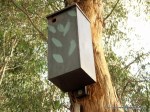
- A well-used (and badly decorated) glider box
-

- A jumble of Sugar Gliders
-

- Glider/phascogale box
-

- Typical Sugar Glider cup nest of eucalypt leaves
-

- Home-made box designed for treecreeper or owlet nightjar
-
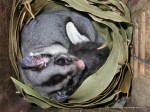
- Sugar Glider
-
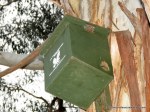
- Well-designed glider/phascogale box provided by La Trobe Wildlife Sanctuary
-
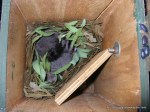
- Sugar Glider – note entrance hole behind baffle
-
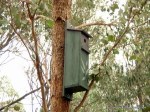
- Glider/phascogale box
-
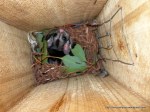
- Sugar Glider – note wire ladder to help the glider exit
-
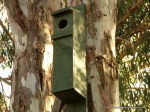
- Box designed for rosellas
-

- Sugar Glider and remains of former rosella occupant – who needs leaves?
-

- Specially designed phascogale box with rear entrance and baffle
-

- Brush-tailed Phascogale nest – the entrance baffle is obscured
To B(arbed wire) or not to B(arbed wire)

What a way to go
Moving to a rural community one becomes very much aware of the raging debate about the use of barbed wire in fencing. It seems that farmers are pro-barbed wire as it is said to deter livestock from pushing through fences. On the other hand, there are those who posit that many a possum or sugar glider has been shredded by the dastardly invention. As I have no personal experience of either, I have reserved my judgement and sat on the fence (a non-barbed-wire one of course).
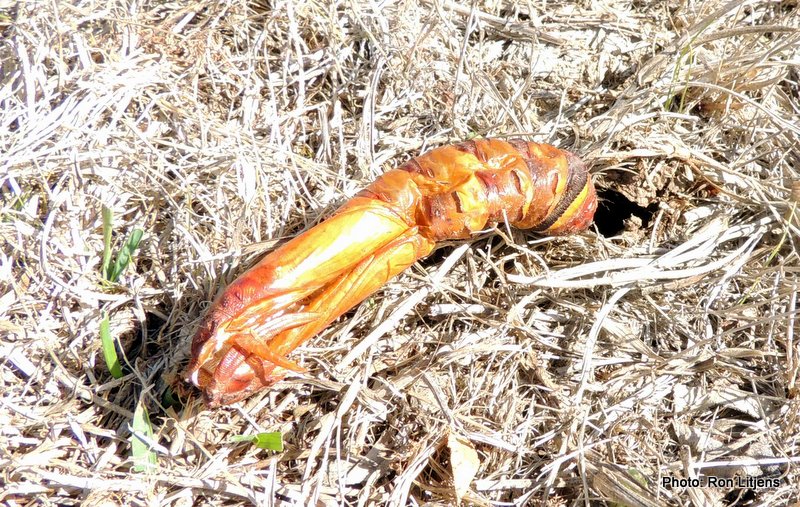
Empty pupal case
However…walking along our perimeter fence I have just found in the space of several metres not one but two Rain Moths (Trictena atripalpis) hanging lifelessly, hooked through the abdomen by barbed wire. Rain Moths are so called because the adults emerge from their pupal stage after rain. At this time of the year you can see the abandoned pupal cases sticking out of the ground.
Some will say that they are only moths. All I know is that when I eventually depart this place I hope it is not by hanging upside down, skewered through the stomach.
To B or not to B. It’s still the question.
Homing huntsmen …not a story for arachnophobes!!
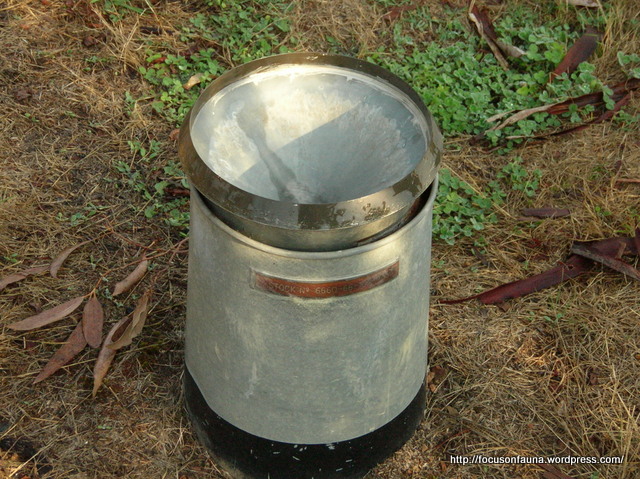
Standard rain gauge and spider home
Being the local rainfall observers for the Bureau of Meteorology can have some little hazards now and then. What may just look like a standard rain gauge pictured at left is in fact home to a family of aptly-named Social Huntsman spiders (Delena cancerides). On lifting the lid to read the gauge a few weeks ago we noticed dozens of small pale spiders living inside the gauge, together with some larger reddish-brown ones.
In deference to the feelings of one of the observers (the resident arachnophobe), the spiders were carefully relocated to some timber on the ground a few metres away. When the gauge was checked the next day, there they were – back again! This time they were relocated to a flaky-barked Yellow Box tree a bit further away, thought to be ideal habitat. But, you guessed it, the next day – homing huntsmen, albeit in reduced numbers!
So, we have now accepted the situation – the spiders have grown, are less flighty and are down to about six – and we are down to just one on rainfall-recording duty.
-
- Ideal spider habitat showing an egg sac and some shed skins
-

- Typical spider egg sac
-
- Huntsmen socialising
-

- Social Huntsmens’ ability to flatten their bodies allows them to fit in small nooks and crannies such as under bark
-
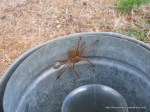
- Adult huntsman
-

- Large adult huntsman
The Social Huntsman is endemic to Australia. It is one of 94 described species of ‘Huntsman’ spiders in the family Sparassidae. Its gregarious habit is somewhat rare in spiders. For more information on huntsman spiders from the Australian Museum click HERE.
It’s back!

Australian Owlet-nightjar
By now you are probably all sick and tired of reading about the rosella nest box in the tree next to our deck. Recent posts have described the departure of Chubster the Common Brushtail Possum (click HERE) simply because it became too large to fit through the entrance hole of the nest box. Chubster’s departure was followed by the arrival of two Common Ringtail Possums (click HERE to view post). Their tenancy was also short-lived as the box proved to be too hot for both of them together over the summer. It did however provide hours of endless fascination as we watched the tossings and turnings of the two possums within the box trying to keep cool. About a month ago they too moved out.
This week we noticed a familiar face peering out of the nest box opening…that of an Australian Owlet-nightjar (Aegotheles cristatus). One had been the resident of the box 2 years ago. When it left we placed two smaller Owlet-nightjar-specific nest boxes in the nearby trees with the hope of attracting it back, but to no avail. These nocturnal birds have been around as we have heard their distinctive call (click on the arrowhead in the audio bar below to hear one example of its call). Now it’s back, obviously preferring the more spacious abode offered by the rosella box. This bird is a little smaller and a little browner than the previous incarnation.
So if this continuing saga is not boring you and you want a piece of the excitement, install a nest box around your place where you can view it easily. You never know who your neighbours will be.
That’s not at all what we expected

Rakali
We returned home from a two-week trip last night and decided to wander around the property in the forlorn hope that the Powerful Owls had returned for another season. Alas, not…yet!
My approach to one of our dams precipitated a sudden splash followed by a trail of bubbles across the water surface. Even though I have seen Common (Eastern) Long-necked Turtles in the dam before (click HERE to view previous post) their method of retreat is usually to silently slip below the surface, no splash nor bubbles, until the perceived danger has passed.
Thinking nothing more about it I continued walking but then noticed a flurry of activity on one of the branches of a submerged tree. And there it was, totally unexpected: a Native Water Rat or Rakali (Hydromys chrysogaster). Being mainly a carnivorous eater feeding on frogs, crustaceans, fish, aquatic insects and sometimes birds, I am surprised that our small dam could support such a creature.
In my haste to get a better photo I fell in the dam (saved the camera), which of course caused the Rakali to head for cover. I did manage to see its distinctive white tail as it crawled up the opposite bank and into a hole in the wall.
And to think, I spent many summer twilights sitting on the banks of the King Parrot Creek hoping to photograph a Rakali. It was probably waiting for me back at home.
Rare footage of endangered possum

Leadbeater’s Possum

Common Ringtail Possum
Trent was able to record this rare sighting in the video below. [This is quite a large file, but is well worth a look – you may need to stop the video and let it it load before playing right through.]
This amazing little possum shares the role of Victoria’s faunal emblem with the critically endangered Helmeted Honeyeater and is the State’s only endemic mammal. Its numbers have declined drastically in recent years, particularly after the Black Saturday fires. Conservationists and wildlife researchers warn that the Leadbeater’s Possum is being pushed towards extinction by the loss of suitable habitat containing large hollow-bearing trees vital for nesting – a situation exacerbated by fire and by logging within its limited range in the Central Highlands. Being unable to glide, the Leadbeater’s Possum needs a dense interwoven understorey to facilitate travel by running, leaping and climbing, as seen in the video.
Gone fishing !
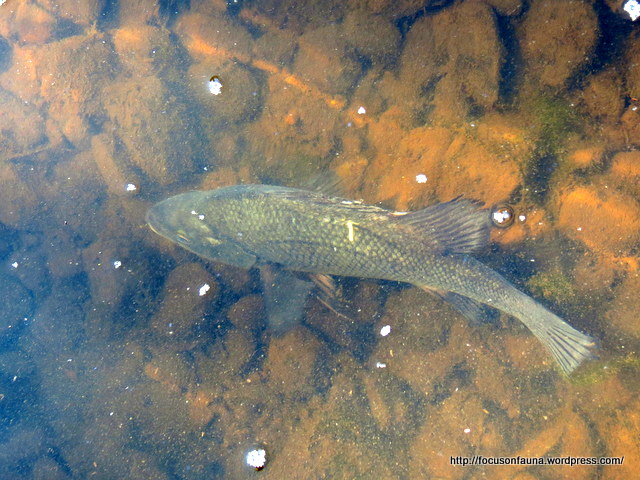
Macquarie Perch
This week the Department of Sustainability and Environment has again been conducting its annual fish monitoring survey in the King Parrot Creek, funded this year by the Goulburn Broken CMA. We were fortunate to spend a morning with Jo and Renae, freshwater ecologists from the Arthur Rylah Institute, who are carrying out the survey, as they have for a number of years. They showed us all the various techniques they are using to capture and identify the fish. They are using both electro-fishing and Fyke nets at 5 locations between Flowerdale and Kerrisdale, with a particular focus on the Macquarie Perch (Macquaria australasica), a threatened species which is protected in all streams in Victoria except the Yarra River, which has an introduced population of the fish.
Electro-fishing involves applying a current through the creek water via a backpack generator. Fish are temporarily stunned, identified and recorded, and recover quickly after release. This technique has limitations, such as not being suitable for monitoring deep pools.
The Fyke nets are cylindrical with a series of supporting hoops, and internal partitions with access holes of decreasing size along the net away from the winged entrance. The other end is tied off and fixed above water so any platypus that is inadvertently trapped can breathe. These nets are left overnight and early in the morning the trapped fish are identified, measured and weighed. The Macquarie Perch, if large enough, are also tagged, and have a small piece of tail clipped for DNA analysis, before all the fish are released unharmed.
Two separate tags are used. A ‘T-bar’ tag, with a readable external flag showing its identification number, is inserted in the dorsal flesh. This tag also has a DSE phone number for anglers to report its capture (and claim a reward!). A second small ‘pit’ tag with a universally unique identifying number is inserted into the fish’s stomach. This tag can be electronically detected. Both tags can provide valuable information on fish movement up and down the creek.
When we left Jo and Renae, they were delighted with the results so far. It looks like being the highest tally of Macquarie Perch of any of their King Parrot Creek surveys, with sizes ranging from tiny ‘young-of-year’ up to almost 40cm long. We will let you know the final tally in a future post.
For a previous post on last year’s survey of Macquarie Perch (also known as ‘Macca’), click HERE.
Now you see ‘em …
When walking anywhere on our property in summer we are accompanied by grasshoppers that suddenly appear, fly out in front, maybe flash a bit of colour, and then just as quickly, they disappear. Grasshoppers are of the same order as crickets and katydids, Orthoptera (from the Greek, ortho meaning straight and ptera meaning wing). One of the distinguishing features among them is that grasshoppers generally have antennae that are shorter than their bodies, and therefore have fewer segments in them than the others. (But this is not a rule…)

Bark-mimicking Grasshopper
Most grasshoppers are omnivorous. This means they eat plant matter, but will also dine on dead animals and catch insects. In turn they are the food source for reptiles, birds, mice and other insects. In many countries grasshoppers are a high-protein part of the human diet. Grasshoppers are eaten raw or boiled, dried, fried, with soy-sauce: you name it.

Gumleaf Grasshopper
The main defence mechanism of the grasshopper is to use camouflage to hide from predators. Pictured (above) is the Bark-mimicking Grasshopper (Coryphistes ruricola), which even at close range is difficult to distinguish from its surroundings. This Gumleaf Grasshopper (Goniaea australasiae) (right) has been photographed away from its preferred dried gumleaf backdrop, and therefore is easily seen.
Tempting as this juicy, crunchy little morsel looked, I had a vegemite sandwich for lunch instead.




 Focus On Fauna